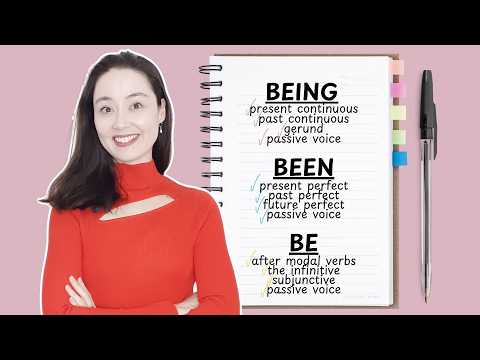
[0:00]Be? Being? Been? When do we use these verbs? Today I will explain everything step by step. And at the end of this lesson, I have a mini test for you with 10 questions. Please let me know your score in the comments below. Did you get nine correct out of 10 or maybe just five correct out of 10? Let me know. My name's Arnell. Let's start. Let's start with a simple chart and some common verbs. You already know these verbs. Eat, ate, eaten, eating. Go, went, gone, going. Walk, walked, walked, and walking. You can see each verb has different forms. You already know this, I'm sure. What do we call these verbs? They each have a name. We have the base verb, the past simple, the past participle and the present participle. In your classroom, your teacher might just keep things simple. Verb one, verb two, verb three and ing. Those names are simple and perfectly correct. How does this help with today's topic? I want to show you that be, being and been are the same as other verbs. Be, was, were, been and being. We have verb one, verb two, verb three and ing. It's the same. There's nothing special or different. Well, I mean, be is a little bit special because there are different forms in the present and the past. Other verbs don't do this. Mini review, present. I am, you are, he, she, it is, we are, they are. Past. I was, you were, he, she, it was, we were, they were. I am a teacher. They are my students. My dad was a doctor. We were friends. You know, these verbs here, they're also be verbs. But in today's lesson, I am going to specifically focus on be, been and being. I'm going to start with being. We use being with the present and past continuous tenses. If you can use verb ing, you can use be ing, being. And I'm going to compare this to other verbs. Again, so you can see it's really the same. Present continuous. Subject, am, are, is, verb ing. You are reading a book. He is playing football. She is being nice.
[3:16]Past continuous. Subject, was, were, verb ing. You were cheating on the test. Ruby's English was improving. He was being taught how to tie his shoes. In this last sentence here, why are there three verbs? Was being taught? This is called the passive voice. More on the passive voice later. You can see in my examples that being functions grammatically just like the other verbs. Wait, wait, wait, wait, wait. Be is a stative verb. Stative verbs can't be in the ing form. Some verbs can be stative and dynamic, both. And if you're thinking, what is this teacher talking about? What are stative verbs? Don't worry, I have a full lesson on stative verbs and I'll link it down below for you. Do you want the notes for today's lesson? Join Gravotion. My fast growing platform for grammar, vocabulary and emotion. Download the notes for today's lesson, plus hundreds of other PDFs ready to use. You'll also get access to my complete grammar course roadmap. So you'll never wonder how do I learn grammar? Where do I start? And the best part, the community. Join and connect with English learners from all around the world, just like you. Write gravotion in the comments and I'll personally send you a link to join. Let's get back to the lesson. Next, we use being as a gerund. A gerund is an "ing" word that functions as a noun. Napping after lunch gives me energy. Napping means a short sleep during the day. Cooking is more enjoyable than cleaning. Being an online English teacher is amazing. I love it. You can see my subjects, napping, cooking, and being an English teacher. If you want your verb to be a subject, you need a gerund. Summary. We use being in the present and past continuous tenses, and as a gerund. Been. First, let's look at the pronunciation. Been. Been. You could use a long e sound, been, but when you're speaking, just say been. We can use been in perfect tenses, and again, I'm going to compare it to other verbs. Present perfect. Subject, have or has, plus verb three. Molly has passed her test. We have decided not to sell our house. I have been to Germany. Past perfect. Subject, had, plus verb three. Molly had passed her test. We had decided not to sell our house. I had been to Germany. Well, what's the difference between present perfect and past perfect? On my channel, I have a lesson on perfect tenses and just the perfect tenses. I'll link it down below for you. Future perfect. Will have, plus verb three. Molly will have passed her test. We will have decided not to sell our house. I will have been to Germany. Back to our summary. I'm going to keep adding to our summary throughout this lesson. We can use been in perfect tenses, present perfect, past perfect and future perfect. Be. In this part, when I say be, I really mean be. I don't mean the other forms of be. After modal verbs. Modal verbs are can, could, will, would, shall, should, may, must, and might. After a modal verb, we use verb one, the base form. We can use a calculator for this homework. Can plus verb one. You should wear green more often. It suits you. Should plus verb one. Jerry might be late. Might plus verb one. Common mistake, we can to use, Jerry might to be late. With modal verbs, there is no to. Okay, no two with modal verbs. But we do need to to form the infinitive. What's the infinitive? The infinitive is to plus verb one. I need to go. It's getting late. To go is my infinitive. Maggie decided to major in geology. To major is my infinitive. And the verb major means to specialize in a subject in college. Pause, pause, pause. Look, my video is blurry. Blurry means not clear. See, this picture is clear and this picture is blurry. I do not know what happened. So, for exactly two minutes and 30 seconds, I'm going to make my video smaller so it's not so noticeable. Don't worry, this will go back to normal soon. So, in Maggie's case, she is specializing in geology. I want to be just like you. To be is my infinitive. Certain verbs in English are always followed by the infinitive or commonly followed by the infinitive. These verbs here are common. Use these verbs plus to verb one, including be. Next one, we use be with the subjunctive. What's the subjunctive? Let me give you a mini explanation. Normally verbs are like this. I go, you go, he, she, it goes, we go, they go. You can see the third person form changes. We add S or ES. But with the subjunctive, things are different. The forms don't change. What? She go, he go, is that correct? Yes. Julian's teacher recommended that he go up a reading level. His current books are too easy for him. Julian's teacher recommended that he be put in a higher reading group. If you want a full lesson on the subjunctive, I have a lesson on my channel. I'll link it down below for you. Back to the summary. You can see we have be after a modal verb to form the infinitive and the subjunctive. Last part here, we are almost done. And this time we can use all three, be, being and been, the passive voice. To form the passive voice, we need be, being, or been. It depends on the tense plus verb three. Our windows are being washed. Our windows have been washed. Our windows will be washed next week. Each sentence has a be form plus verb number three. Mini reminder, we use a passive voice when the person doing the action is not important. Like here, who is washing the windows? We don't know. It's not important. Summary, again. You can see we have be, being and been with the passive voice. To help you practice all of this and review, because I know there's a lot of information, I have my test. Let's take a moment to review everything. Can you please complete each sentence with be, been, or being? There are only three options. Pause the lesson to do this. And here are the answers. How did you do? Here are also the topics. You need to focus on if you got an answer wrong. For example, if you got number one wrong, watch my lesson on Gerunds. I really hope this lesson helped you with be, being and been. I know, you see them everywhere in English. Please let me know your score in the comments below. Thank you so much for watching and I'll see you next time. Bye.


