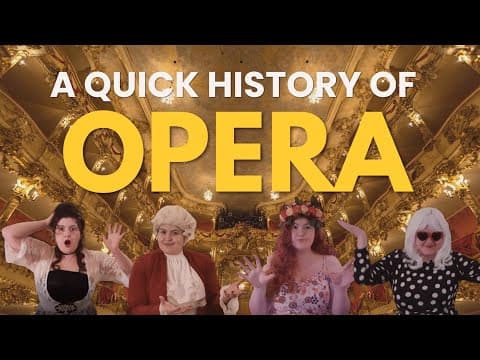
[0:39]This video, I'm going to give you the low down. So sit back and enjoy this crash course in the history of opera. First things first. What actually is opera? Well, putting it in simplest terms, opera is the use of voice and music to convey a narrative. It's acting through song. So, now we know what it is, but where did it come from? Well, opera originated in Italy in the 16th century, when musicians and singers were brought to Royal Court to entertain kings and queens, dukes and duchesses and their courtiers. Music historians refer to this era as the Baroque era.
[1:29]This era served as a playground for vain monarchs and other members of the aristocracy, who were wealthy enough to commission poetry, paintings, music, and opera. Basically, they used opera to impress people and to make themselves look all cultured and clever. Baroque opera usually had a chamber orchestra, which just means a small orchestra. An orchestra is just the instruments that make up the band. The singers in Brock Opera needed to have light, agile, pure sounding voices, but they also needed to be loud enough to sing over the top of the orchestra, even though it was small. Italian opera reigned supreme throughout the 16th and 17th century. In the 18th century, opera started to gain popularity in other parts of Europe, such as England and Germany. Then composers who lived in these countries were able to break through the genre and begin to write operas in their native languages such as English, German, and Spanish. After the Baroque era came the classical era.
[2:39]And this is where perhaps one of the most famous composers of all time comes into the story. Wolfgang Amadeus Mozart. Have you heard of him? Apparently, he had a very silly sense of humor and obviously a great taste in wigs. Mozart was born in Austria in 1756. He wrote 22 operas in total, in both German and Italian. It was around this time that opera started to become popular with wider audiences outside of the aristocracy. Although composers like Mozart still very much had ties with the aristocracy and took on commissions from kings and queens, opera slowly but surely started to move out of the royal courts and into theaters. Classical opera was a fuller sound, which meant that there were more instruments in the orchestra. The larger orchestra mixed with the bigger venues meant that naturally over time, operatic voices had to adapt to the new environment. Voices became fuller and louder. The classical era was iconic and transformative. Mozart's operas are incredibly famous. They have gone down in history as some of the greatest operas of all time, and even hundreds of years later, they are regularly performed by
[5:44]1800s and the early 1900s, at the turn of the century. When composers were looking for new and innovative ways to create music. This was the era of groundbreaking composers such as Maurice Ravel, Leo S Janacek, Arnold Schoenberg, and Richard Strauss. These composers, along with many others of the time, began to rethink the musical language that was opera. As new musical genres such as jazz, blues, music hall, and ragtime began to emerge, composers had new inspirations to draw from. Kind of like a chef being given a new ingredient. Just as operas were being influenced by other genres, so too did they influence popular music. For example, Summertime, an aria from George Gershwin's Porgy and Bess, became really popular with jazz artists in the 1940s and 50s. This became part of the jazz catalog, which means it became a song that loads of different artists covered. Even today there are artists that cover this song. More recent artists such as Nora Jones, Leona Lewis, and Lana Del Rey have all covered Summertime. This just goes to show how opera can weave its way into popular culture. From the 16th to the 19th century, opera really was the popular music of its time. But as sound technology became more ingenious, singers began to adapt to microphones. Orchestras became smaller, the songs became shorter, and people were able to create completely new sounds using newer instruments like electric guitars and synthesizers. So, with all this change, did that mean that opera simply withered away and disappeared? Absolutely not. Opera made the most of this new technology too. The advancement of sound technology meant that opera recordings could be created and distributed to a huge audience. Opera stars like Maria Callas and Luciano Pavarotti emerged and became world famous for their recordings of operas from Mozart to Verdi and everything in between. This meant that opera was more widely available than ever, and it