[0:01]Hello everyone and welcome to the class of International Trade Theory, Econ 446. I'm Yasir Saeed and today we are going to study economies of scale, imperfect competition and international trade.
[0:21]Now, in this lecture, we are going to study the types of economies of scale and basically we have two types of economies of scale, uh and we will cover both of them. Then we will cover the type of imperfect competition and these imperfect competition usually comprise of oligopoly, monopoly and monopolistic competition.
[0:52]Then again, we will discuss in detail the monopolistic competition and compare that with the international trade. And later on we will also study inter-industry trade and intra-industry trade and uh we'll study the concept of dumping in this chapter as well as in the later chapter, we will see the impact of uh dumping on the overall economy and on the international trade. Then we will study the uh external economies of scale and the trade.
[1:37]Now, when defining comparative advantage, the Ricardian and Heckscher-Ohlin model, uh and all those models, we have an assumption. And that assumption is about the constant return to scale. And what do we mean by constant return to scale? Basically it means that uh when we double the inputs, we have initial input of 10 units, uh both uh let's say we have 10 units of labor and 10 units of uh capital. And then we increase uh those input to 20, for example, then we have 20 units of labor and 20 units of capital. And the effect of uh this doubling is that our output basically doubles. If you were producing 100 units with those resources, now we will be producing 200 units. So that is the constant return to scale. Then we have alternate concepts to uh the constant return to scale, that is the increasing return to scale and decreasing return to scale. An increasing return to scale basically means that when we double the input, our output is uh more than doubled. For example, uh again, let's say that we have uh 10 units of labor and 10 units of capital and we double them. We have now 20 units of labor and 20 units of capital, but instead of uh the output from growing from 100 to 200, now the output grows from 100 to 300. So this is increasing return to scale. Alternatively, we have decreasing return to scale, where when we double the input, the output are is uh less than uh the double. Uh for the same example, if we had to double the inputs from 10 to 20, the output will uh increase from 100 to 150, but not to 200. It will always be less than 200. So in that case it is decreasing return to scale. So here we uh uh our assumption for all those models that we have studied in the earlier chapter, uh whether that be the absolute advantage theory, the comparative advantage theory or the Heckscher-Ohlin model. Or again, uh the standard trade model which uh combines the the effect of all these models. In all those models, we had this basic assumption of constant return to scale, which uh in reality is not uh practical. Uh in real life, we do have increasing return to scale, and we also have decreasing return to scale, but most often we have increasing return to scale. So we will see, uh how that impacts our models, and how that impacts the trade models that we usually study. Now, when factors of production change at certain rate, output increase at the same rate, that is constant return to scale, and uh it has the example that we have already discussed here. But a firm or industry may have increasing return to scale or economies of scale, uh that is what it is called alternatively, economies of scale. Uh when factors of production change at a certain rate, output increases at a faster rate. And a large scale is more efficient.
[5:19]Uh because what happens when you have uh the uh increasing return to scale, what happens is that you are now able to produce more than uh with those same inputs. You are doubling those inputs, but you are able to produce more than you could have individually with those 10 inputs. So basically the cost of production decreases. As you add up the resources, the cost of production decreases. So a larger scale is more efficient. It increases the efficiency of production. The cost per unit of output falls as a firm or industry increases output. The Ricardian and Heckscher-Ohlin models also rely on competition to predict that all income from production is paid to owners of factors of production: no "excess" or monopoly profits exist. Right? Uh the prices that are determined in perfect competition are through supply and demand, and there is no extra profit for the firms. Whereas uh the alternate uh way of competition, the imperfect competition which comprises of monopoly, duopoly, oligopoly, and uh monopolistic competition. In all those types of market, um a producer can earn more, uh excess profit can be earned in those scenarios. But when economies of scale exist, large firms may be more efficient than small firms, and the industry may consist of a monopoly or a few large firms. Again, this the presence of monopoly, uh is also made possible due to the uh economies of scale. Because larger firms uh can be efficient in production, uh then the smaller firms. They can uh compete uh these smaller firms out of the market. They can uh sell at prices uh such that uh the small forms cannot compete and they may exit the market.
[7:41]So, uh this same uh assumption, the assumption of increasing return to scale also changes our second assumption that is of perfect competition. So imperfect competition is basically related to our uh assumption of constant return to scale, if there is constant return to scale, then we may safely say that there would be um perfect competition. But if we assume it out and we say that we have increasing return to scale, then again we will have imperfect market as well, the presence of uh monopoly in such cases is not unusual. Uh, now, uh let us talk about the types of economies of scale. Economies of scale could mean either that larger firms or a larger industry is more efficient. Uh, economies of scale is basically uh of two types. One is uh related to the overall industry. If the industry is large, then we may have economy of scale. But alternately the, uh, there may be a single firm that gets bigger and bigger, larger and larger. And that could also cause economy of scale. So we discuss these two uh over here. Uh one is called the external economy economies of scale which occur when cost per unit of output depends on the size of the industry. When the industry gets bigger and bigger, then, uh, we in that case the economy of scale is called the external economies of scale. But when a single firm is getting bigger and bigger, internal that is called the internal economy of scale. By definition, internal economies of scale occur when the cost per unit of output depends on the size of a firm. Um and why does that differ? Why do we have these two types of economies of scale? For the external economies of scale, assume that we have uh a business that is gathering into a single city or a single area. For example, uh, if we are talking about Peshawar, we have a computer market called Gul Haji Plaza. Uh, there are a number of shops related to the IT sector. Uh large we have so many shops for computers, uh laptops and uh everyone tries to visit that place. So that area, we may consider uh to have external economies of scale. Why? Because um the industries that are there, they are not industries basically, but they are shops. But uh people tend to go there because of the availability of variety, and there may also be uh mechanics who could repair laptops. There may also be other uh suppliers who would directly target uh that industry and provide materials to them, uh on the lower or competitive prices that give raise to the economy of scale over there.
[12:06]Then the second type, that is the internal economy of scale, that is basically depending on the size of the firm. And a firm gets bigger and bigger, it gets more efficient at the at the production, it gets efficient at controlling its cost. Uh you may say that with the same labor, they may be able to produce more. Maybe they hire a few more labor, but their output can increase much more than that uh because of uh specializations as well. External economies of scale may result if a larger industry allows for more efficient provision of services or equipment to firms in the industry. As I have discussed with two examples like that of Gul Haji Plaza and uh that of uh cities in China. Many small firms that are competitive may comprise a large industry and benefit when services or equipment can be efficiently provided to all firms in the industry.
[13:42]Internal economies of scale result when large firms have a cost advantage over small firms, causing the industry to become uncompetitive. This is basically related to um this uh uh the internal economy of scale. This is basically what cause imperfect markets. The external economies of scale may not necessarily, or it uh we can safely say it does not causes the imperfect competition, but the internal economies of scale do cause imperfect competition, some firms gain monopoly. Uh if you want example of internal economy of scale, you may see the software industry. Uh Google, Facebook, and uh all such type of firm, they are hiring uh the smaller firm and they are capturing the overall market. No firm can compete with Google because of the economies of scale and no firm can compete with Facebook, again, because of the economies of scale.
[14:50]So let's have a small review about the monopoly, or the imperfect market. A monopoly is an industry with only one firm.
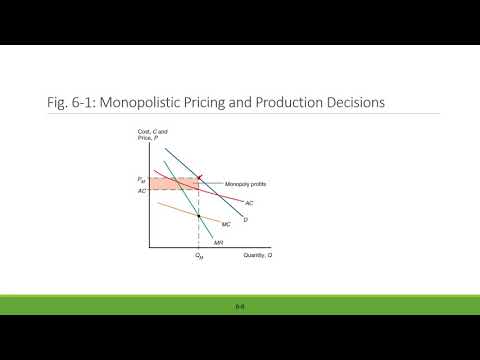
[15:03]Basically, mono means one and there is only a single firm. Oligopoly is an industry with only a few firms. So if there are two, three, four, five, uh six firms, we may call that oligopoly and a single firm that is monopoly. If we have two firms, we call that a duopoly and duopoly is a part of oligopoly. In these industries, the marginal revenue generated from selling more products is less than the uniform price charged for each product. And to sell more, a firm must plan to lower the price of additional units as well as of existing units when it cannot price discriminate. Now, remember, in a monopoly, uh a firm can charge whatever price he wish to charge, unlike perfect competition. A firm is a price taker, but in monopoly, a firm is a price maker. It can change the price, but again at the cost of something. He is not entirely free to change the price. If he increases the price, he he must be selling lower quantities. But if he want to sell more, he will have to reduce the price. So basically the demand function do work here. Monopoly firm does face uh monopoly a firm in monopoly industry does face uh certain level of demand and it has to fulfill that. The marginal revenue function therefore lies below the demand function which determines the price that customers are willing to pay. So to understand this, we do need a graph. We can do that with, we can explain that with graph. Here is the graph for monopoly. The green line is the marginal revenue, whereas the blue line is the demand curve. In perfect competition, uh the blue and green line are identical and horizontal, but in monopoly, both are downward sloping, whereas marginal revenue is much lower than the demand curve. Then we have the marginal cost curve and the profit maximization condition is that marginal cost must always equal to marginal revenue. So here again, we have selected uh the quantity where marginal cost and marginal revenue are equal. QM represents the quantity where both the both the lines intersect each other, the marginal revenue equals the marginal cost. But the actual price is higher than uh what normally would have happened in a perfect competition. PM is uh where it intersects, the QM intersects with the demand curve. And the red area, the orange area, that that represents the profits in monopoly. If it was, if it were perfect competition, there would have been no profit. As in perfect competition, there is no economic profit, but in monopoly we have excess economic profit. It doesn't mean that in perfect competition firms do not earn anything. They do, but uh um the concept of economic profit is different there from that of the accounting profit. Or we may also call this the abnormal profit. And this also shows, when a firm is able to charge higher than the marginal cost, this also shows the market power. A monopoly uh has a market power because it is able to charge higher than the marginal cost. So the distance between the the point at blue line, let me identify that the distance between this point and this point, this actually shows the market power of a firm. If it was for perfect competition, uh this would have been a single point.
[19:32]Average cost is uh we are reviewing basically the monopoly. So average cost is the cost of production C divided by the total quantity. Total cost divided by total quantity is the average cost. And marginal cost is the cost of producing an additional unit of output. When we increase one unit of the resource, the input, the labor or the capital, and uh the cost of producing that extra unit is called the marginal cost. The total cost is represented by fixed cost plus variable cost, whereas CQ is the variable cost. Uh F represents fixed cost, those independent of the level of output. And variable cost is dependent on the output. The more output, higher will be the cost. So average cost is equal to F by Q. We are basically dividing uh the left hand side and right hand side by Q. So we are left with AC is equal to F over Q plus C. A larger firm is more efficient because average cost decreases as output Q increases, internal economies of scale, for a larger firm, uh the fixed cost continuously continuously declines. The relationship of average cost and marginal cost can be seen clearly from this graph. As you see that the more output we produce, the average cost is declining. And that is for the said reason that the fixed cost is continuously divided by each and every unit. But then at a certain stage, uh the slope almost is horizontal. Uh further decline is very minute. Marginal cost in this case, uh in our example, we had a straight downward sloping line. So it is constant in this regard. So, uh this was uh enough for the current lecture. We will continue uh with the imperfect competition in the next class. And then we will discuss how it impacts the our international trade.


