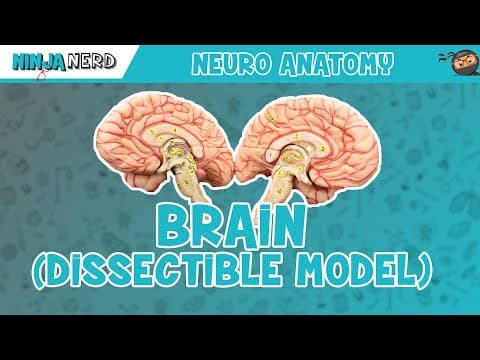
[0:07]All right, engineers, what we're going to do in this video is we're going to take a look here at the brain. So if you look here, we have the outer part here, which is the outer gray matter. This is actually the cerebrum, or they call it the telencephalon. And so the cerebrum is this top part of the brain up here, right? And it was derived from the telencephalon during embryonic development. Now, if we look at the cerebrum, it has this thing called an outer gray matter. So it's this outer gray matter, and all gray matter means is it just means it's unmated uh cell bodies. It's unmated cell bodies. So if we have unmated cell bodies here, that is our cerebral cortex. Now, if you see all these big bumps and stuff that we have popping off of the brain surface, just kind of increasing that surface here, all these big bumps, these things are called gyri, and that means it's plural, right? If I have one of them, that would right there would be a gyrus, but I have multiple, it's called a gyri. Then if you see these little like divots in between all of these actual gyri, those are called sulci, and that's the plural form. So that's multiple sulcus. So sulcus would just be one right there. So we have specific sulci and we have specific gyri that we have to take a look at. So what we're going to do is we're going to take a look at those and I'm going to take this actual part of the telencephalon off so that we can get a better look at it. All right, so if we take a look here, we have our left over here and our right cerebral hemispheres. Okay, so we're just taking a look at it. Now, if you look right here, there's this big, big divot that's separating the two cerebral hemispheres from one another. This is called the longitudinal fissure. So the longitudinal fissure is the structure that separates the two cerebral hemispheres. There's actually a dural Septa, a chunk of dura mater that actually dips down into this longitudinal fissure. It's called the falx cerebri. It's what that helps to protect a lot of the actual cerebral vessels or the dural sinuses that are present within there. Okay, so again, we got left and right cerebral hemisphere. Then we have to take a look at a specific sulcus that helps us out here. So I'm going to turn this around, guys. So if we look here, we have this nice little sulcus running all the way up here. I'll follow it again one more time all the way up here. That's called our central sulcus. So the central sulcus is important, it's a good landmark because of what it does is it helps us to separate two lobes of the brain. So if I come up the central sulcus, anything in front of the central sulcus is my frontal lobe, and anything behind my actual central sulcus is parietal lobe until I hit another sulcus that we'll talk about. But at least we've been able to differentiate two different lobes. Frontal lobe is in front of the central sulcus, parietal lobe is after or behind the central sulcus. Now there's another thing. Remember I told you we had these things called gyri, or we had gyrus, which is singular. There's a specific gyrus here right behind the central sulcus. If I take the central sulcus, there's a gyrus right here behind it, a really, really important one. It comes all the way up here. So loop, loop, wow. That guy right there is called the post central gyrus. And the reason why he's important is because there's our cortex there, called the primary somatosensory cortex. So the primary somatosensory cortex is the cortex that helps to be able to pick up sensory information from the body via proprioception and touch and and cold and hot and so on and so forth. So it's very important. So again, it's called the postcentral gyrus, and again, it's also called functionally, it's called the primary motor cortex, and that has voluntary control of our skeletal muscles.
[3:59]Right in front of that would be our premotor cortex, and if we were to keep going in front of that, we'd even get into the prefrontal cortex up here. Okay? So again, what have we covered so far? Frontal lobe, parietal lobe, separated by the central sulcus. Postcentral gyrus or primary somatosensory cortex, precentral gyrus or primary motor cortex, premotor cortex would be in front, and then we would even have our prefrontal cortex, which is up here. All right. And then what else did we say? We talked about the longitudinal fissure that's separating the two cerebral hemispheres from one another. Okay. Now let's go ahead and say that we go ahead and go farther back here to see the separation between the parietal and the occipital lobe. So what I'm going to do is I'm going to separate these two points here. And I'm going to turn this guy in here. So if you see here, this is the anterior or frontal lobe. This back here is going to be another lobe that we'll talk about called the occipital lobe. But if you notice there's another sulcus which is running right there. You see that one right there, guys? That one right there is called the parieto occipital sulcus. So what does that mean? It's separating the parietal lobe from the occipital lobe. So we know that what gives what actually outlines our parietal lobe. If you remember, it was from the central sulcus, which is about over here, all the way over here to the parietal occipital sulcus. So that's what be able basically outlines our parietal lobe. So the frontal lobe is from the beginning of the actual uh brain, all the way to the central sulcus. The parietal lobe is from the central sulcus, all the way to the parietal occipital sulcus, and then from the parietal occipital sulcus, back here to another structure we'll talk about in a little bit, called the transverse fissure. This is all occipital lobe. So all this occipital, but I can actually let you see it like this now too. So if I were to actually again, this is the posterior aspect of the brain, all of this right here, all that that I'm kind of like circling around right there, that's all occipital lobe. Okay, guys. All right, so now what we're going to do is we're going to bring in the actual other lobes that we couldn't see here, because we talked about the what have we talked about? We talked about the frontal. We talked about the parietal. We talked about the occipital. Now we have to throw in there two more lobes, that being the temporal and the insula. So again, guys, just before we move over to the temporal lobe, which is over here, we've looking right here in the anterior view, so this is the frontal lobe right there. What I'm going to do is all I'm going to do so that we can get our orientation set up, and I'm going to turn this guy over like that. So we can get a better look at our temporal lobe right here. So again, where's our temporal lobe? Well, let's find out what separates the temporal lobe uh from all these other lobes over here. So if I follow this guy right here, you can kind of see a little sulcus running right in there, right in there. That guy right there is called the lateral sulcus. And the lateral sulcus is what separates what? It separates the temporal lobe from the parietal lobe over there, right? So again, this lateral sulcus is really good at being able to separate the temporal lobe from the parietal lobe right there. And again, you can't see the other lobe ins but it's actually deep right underneath this temporal lobe. There's a fifth mini lobe called the insula or you they even call it the island of real. But again, how many lobes have we talked about so far? We've talked about frontal lobe from the all the way from the front part of the actual brain, all the way to we hit the central sulcus. Then we talked about from the central sulcus, all the way to the parietal occipital sulcus, was the parietal lobe. And then we said the parietal occipital sulcus, all the way to what we'll talk about here in a second, but the uh transverse fissure, that's the occipital lobe. And then we said that lateral sulcus right there is what separates the temporal lobe from the parietal lobe. And then we do have one more lobe. We just can't see it. We'll see it in another model. It's called the insula or the island of real. And we will actually take a look at that and that's the fifth mini lobe. All right, guys. So now what we're going to do is we're looking at the brain here, and its orientation is it's it's flipped upside down, right? So we have we were looking at the cerebrum from a top view now. Now we just flipped this sucker upside down. What I want to do is I want to continue to look at some more structures at in the cerebrum just a little bit deeper that we can't visibly see on the outside. So what I'm going to do is I'm going to take this one off, so we can take a better look inside of it. All right, so now we're taking a look here. So I wanted to show you something. Remember I was talking to you guys about the outer gray matter of the cerebral cortex. And again, what is gray matter means just means it's unmated cell bodies. Well, if you see this pink right there, that's the cerebral cortex. So that's the unmated cell bodies, right? All that right there, even a little bit right there, too. All this white stuff that you see underneath it. All this is white matter, and white matter is mated axons. So we have mated axons right in here. Okay, so all of this is mated axons. That's the white matter. Okay? Then if we look over here, there's a little cavity in here. This cavity is called the lateral ventricle. So it's a little fluid-filled cavity consisting of cerebral spinal fluid. If you look right there, this nice little uh red and blue-like looking structure right there, that's a specific type of structure that you find within the walls of the are the floor or even the roof of specific types of ventricles, and that's called the choroid plexus. So 43 right there, all of this red and blue-like structure right there. You usually find this in the roof of the uh lateral ventricle or you can find it within the roof of the third ventricle or even the fourth ventricle, and that's called the choroid plexus. It's what makes the cerebral spinal fluid. We'll talk about that in physiology when we talk about glial cells. Okay, so if you look right here underneath the choroid plexus, it looks like it's bathing this little structure there, number 41. That's called the hippocampus. And the hippocampus is what's responsible for our memory. So it helps to be able to convert some of our uh sensory uh memory and a whole bunch of other different types of memory to short-term or even long-term memory. Okay, so he's very important for memory control. So again, we've talked about the outer gray matter of the cerebral cortex. We talked about the white matter, which is just unmated axons. Gray matter is unmated cell bodies. We talked about the lateral ventricle, which is the fluid-filled cavity. We talked about the choroid plexus and then we talked about the hippocampus. All right, so now what we're going to do is we're going to take a the next look we're going to take uh we're going to look at the actual uh cerebral cortex, the upper layers from the frontal and the parietal and occipital lobe and some of those structures. All right, guys. So now what we're going to do is we're going to take a look at some of the deeper structures in the cerebrum, but specifically within the frontal and the parietal and occipital lobe. So in order for me to do that, again, we're still in the same orientation where the brain is flipped upside down. So now what I'm going to do is I'm going to take the two temporal lobes off. Then after that, I'm going to take the actual brainstem and the diencephalon out. And then we're going to look at some of these other structures in here before we start looking at the diencephalon. So now what I have here, if you see, you can see remember we talked about the lateral ventricle before. Well, you can still see pieces of the lateral ventricle right here. This is actually a a view of the lateral ventricle, this little cavity right there. But there's also another one over here, and that's also the lateral ventricle. Right there, okay? Then if you look here, 47 looks like it's kind of coming straight up right there. It looks like it's moving these fibers and it's going to be going up into the cerebrum. These are actually called uh projection fibers. And projection fibers are going to be fibers that take sensory information up to the cerebral cortex or they can actually bring it down. But in general, this is called a projection fiber, but it's a specific type. And that type is actually going to be called uh the Corona radiata. You can see a piece of this right here. So again, there it's called the internal capsule, and then it actually goes up into what's called the Corona radiata. So that's the Corona radiata. That's the Corona radiata right there. And again, these parts over here are the lateral ventricles. White matter right there, and that's going to be consisting of mated axons. And right there the pink stuff is the outer gray matter, which is unmated cell bodies. All right, guys. So now we're going to do is we're going to put this back down and we're going to take a look at the diencephalon and the brainstem. Okay, guys, so we've taken a look at the cerebrum, which was again derived from the telencephalon during embryonic development. And uh what we're going to do now is we're going to take a look at the diencephalon. Okay, so some of the deeper structures within inside the cerebrum where there're going to be a lot of gray matter and some also white matter. So what I'm going to do is I'm going to take the two temporal lobes off over there. Put them over there. And then I'm going to pull this guy out by the brainstem and we're going to get the cerebrum out of the way here. And then we're going to take a look specifically at the diencephalon but we're only going to take a look at one of these first. Let's go ahead and take this one out. All right, guys, what we're doing is we're just taking a look at half of the diencephalon with the half of the brainstem also. And what we're going to do is we're going to turn this in a little bit here. And if you notice right here, I have this structure right here. Remember I told you I was going to show you guys the insula? Well, there's the insula. The insula is really deep to the temporal lobe, and it's the fifth many lobe, or also called the island of real. So there's our insula right there. All right. So if you remember, guys, we're going to have this part right here, that was our Corona radiata, right? If you remember, he was at the top part. The Corona radiata are those projection fibers that basically are going to come up and radiate all of those uh projection fibers white matter, all the way up to the cerebral cortex. So again, that's going to be the Corona radiata. Then let's go ahead and turn this in a little bit more, guys. And what we're going to see here is we're going to see a whole bunch of nonsense, right? So if we look here, remember I told you there was a lateral ventricle? Well, there's a part of the lateral ventricle. All of this right here is the lateral ventricle. This fluid-filled cavity right in here. So all this imagine there's just a big fluid-filled cavity kind of right here. All this is like fluid cerebral spinal fluid rushing across this. This is basically the lateral ventricle. And then this right here, that like uh blue and red-like structure right there, that's called the choroid plexus of the lateral ventricle. Okay, so there's our choroid plexus of the lateral ventricle. And if underneath this, underneath, so imagine like the the cerebral spinal fluid's kind of washing over. There's a nuclei here, called the basal nuclei. And that one right there is called the caudate nucleus. So underneath this guy is the caudate nucleus. And the caudate nucleus is responsible for being able to dampen unwanted or motor movements, right? So again, caudate nucleus is right there. And it's being kind of washed by the lateral ventricle. And then again, you get the choroid plexus of the lateral ventricle. All right. Then if you see right here, we have this little white fiber structure right there. This little white fiber is called the fornix. And the fornix is basically a fiber tract that connects a lot of different limbic nuclei together. And limbic nuclei are nuclei that are associated with emotions and fear and anger and uh maybe even sexual desires in certain situations like that. Okay, so he collects a lot of these limbic nuclei together. Underneath him is another choroid plexus. So that must mean that there's a ventricle in the vicinity and they're always found in the roof. So in this area right here, there must be the third ventricle. So the third ventricle is located in this area right here. And again, it's just a potential space which consists of cerebral spinal fluid. And this is the choroid plexus of the third ventricle. So third ventricle is located in here and there's the choroid plexus of the third ventricle. Then back here, number 12, that's the pineal gland. So the pineal gland is responsible for being able to secrete melatonin. And melatonin is what regulates your sleep and wake cycles, or your diurnal cycles, by regulating activity of the superchiasmatic nucleus within the hypothalamus. Uh this right here, this little egg-shaped structure, this circular structure right there is called the thalamus. You have two of them, so you have thalami. There is a kind of connection or interthalamic mass that adhesion between the two thalami, right there, that's called the intermediate mass. So you have the intermediate mass, which is right in the center of this thalamus. So imagine it being the eye. So again, you got a whole thing right here, which is the thalamus, and right in the center of it is the intermediate mass. Then down here, you have the hypothalamus. So imagine this being like the bird's beak. So 14 is uh the hypothalamus, imagine is the bird's beak, and imagine the thalamus and the intermediate mass being the eye of the bird, right? Okay. So then uh what else do we have here? We have also this structure right here, and this is going to be a part of what we call the infundibulum that gives way to the pituitary gland. It's what connects the hypothalamus to the pituitary gland. And then if I turn this guy around a little bit more, so we can look at the back part here. Now, guys, we're going off here, and we're going into the brainstem now. So we're going into the first part of the brainstem, which is called the midbrain. So we have the midbrain right now. And the midbrain has what's called a superior colliculi right there, and right underneath it is the inferior colliculi. So you got superior colliculi, inferior colliculi. The superior colliculi control uh basically reflexive movements of the head in response to a visual stimulus. And the inferior colliculi control reflexive head movements in response to an auditory stimulus. Okay? Then if I turn it around again. So if we come back to the midbrain, we have this little tube right there that drains the third ventricle. This little tube right there is called the cerebral aqueduct. Okay, and the cerebral aqueduct actually gives way into this big, big ventricle down here. You see all this tent-shaped ventricle right there. This is all the fourth ventricle. All this right there, all fourth ventricle. Okay, so let's go back to the midbrain again. And again, so you got midbrain. Then you got all of this being pons. All of this is pons. Then you have the medulla oblongata right there, okay? Then after that, you'll go eventually go down to the spinal cord after this. So again, right here, we have the pons, and then we have the medulla oblongata right there, guys. So what I'm going to do is I'm going to turn this guy around here, so we can take a look at some other important structures here before we kind of finish off here. So if you look here, you can kind of see this really cool looking structure. It's like a white matter structure right there. That white matter right there is called the superior cerebellar peduncles. Now, we also have middle cerebellar peduncles. I'll show you that in a second. And then down here, we have our inferior cerebellar peduncles. And so how I remember that is the midbrain has to connect to the cerebellum. So these have to be the superior cerebellar peduncles. The pons has to connect to the cerebellum, so there's going to be one right here. I'll show you that on the cerebellum. There'll be the middle cerebellar peduncles. And the medulla has to connect to the cerebellum, so it has to be through the inferior cerebellar peduncles right there. Okay? And again, that's our fourth ventricle. All right. Now let's go ahead and take a look at another structure up here. Now let's take a look here. So we if we come underneath or actually inferior and posterior to the hypothalamus up there, there's going to be this little white nuclei right there. It looks like a little white nuclei. This is a limbic nuclei. So this is actually called the mammillary bodies. Okay, so that's called the mammillary bodies. The mammillary bodies are going to be right there. And then while we're here, let's take a look at another structure here. I'm going to turn this over here on the side, and I want to get number 17. Number 17 is a very important structure. Now be careful with the way I say it. These are called the cerebral peduncles. Remember I said cerebellar before? These are cerebral peduncles. These are actually projection fibers. So these are what take sensory information up into the cerebrum. They have to go to the thalamus first because the thalamus is a relay station for a lot of the sensory information going into the brain. So again, these are called the cerebral peduncles and they are projection fibers. Then after that, remember I told you I'd show you the middle cerebellar peduncles. Well, there they are. They're beautiful right there. Nice little beautiful cerebellar peduncles, but middle, middle cerebellar peduncles right there. So if we had to see all of them, right there would be superior cerebellar peduncles, middle cerebellar peduncles, inferior cerebellar peduncles. So very beautifully, we can see all of those. And again, there's the fourth ventricle right there. All right, guys. So now we're taking an anterior view at the half section of the brainstem right here and part of the diencephalon. So again, this is midbrain, this is pons right there, this is medulla. And again, if you see this part right here, the medulla, this part right there that I'm kind of scraping across, that is the pyramids. So that's where the actual uh descending cortical spinal tracts that actually take information to the muscles for motor movement, they actually cross, or what they call decussate at that point right there. So that's where the decussation occurs. That's what actually forms this structure of the pyramids. It's the crossing over of the descending cortical spinal tracts. Over here on the side, number 26, this little like uh pink-like structure right there, those are called the olives. Okay, so these are called the olives. All right, so we got the pyramids, and then we got the olives. And the olives play a role in proprioception, which we'll talk about this when we get into neurophysiology. All right, guys. So now what we're going to do is before we get into the cranial nerves, I want to show you one more structure. Uh I'm going to take this guy off here, so we can take a look there. So if you look here, this structure right here, kind of making this little uh C-like structure here. This is called the corpus callosum. And the corpus callosum is a commissural fiber, meaning it allows for a connection to be passed from left cerebral hemisphere to right cerebral hemisphere, or for right cerebral hemisphere to left cerebral hemisphere. So it's important for allowing for a left to right uh transmission. And it's actually one of the most common areas that is damaged during concussions. And it also can there are certain surgical techniques that they can use to treat uh epilepsy also because of this guy. Okay, and then also right here, you have this membrane right here, called the septum pellucidum. And the septum pellucidum is a membrane that basically right underneath this is actually going to be the lateral ventricle. So right behind this is the lateral ventricle.
[21:30]All right, guys. So now we're going to do is we're going to take a look at all the cranial nerves. So let's go ahead and start right here. So right here, we have cranial nerve one. Cranial nerve one is specifically called the olfactory nerve. So what happens is you have these little nerves in your nasal cavity, called the olfactory epithelium, and they pick up specific odoring chemicals. And they send those action potentials up through a specific part of your the the bony part of your skull, which is called the the olfactory foramina within your cribriform plate of the ethmoid bone. And they run up through the glomeruli, and then they come up into this structure right here, which is called again, the olfactory nerve. And so this is specifically a sensory nerve, because it helps to be able to pick up what things? Well, specifically sensations for smell, okay? So again, that's cranial nerve one. Next one is cranial nerve two, and it's these guys right there that I'm poking at right there, and this one right there. So if we were to be specific, this would be your left uh optic nerve, and this would be your right optic nerve. Okay, because we're looking at it upside down. But we can call them cranial nerve two. And again, what happens is when they're moving one from the right eye, one from the left eye, they cross over. Some of the fibers cross right here. And so we could actually point at this point right there, wherever the two optic nerves are crossing over, that's called the optic chiasm. Okay, it's called the optic chiasm. All right, so we have the optic chiasm, which is where these two uh optic fibers are crossing, optic nerves. And then this guy is specifically going to be bringing that sensory information from the retina for vision, and it's moving through what's called the optic canal. And when it comes back through the optic canal, again, what kind of uh information would this be picking up? Sensory information. Okay, so that's cranial nerve two. Then we got cranial nerve three, which is right there. It's in the midbrain. It's within the interpeduncular fossa right there. So right there is cranial nerve three. We also call him oculomotor nerve. So it's the oculomotor nerve. So the oculomotor nerve is actually a motor nerve. And it kind of says it in its name. It actually moves through what's called the superior orbital fissure. And when it moves through that, it goes to a whole bunch of different extraocular eye muscles that we'll talk about in another anatomy video, and it controls eye movements. Okay? After that, if we turn this guy a little bit over here. We have another nerve, which is called the trochlear nerve. So the trochlear nerve is another nerve that passes through specifically the superior orbital fissure. Okay? And the trochlear nerve is also playing a role within extraocular eye movements. Okay, so the trochlear nerve also plays a role within extraocular eye movements. Specifically, if you want to he supplies what's called the superior oblique, okay? So he's specifically controlling motor function. All right. Guys, we talked about the trochlear nerve right there. Now we're going to come up here and talked about the trigeminal nerve, cranial nerve five. So cranial nerve five is a really big nerve, and it helps to be able to supply a lot of the muscles of mastication. And it also helps to be able to pick up sensory information from the face, too. So because of that, it's a very important nerve controlling both types of functions, both sensory and motor. Now, where does it move? This sucker moves through the superior orbital fissure, the foramen rotundum, and the foramen ovale to be able to innervate those muscles of mastication and the specific areas of the skin for sensation. So that's our trigeminal nerve right there. And we're going to come over here. Now, if you notice this guy popping off right there, that's called the abducens nerve. So that's cranial nerve six. Cranial nerve six or the abducens nerve runs through specifically the superior orbital fissure also and innervates the lateral rectus. And the lateral rectus is basically an extraocular eye muscle that rotates the eye out laterally. Okay, so again, if we go right next to a little bit more laterally over here from the abducens, we come right there. This is the facial nerve. So facial nerve is cranial nerve seven. Now the facial nerve has many different branches. Okay, and it serves many different organs. We'll talk more in-depth about all of the different organs and certain areas of the body it's it's innervates. But for right now, just know that it moves usually through what's called the stylomastoid foramen. So he can move through what's called the stylomastoid foramen, and he helps to be able to control both motor and sensory function. All right, so he controls both. Okay, so that's also going to be a nerve that controls both, both motor and sensory. Then if we come down over here, you see this little nib right there, that little nub.
[26:30]That little nub right there is called the glossopharyngeal nerve. So that's called the glossopharyngeal nerve. And the glossopharyngeal nerve actually runs through what's called the jugular foramen, and it has many different organs that can supply also. It can supply the tongue. It can supply the pharynx. It can supply specific baroreceptors. So he controls both sensory and motor functions. So he's both. Okay? Then above him right here, we have specifically the vagus nerve or cranial nerve 10. And he runs also through the jugular foramen, but he supplies so many different organs. It's not even funny. He's the main parasympathetic nerve. So most of the parasympathetic innervation that's carried, 90% of it is carried on your vagus nerve. So he controls a lot of different organs, and it's both sensory and motor. Like I said, we'll go over these in more detail in a neurophysiology lecture. Okay, and here we have, guys. We have the accessory nerve. So here's the accessory nerve right there. And the accessory nerve is pretty cool because there's a brainstem branch of him, and then there's the actual cervical branch of the spinal cord. And so what happens is he can move through the foramen magnum and merge with those fibers, and help to be able to provide nerve fibers that supply the trapezius and the sternocleidomastoid. So he's mainly a motor nerve, okay? So that's going to be your cranial nerve 11, which is again called the accessory nerve. And there's two branches of it. One is this brainstem branch, or the medullary branch, because it's coming off the medulla, and the other one's coming off the cervical region of the spinal cord, and they come together and fuse. All right. Then over here, we have our last nerve right there. And this nerve is called the hypoglossal nerve, or cranial nerve 12. And it runs through the hypoglossal canal and supplies specific areas of the tongue, specifically the muscles of the tongue, the extrinsic muscles of the tongue, which helps to be able to protrude the tongue or move the tongue around from left to right, protract, retract. Okay? So he's mainly a motor nerve. All right, guys, we've basically talked about all of the cranial nerves and what holes they move through. We haven't discussed all of their functions, but we will in detail in neurophysiology. So if we look here at the cerebellum, guys, he's really important. He has unconscious control of our skeletal muscles through proprioception. He controls the tone of muscles, and he controls equilibrium, and a lot of different other things, even uh so what we're going to do is we're going to take a look at him. So if we look here, you can see this little structure, this little worm-like structure between the two parts of the cerebellum. That is actually called the vermis. And what's important to mention about the vermis is that in between the vermis, there's a dural septum that dips in between those two. That is called the falx cerebelli. And again, what the function of the dural septum is to protect a lot of the dural sinuses, which are the veins in that area. Okay? And then you're going to have the outer gray matter of the cerebellum, which is called the cerebellar cortex. And again, gray matter is just unmated cell bodies. And then you're going to have these little folds here, which are called the folia. All right. Now we're going to do is we're going to kind of bring this down a little bit more, so we can take a look at another structure here. So if I take, again, this was the occipital lobes right here, right? And then if I look at that little structure right there, that little slit-like structure between the cerebellum and the occipital lobe, this is called the transverse fissure. And the transverse fissure is where we have another dural septum that dips in between there, called the tentorium cerebelli. And the tentorium cerebelli, the function of that is to again, protect the dural sinuses that act like veins. Now what we're going to do is I'm going to turn the cerebellum inwards, so we can take a look at a couple other structures here. All right, guys, I have just one half of the cerebellum here, and what I'm going to do here is you can see here, we got this white matter here that looks like a tree. They call this the arbor vitae, which just means tree of life. So that's just this little white matter right there. And again, white matter is just unmated axons. And then again, around the edges here, we're going to have unmated cell bodies, which you could have some certain types of uh cells there, called Purkinje cells are very common ones. And again, it's unmated cell bodies. That's what gray matter is. Okay? And then if I turn it a little bit here, you can see 42. That's a white matter structure. Remember I told you there was a big, big structure that connects the pons to the cerebellum? Well, that's this guy. That's called the middle cerebellar peduncles. And again, that's white matter. All right. So that covers the cerebellum. All right, guys, one more thing before we finish this video. So if we look here, we have only present on the left side of the cerebrum on the frontal lobe. There's this kind of little area here that controls the muscles of speech. They call that the Broca's area, okay? So again, Broca's area controls muscles of speech. All right, so that's the Broca's area, only on the left side of the frontal lobe. Then over here in the temporal lobe, the temporal lobe is called the primary auditory cortex. So it has neurons there that basically help to be able to pick up sensations from the the cochlea that controls sound and and hearing and basically interpret that into, you know, words, right? So that again, he's in he's important for primary auditory cortex, for picking up auditory information. And then we also have another area, which is kind of a little bit of the temporal lobe and it's overlapping over here into the parietal. He's kind of like, they kind of encircle it with a little dash line around all of this area right here. This is called the Wernicke's area. And the Wernicke's area is really important for being able to understand or put together the words that someone's telling you and to be able to put that into a full sentence basically. So whenever there's aphasia of this area, sometimes they have a hard time being able to put together words and whenever you're trying to speak them, it kind of gets jumbled up together. Okay, so it's really important for that. And then Broca's area that would have a hard time being able to speak. So they might have Broca's aphasia, so trouble being able to speak.


