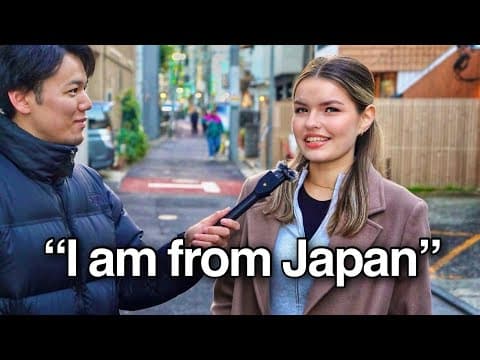
[0:00]My name is Victoria, I was born and raised in Japan. I spent my entire life in Japan. So you're born and raised in Japan, right? Do you have a Japanese passport or you only have an Indian passport? I had a little bit of the American culture and I kind of understood it, but culturally I was more Japanese. It's very hard to fully feel Japanese if you're not ethnically fully Japanese. Can you say something in Japanese, your native language, right? Hi, I'm Tiffany. Hajimemashite Tiffany to moushimasu. I mean I never really lived anywhere else, so this is my home. And I always called Japan home. Hey guys, how are you doing? Takashi. So today I'm going to interview people from Japan, but not ethnically Japanese. Could you introduce your background? Hi, I'm Crystal K. I'm a singer in Japan, and I was born and raised in Yokohama. My father is African-American and my mother is Zainichi Korean. My name is Reza, and I was born in Tehran, Iran. I came to Japan when I was 2 years old, and I went back to Iran when I was 6 and came back again when I was 12, so I've been here most of my life and I love it. Hi, my name is Yuna. I was born in Japan, I moved to China when I was 6, and I moved to the States when I was 10. I was there for 17 years and I moved back to Japan 6 months ago. Both my parents are from China, and yeah, like one of them living in China right now and one of them living in the States right now. I was born and raised in Japan for first 6 years and my family is basically scientists, so that's why I was born here. And after doing Hoikuen from here, I went back to India for my schooling. So I did 12 years of schooling from India and then I came back here again because I like Japan. My name is Victoria, I was born and raised in Japan. My both parents are Russian and I spent my entire life in Japan. I was born and raised in Ibaraki Prefecture, Japan. My parents are originally from America and based in Charlotte, North Carolina. I was raised in Ibaraki until age 13 and then moved to America for 6 and a half years in Charlotte and now I'm back in Tokyo and this is my seventh or eighth year here. I was born and raised in Tokyo, Japan, and my family's been living in Japan for the past three generations. I've been living in London for the past 1 year, but been going back and forth between the UK and Japan since 2018, I think. Yeah, that's me, basically. I'm David Neptune, and I'm a filmmaker living in Los Angeles, California, and I was born and raised in Japan till I was about 15 years old, I lived in Japan. My parents are both American, and so my dad's from San Diego and my mom is from Hawaii. We're filming this video in Los Angeles right now with him because you live in Los Angeles right now, right? And I'd like to ask some questions about your life in Japan, what was your life like in Japan, and now your life in America? As someone not ethnically Japanese, what kind of unique experience do you have in a good way or like positive or negative way? I grew up there, you know, going to public school and so I was in shogakko until fifth grade. And for the most part, really enjoyed it, but I also felt like everything is very memorization-based, you know, in the Japanese education system. And um, I have an artist father who plays Shakuhachi and, you know, a very creative family in general and, um, I felt like that didn't really fit for me. So I ended up homeschooling for a few years. I also think my mom realized that my Japanese was better than my English when I was a kid. So I think that was part of it that I started doing homeschooling and studying in English, basically with an American school. And this is just when the internet started, so they would send all the material from the US and I would do all my homework and everything and then I would send it back to the US, basically. It was very colorful. Um, I I was very lucky growing up and having the experience of going to an American school on the military base. Because I didn't go to Japanese school, I didn't experience bullying. I went to Taiken Jugyo like a summer experience. Of Japanese school? Of Japanese school, so I went for like a week or two and I hated it. Oh, you didn't, you didn't feel comfortable there? No, because, I mean, kids are cruel, kids can be cruel. Um, and I was the only half Black, half Korean girl there. I'm darker than them, so yeah, they would be like, oh, gaijin or like, oh, why are you so dark and stuff like that. When I was in sixth grade and, um, first year of middle school, I think I really wanted to become Japanese, like how I look. I really hated how I looked, and I think I felt more comfortable being with Japanese people than being with Americans or British or like other international people, because I just felt more comfortable being surrounded by Japanese people because we have the same humor, same mannerism, just the culture we grew up with is basically the same. But when I went to International School, I think it was too different to me. We couldn't connect on a deeper level. But with Japanese people, I think I never had a problem back then. But because you're a shakaijin, people don't know your background, because I always was surrounded by the same people from the same city, like my my local area. People only saw me as a foreigner and people tell me I'm a foreigner, I'm an outsider. So that's when I started to question who I am. I wanted to connect with my roots, and that's one of the reasons why I moved to the UK, as well. I knew I was a foreigner, I knew I was different, but I didn't feel different or feel like a foreigner because, you know, I had friends, we went to just go together, we took pretty good pictures together. We like paneled out, put on videos, and I was part of a local sports team and so everything I did was with them. And so me being a foreigner, I feel like didn't exclude me out of society, although my parents were interviewed on another channel, um, about their experience of raising us in Japan.
[5:57]And something I realized in that video a few years back was they feel like they were treated as outsiders, but not myself and my brother. We lived in a danchi, so, you know, it's like a close-knit community and the people living there are responsible of everything in that in that neighborhood, so everyone is expected to join, but there's only two people in that neighborhood that were not required to join and it was my mom and my dad. I actually felt a little bit distant from my parents actually, cuz I knew I was I was culturally different from them, even though they were my blood parents. Interesting. I went to a regular Japanese school and there was a gap, like so I wasn't here from elementary, so I came back here and I was in junior high. And I kind of forgot all the Japanese that I could speak when I was, I don't know, 6 years old or something. So I had to learn all the Kanji of the elementary to kind of catch up with everyone else. It was a really hard time because I had to study more than anyone else. I didn't really felt felt like an outsider or anything. Like people didn't treat me like an foreigner because I think it's because like I don't really look like a foreigner. You know, I'm Asian like I feel like, you know, Chinese, right? Like Chinese, Japanese, Korean, I really don't think like when you're at your age 6, there's no big difference. What makes you so different is like you're from your makeup, like from what you wear, but, you know, I was only 6, so like nobody really treated me like a foreigner. So, I mean, I was genuinely happy when I was in Japan. I was born in the countryside of Japan, Prefecture Niigata, and, uh, I had not a lot of friends who are like from other countries. Like some half mixed friends, but I went to entirely public school until high school, so I never felt like I fitted in. My interests and hobbies were really different, but I was just like really trying hard to blend in. Like, like, how? Like, can you give me an example? I don't listen to like Japanese music or Japanese, I don't watch Japanese movies, but I just try to watch them or like anime, I I don't watch anime at all. But you tried. Yeah, I really. Yeah. What about in China? Oh, yes, that's where the problem came. So like when I was in China, because I didn't speak Chinese when I first moved to China, so, um, people only Japanese? Yes, only Japanese, so like people found out that I was from Japan. Like from all my stationaries are from Japan, so like people are like, oh, you're from Japan. And, you know, like in China, like with China and Japan, they had like a lot of, you know, conflict. A lot of kids bullied me. The first 2 years when I was in China, I made no friends. Because you're from Japan or what? Just because I was from Japan. Even though you're Chinese. Yes, it's really ironic, it's really ironic because, you know, I'm Chinese. Like I was only 6, so I thought China is where I'm supposed to be going back to. A place that I should be calling home. But then people didn't treat me like I was at home. People are like, oh, you're from Japan. Like I don't like you. I was like, okay, why? I'm Chinese. What brought your parents to Japan and why did they decide to raise you here? So, initially, my dad came here to work and make money. He runs a travel agency here, he works between Iran and Japan. He thought that Japan is safe to raise his children and that his family could have a good life, so he decided to bring us all here. I grew up on the military base. Oh, okay. Yeah, so my dad was in the Navy and so from kindergarten till high school, till I graduated high school, I went to school on the base. It's literally like the moment you step into the gate, it's like America. Just the aesthetics and the buildings, um, it's very chotto monotone because of it's a military base. The houses aren't like those Japanese small Ikka. They're like actually like townhouse looking, and they have yards and, you know, people are cutting grass like lawn mowers, like you're in the US suburbs kind of. My grandparents are Protestant missionaries. So they were planting churches, mostly in Hokkaido. Many missionaries were moving to Japan in the 50s, 60s, so they were one of that movement. And my family, interestingly, just stayed in Japan. The university my dad attended in America, there was quite number of like Japanese population and he became really good friends with one of them. And through that friend, he was invited to visit Japan a few times in the early 90s. And from that, he just really liked the country and that friend's father, um, was a preacher and an owner of a church located in Hitachi, Ibaraki Prefecture, Japan. And so, uh, that person offered my dad a job to teach English for that congregation kind of privately. But that went well and they decided and my dad went back to America and married my mom, um, and they came back to Japan and then they just happened to have my brother and I there, so. My mom came here to study at a university and my dad chased my mom to Japan and they really loved the country. They decided to stay. Any differences between Japan and the country your parents from, Russia? I just went there this August and I realized that people are so different, like Russian people are more honest, and in Japan I have relationships that are more just on the surface, like sometimes like I just hide, my like honest opinions, it's just like tatemae. But in Russia, like people are really like straightforward. The biggest thing was just in school. I was in, I was in Boise, Idaho for a year. Uh, that's where I lived the first year I was in the US and I I remember being in school and a teacher would give us like a group assignment to do like in the during the class, you know, and get in a group and have a discussion about this and write this or whatever. And I would just see kids like goofing off, they would just, they would, they would just get in a circle and they just talk about whatever, or, you know, one kid would just be like drawing on his, on his notebook or whatever. And I was just like, guys, what's going on? Come on, like, we don't have that much time left. Like we have to do the assignment, you know? And everybody was like, huh, like, why are you so worried about that? You know? So just like that sense of like, we just kind of do do whatever feels good in the moment. Um, that was kind of a culture shock. Both the cultures of Japan and India are a bit different. Japan is a, I feel Japanese people are more polite and, um, they talk nicely and everything is just good about Japan, I think, like even it's safe, less criminals, less Hanzo. It's not that India is bad, but, um, it's just culturally different. That's why I came back because I think Japan is just better, I think, yeah. Compared to Japan, Chinese people are more aggressive. I would say they're more down to earth. So like once they like you, they'll be like, oh, you're my family. When you talk to a Chinese people, when they say something, they pretty much like in most cases they mean it. But then in Japan, I feel like, like even if they say something, you you have to be like, do they really mean this? Or they're actually trying to, you know, convey something else. I think the prominent difference between Japan and America is people in America can be too self-centered where it's all about what I say, how I feel, which I actually think it's not entirely bad, cuz there are certain situations where you should put your yourself first. But there's a time and place, but I think oppositely in Japan, people don't put themselves first enough where they prioritize others first before themselves, which I also think it's not entirely bad, cuz the world does not revolve around you, but there's a time and place, so I think that's maybe like the the main difference. It was only until 2017 that I got to visit the UK for the first time, and that's when I got to see my home country for the first time. And that was pretty shocking experience, I would say, because I had this image of the UK in my head and it was pretty different to that. So, I mean I only went to London that time, but it was rough, dirty. At the same time, the diversity was very appealing to me. The diversity there, how people just don't care who you are, in a in a positive way, they just don't care. And I felt accepted and I just felt so at ease there. I never had that strong connection with my home country because, obviously, my parents are from here as well, so. It's a very bizarre, unique experience, isn't it? Yeah. The big difference is the fieryness. I personally call Koreans the Asian Latinos. They're very expressive. Direct? Direct, kind of loud, and it it seems kind of aggressive because the language kind of sounds aggressive. But it doesn't necessarily mean like they're mad or being aggressive with you, but they're just very direct. I think it's pretty opposite, you know, Japanese people don't want to stand out. In this video, I talked with people from Japan, but what might you miss out on if you didn't grow up in Japan? It could be things like anime, food culture, or seasonal traditions like summer festivals. But also, you miss out on Japanese snacks. Japan has a unique snack culture and I'm going to explain it using Tokyo Treat and Sakuraco snack boxes. Sakuraco is a subscription service where you receive a monthly Japanese artisan snack box fit with traditional and authentic Japanese tea and snacks every month. Sakuraco has been partnering with local Japanese snack makers to continue to share Japanese culture and traditions that have been passed down for over a hundred years. This month theme is Valentine's Delights. Did you know that Japan has a unique Valentine's Day culture? It's not just a romantic holiday, it's also a time to express gratitude and strengthen bonds with friends, family, and loved ones. With these sweets, you can celebrate this special day as if you were in Japan. And Tokyo Treat is packed with latest season sweets in contrast to Sakurako which represents to traditional Japanese culture. You can feel a modern life in Japan with Tokyo Treat. This month theme is Sweet Valentine. Did you know that how Valentine's works in Japan? There are three types of chocolate gifting, each with a different meaning depend on the type of chocolate given. The details are explained further in the box and each snack is explained so that you can see what's produced and you can also check allergy information. This week would be more precise to go when you come to Japan. So if you like to experience having a good quality Japanese snack right in your home, use code 'Takashi' for $5 off! Check the link in the description below. You live in America more than you lived in Japan, right? At this point, at this point, do you? How, how do you feel right now about it? Yeah, I feel more American now, actually. Yeah, the scale has turned for sure. I still have this basis of Japanese culture and those are my formative years when a lot of my sense of identity and stuff like that is created, but actually as an adult, I think I've done more work with my identity and realizing who I am, um, here in the US. And so I feel, yeah, I feel more American, which in in so many ways is like, what, what is American? Like we have people from every culture in this country and everybody is blended together. So, that's beauty of this country. Yeah, yeah, that's, that's what I love about it, too. Especially LA, it's like such a blend. There's like, you know, there's Thai Town, there's Korea Town, there's like, you know, Little Tokyo, there's, there's all these different areas and people from all cultures are here, so in that way it feels really global and I feel at home here. I don't feel British, I don't feel Japanese, but I know I'm from this country, I know I grew up here, but I also know my roots. I know where my ancestors are from. I'm very proud to be British in ethnically, I'm very proud. I'm very proud that my grandparents moved to Japan 10 years after the war when there was no base for them. They left their country and they started a life here, so I'm very proud what they did, but so I want to take on that pride as well. I just feel like a person from Tokyo. I would consider myself Japanese. Of course, I'm like ethnicity-wise, I'm Chinese, and you can never take that part away from me, too. Like when I hear like Chinese songs, I'll be like, oh my God, I want to sing with them, cuz, you know, it's it's part of my culture. But I know, like I will never be completely Chinese or Japanese or American. You know, I I didn't spend enough time in a certain place, in a specific place, enough to consider myself like 100%, 100% Japanese, Chinese, or American. After I moved back to Japan, I realized that like when I hear like English, I'll be like, I want to talk to you guys. I I want to talk with you guys because I feel like speaking English, speaking Chinese, speaking Japanese, like all three of them makes me whole, makes me a whole. Culturally, now I feel fully bicultural where it's like, you know, thanks to being born and raised in Japan in the countryside where, you know, there's no other foreigner, so the only environment I have was where it was. But then moving to America, I learned how to be more American where it's like, you know, you have your strong stance and, you know, thanks to that, I feel like I have my own opinion in a sense like, and, um, I think if I didn't have that experience in America, I would have a void somewhere where it's like, I know I'm American, but I don't know what that means, I don't know about America, I don't know English type of thing. So I'm glad to have had that experience, so I think overall, I think I feel fully bicultural. I'm not fully maybe this or that, I'm I'm just a mixture and this is who I am and I had like a little identity crisis probably when I was, around, I don't know, I was a teenager. I just got to accept it as I grew up, you know? I think it's something that we have to cherish, right, the differences. Definitely more to Japanese culture. Yeah, I think it forms my mentality, behavior, and everything. For Russian culture, I feel like I'm really connected to, like, I feel really close to a food culture, like when I eat Russian food, I feel like really like nostalgic home kind of feeling. Yeah, I really like it. I'm still not sure because I only experienced living in Japan. I need to see the world before I decide, but I think the education system in Japan is, it gotten better, I think, so probably a possibility. Okay, thank you for watching so far. How was it? That was interesting. I really like to interview people like them, people who have specific, very unique backgrounds, so if you're one of them, please let me know. Also, please don't forget to follow my Instagram and TikTok. I approach shorts of my videos. Okay, anime, thank you for watching. If you like this video, click the like button, please subscribe to my channel. If you have any questions you want me to ask people in Japan, please leave a comment, too. See you next time.


