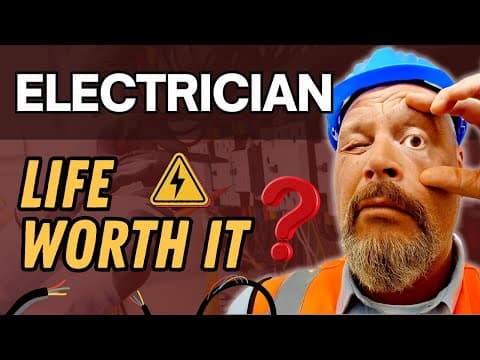
[0:00]Is it worth being an electrician in 2025? What's up, everybody? This is Zach of All Trades. Back again with another real talk about the trades. Today, we're diving into a big question I get asked all the time. Is being an electrician actually worth it in 2025? Let me tell you something right off the bat. I've been in the trades for 29 years now, and I've seen the highs and lows and all the bullshit in between. So buckle up, because you're about to get into the raw truth about this career path. The good, the bad, and the ugly. First things first, being an electrician isn't for everybody. It's not always glamorous. Some days you're crawling through the nasty attics in the middle of August when it's 130 degrees up there. You're covered in insulation that makes your skin itch like crazy. And you're thinking, what in the hell am I doing with my life? But then there are days when you're finishing wiring up an entire custom home, flip that main breaker and watch everything come to life. And let me tell you, that feeling, that feeling is worth it. Let's talk money, because that's what you really want to know. In 2025, the average journeyman electrician is pulling in about 75 to 85K annually. Master electricians, they're taking in 95 to 120K, depending on where they live. And this is the big butt. Those numbers don't tell the whole story. If you're in a major metropolitan area like New York City or San Francisco or Seattle, you could be looking at 130K plus with overtime. Rural areas, probably closer to 60K to 70K. I personally know guys running their electrical businesses by themselves with no employees, clearing 200K plus a year, not joking. Is that Ferrari money? No. Is that comfortable? I can actually afford to live money? Hell yes. I also know guys that are running 10 plus employees that are making over a million a year, but with more employees can also mean more problems. College debt versus get paid to learn. Here's what blows my mind. People will drop 100K on a college degree that maybe lands them a 60K job. Meanwhile, as an apprentice electrician, you're getting paid while you learn. Let that sink in. When my buddy started his apprenticeship, he was making 17 an hour. Not amazing, but not terrible for a 19-year-old kid with zero expenses, who is basically being paid to learn a valuable skill. Four years later, he was a journeyman, making triple that. Another buddy of mine went to a fancy university, spent four years accumulating debt, graduated with $87,000 in student loans, started his marketing career making 52K. Who made the better choice? Just saying, the work-life balance reality check. Alright, real talk, work-life balance as an electrician can be complicated. Some weeks you're working 40 hours, home every night by 5:00 p.m., coaching your kids soccer team, and living the dream. Other weeks, you're pulling 60 plus hours because a job is behind schedule, a client is freaking out, or there's an emergency work that needs to be done ASAP.
[3:09]You missed your daughter's eighth birthday party because a hospital generator went down, and they need to fix it immediately. That sucks. It really sucks. You'd be making up for that one for a long time. But you also would be able to take random Wednesdays off to go her school events because you would have flexibility that your 95 friends don't have. It's a tradeoff. Job security in the AI apocalypse. Everyone's freaking out about AI taking their jobs. And yeah, if you're a data entry or a certain white-collar fields, maybe you should be worried. But guess what? AI ain't crawling through your crawl space to wire your house anytime soon. Robots aren't climbing poles during ice storms to restore power. This is physical work that requires human hands, problem-solving skills and adaptability. In 2025, and all this talk about automation and job loss, being an electrician is probably one of the safest career bets you can make. The green revolution equals money. Listen up, because this is important. The massive shift in renewable energy, electric vehicles, smart homes, energy efficient everything. It's an electrician's gold rush. I got buddies who specialize in solar installations who can't keep up with demand. They're booked six months out and charging a premium rates. EV charging station installations, same story. Smart homes wiring and automation. Cash cow. If you're thinking about becoming an electrician in 2025, specialize in green energy tech is like buying Bitcoin in 2010. Except without all the risk of becoming worthless overnight. The physical toll, nobody talks about this. Alright, time for some brutal honesty. This job will beat the crap out of your body if you're not careful. My buddy's right knee, garbage from years of kneeling on concrete. His back. Let's just say he knows his chiropractor's kids names. His hands, they look like he's been fighting bears for fun. The physical toll is real, and it accumulates over time. My buddy's only 39 and there are mornings he wakes up feeling like he's 70. But, and this is important, if you're smart about how you work, use the right tools and don't be that hero lifting stuff you shouldn't be lifting alone, you can minimize a lot of this. Plus, as you move up, you get to do less of the brutal physical stuff and more of the planning, supervising and problem solving. The respect factor. I'm going to get a little deep for a second. When my buddy started as an electrician in his 20s, he felt like people looked down on him, not having a real career or a college degree. Like somehow he wasn't smart enough to do anything else. But you know what's happened over the last decade? That's completely flipped. Now when he tells people he's a master electrician, they're like, oh man, that's awesome. We need more people doing essential work like that. The respect for skilled trades has made a massive comeback, and it feels good, not going to lie. Plus, there's the internal satisfaction of driving around town and being like, I wired that building. I did that electrical on that restaurant, that hospital, has power because of me. You can't put a price tag on that feeling. The path forward, advancement opportunities. Here's something people don't realize about the electrical trade. There are so many different paths you can take. You can specialize in residential, commercial, industrial, low voltage data, green energy, control and automation, electrical engineering. Yes, many electricians go on to get engineering degrees, inspections and code compliance, teaching training, running your own business. My buddy started doing basic residential work. Now he runs his own company focusing on commercial and industrial projects. Another one of my buddies started at the same time as him. Now he works for a tech company installing and maintaining data centers. Makes a killing and works in the air condition all day. The point is, this isn't a dead-end career where you're doing the same exact thing for 40 years. What sucks about an electrician, keeping it 100. Alright, it's not all sunshine and rainbows. Let me tell you what absolutely sucks about this job. Dealing with the cheap customers who don't understand why electrical work costs what it costs. My cousin said he could do it for half the price. Then let your cousin do it and call me when your house is on fire, Brad. Working in extreme weather, nothing like trying to connect tiny wires when it's 20 degrees and your fingers are numb. The stress is knowing that if you screw up, someone could literally die. That responsibility weighs on you. Constant code changes, just when you think you know everything, they update the electrical code, and you're back to studying. Finding balance between speed and quality, employers want it fast, but they also want it perfect. The tension is constant. Who should not become an electrician? Let's be clear. This job isn't for everyone. Don't become an electrician if you hate problem solving and critical thinking. You're not comfortable with basic mathematics. You have a genuine fear of electricity. Sounds obvious, but you'd be surprised. You can't handle working in tight, uncomfortable spaces. You need predictable 9 to 5 hours every single day. You're not willing to keep learning and adapt to new technologies. Is it worth it in 2025? My honest answer. So after all that, is being an electrician worth it in 2025? Hell yes. In the world where jobs are being automated away, where degrees cost a fortune, but don't guarantee employment, where people are desperate for meaning in their work. Being an electrician checks almost every box. Essential work, that's not going away. Excellent pay potential, multiple career paths, minimal educational debt. The satisfaction of creating and fixing things with your hands, respect for your skills, freedom to work anywhere in the country. Is it perfect? No, nothing is. Is it worth it? For the right person, absolutely. Final thoughts and my personal take. Look, my buddies have had days where they hated this job. Days where they're soaked in sweat, their back was killing them and some general contractor was breathing down their neck about timelines. They have had moments where they wondered if they should have gone to college and gotten some cushy office job instead. But then they remember that they make more money than most of their friends with degrees. They have skills that will always be in demand. They can move anywhere in the country and find work. And at the end of each day, they can point at something real that they created or fixed. That's a pretty good deal in my book. So if you're considering becoming an electrician in 2025, here's my advice. Do it. Jump in, but do it with your eyes wide open. Understand the challenges, but also recognize the incredible opportunities. And if you're already an electrician, wondering if you made the right choice, trust me, you did. Alright, that's all I got for today. If you found this helpful, smash that like button, hit subscribe, and ring that bell so you don't miss my next video.


