[0:00]Assalamu alaikum everyone and I hope all of you are listening to me. And inshallah we will be having a very good session on climate reality today. Last time actually I wasn't able to share therefore I wasn't uh able to share the screen but now let me start and uh it will be a very good and interesting session for all of you. So uh the presentation is very good and uh you have you are free to ask questions whenever you like. So uh I will go through the presentation first and then after that uh I will be sharing with you. then you will be free to basically ask questions once the presentation is over. Okay. So let us start. I think a couple of people have joined us and it's good. So let me start with the formal uh speech from the vice former Vice President of USA. And then after that uh the session will start. Hello everyone. I'm Al Gore and I want to thank you for joining us today for 24 hours of reality, countdown to the future. As all of you know, we're living through truly extraordinary times, and if you're like most people, you look at these challenges that we're facing now, the climate crisis getting worse, the COVID-19 pandemic, uh structural and institutional racism, the challenges to the operations of democracy, and you ask yourself, what can we do? How do we overcome these truly existential threats that are connected and how do we build together a sustainable future and the just and fair future that we want and deserve. Well, the presentation you're about to hear and the discussion you're about to join is about these questions. Your host is an incredible climate reality leader that I personally have worked with and through their presentation, you'll learn the science behind the climate crisis and why it is having such a devastating impact on the ecological balance of our planet. You'll also learn how the climate crisis is connected to the COVID-19 pandemic and is connected to the broader injustices and inequities not only in the U.S. where I'm located but in places all around the planet. Just as important, you'll learn that we have the solutions and you'll learn how we can work together to solve these crisis starting with a green recovery and with a just transition to clean energy and that the technologies that can make our world better in every way. You'll learn what you personally can do to make a difference and to help us create the future that we want and that humanity deserves. So before I hand you back to your host, I want to say one other thing. Thank you for being a part of this global conversation. The truth of our circumstances is very clear. We have to solve the climate crisis and we have the solutions we need today. I know that we can solve the climate crisis, we have the political will, you know it's a renewable resource, but it's really because of people like you who are ready to commit the time and energy and attention and stand up and fight for a better world. Because of you, I know that we will succeed. Thank you.
[3:40]Thank you very much former vice president US uh Mr. Gore and uh it have really been a good experience working with you and in fact the training uh that I recently got from the former Vice President was fantastic. So uh let us start with the today's session and it's 24 hours of reality uh the climate reality project. Okay. And uh let me start with with the presentation formally. So this is a picture of our globe and it's also known as the blue marble. It was taken by the Apollo mission in 1970s and you can see how beautiful is the planet Earth. All the life, all the human crimes, all the victories, all the wars, everything have occurred on this planet. It's our only home in the whole universe. In the whole universe, not just the planet solar system. So it is what we have and this is what is at stake at the moment because of the climate change, because of the climate crisis, because of the uh changing patterns of climate. Let us see and study what is climate change actually and how can we be uh agent of change in a positive way rather than agent of destruction for this our home and planet Earth. This is sun horizon the upper two layers of atmosphere, the troposphere and the stratosphere. And you can see how thin these uh layers are and how thin the atmosphere is. This is where all the weather occurs. It is this uh where all the clouds, rain, everything occurs and it is very important and vital for the life on earth. Because if we damage the atmosphere, if we pollute the atmosphere, then all the life that is present on earth is really in is in danger. Is really in danger of getting extinct. So this layer of atmosphere is very important and crucial for the life to sustain on planet Earth. And this is a very uh very nice picture taken by the NASA and you can see the horizon, sun horizon and atmosphere and stratosphere in this picture. So let us see what actually is uh the climate change and what actually occurs. So I will go with with the greenhouse effect and all of us uh most of us already know about that. Solar radiation in the form of light waves passes through the atmosphere, it comes from the sun, it heats up the Earth, which is very important. And it warms earth because of this warmth, the life uh continues on the planet. And if there would be no heat, there would be no life, uh because the earth would have been very cold. In fact uh around minus 15 degree centigrade, uh the temperature would of earth will be. So it's very good that the earth uh gets warm by the sun and due to this warmth, we have a temperature which is uh good for the life. Some energy is radiated back into space in the form of infrared rays and some of it is absorbed, natural cycle. So what actually occurs basically is that uh due to extra uh burning of fossil fuels and increase in carbon dioxide, more of the outgoing infrared radiation is trapped. And the greenhouse gases, they trap the extra heat which is going out and that increases the temperature on the earth. That is the cause of the global warming. So it's not the greenhouse effect itself, it's enhanced greenhouse effect due to man-made pollutants. That is the cause and that causes the temperature of earth to rise. So extra layer of gases which we are emitting through our activities anthropogenic activities, that is the one, that are the one which are causing uh the rise in the temperature. So 152 million tons of man-made global warming pollution enters into the atmosphere every 24 hours. As it's just like as if it were an open sewer and we are dumping all waste in it. So it's a huge pollution and this pollution is really really very alarming for our planet, for our life to sustain on planet Earth. And these are all the major sources, air transportation, uh you can see coal mining, uh land transport, industrial agriculture, forest burning, industrial processes. So these are all the activities, man-made activities which are causing uh this increase in the greenhouse gases which are piling up and warming the earth temperature which is piling up into that earth's atmosphere and rising the temperature of the Earth. So the largest source of global warming pollution is the burning of fossil fuels. And you can see the trend. Again after age of industrialization, as I always talk about in my lectures, uh that it's after the industrialization, you can see gradual rise in the fossil fuels burning and this rise is very much directly proportional to the uh rising temperature and rising anomalies of the weather in the globe. And let us see the surface global temperature that is also departed from the average and you can see it's on the rise and this is very alarming. This is very alarming situation. And again we have more than 72% chance that 2020 will be the new hottest year ever.
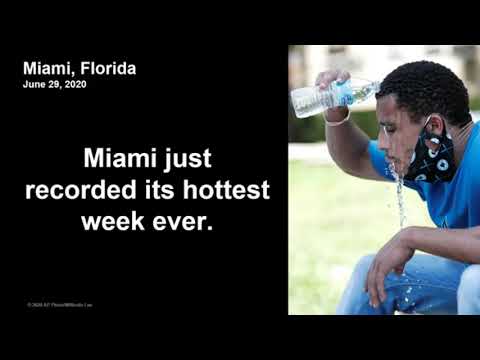
[9:05]So these are really alarming statistics. These are very alarming statistics that we really need to work and think. So 19 of the 20 hottest years on record have occurred in the last since year 2001. 19 of the 20 hottest years on record have occurred in the last two decades. And if we further narrow down the study, the hottest of all have been the last five. All the last five years have been the most hottest and now they are saying that 2020 will be even hotter than the these last five hottest years. So this, this is a very alarming situation. It's a very alarming situation for all of us and we really need to think and we really need to uh work. have to study how the climate is affecting and we have to work for the mitigation because these are very very alarming situations. Miami, Florida, just recorded its hottest week ever. Again, in Australia, in January, because you know uh the Southern Hemisphere and the northern hemisphere the uh when we have winter uh in Southern Hemisphere, it's it's summers. And when we have summers here in northern hemisphere, in Southern Hemisphere it's winter, it's the opposite way. And Australia had around 44° centigrade on January 4th, which is very very uh high temperature, it was all time new uh record. This is picture of Lahore and then uh the picture and then also the temperature, Jacobabad which was more than 51° centigrade on June 2nd. So you can see uh the weather anomalies here in Pakistan as well. Temperature across Europe has been on the record since 2019. Germany, Netherlands, UK, Belgium all broke their all-time high temperature records. Karachi heat wave very alarming and we all of all of us uh know about this. More than 2,000 people they lost their lives to this Karachi heat wave that was in August 2015. People died of thirst, people died of dehydration. And that was a very alarming situation. It was very hard blood blood breaking, you can say, and it was it was something very very abysmal situation of affairs that we have to face. So very alarming situation again. 93% of all the extra heat trapped by the man-made global warming goes into the oceans. 93% of all the extra heat trapped by the main-made pollution, uh basically goes into the ocean and it this warms the ocean. And you know when the oceans are warm, they become very violent. There are cyclones, then there are big hurricanes, they come in into the these oceans. And these are really going to create huge problems, huge problems. So let us see the ocean temperature. It has set a new record uh again, you can see the rise in the temperatures and rise in the temperatures.
[12:26]And since 2000, they are on the warmer side, not on the cooler side. So again a very very alarming situation for all of us. And then 2020 is likely to set a new record again. So this is the normal hydrological cycle. We have evaporation, we have precipitation and we water returns to the sea. So the normal water cycle is very very good because you can see uh water evaporates then there is precipitation and then the water returns to the sea. And but what actually is occurring due to uh that we have actually made this hydrological cycle very fast because of the global warming, now there is more evaporation, there is more precipitation and more water returns. So we are now seeing a surge or you can see increase in freakish weather, in freakish and unpredictable precipitation patterns and that is also very dangerous. Philippines are around 578,000 people were affected by typhoon. Again in India and Bangladesh, they were both affected uh Sundarbans, the area and you can see again large population affected uh with typhoon and India it was a very big crisis because they were facing already the COVID and then they had this cyclone uh which hit the shore, coastal areas of India. And we can also have the example of Karachi. And 345 mm rain in one day, more than 41 deaths. Very alarming and uh all the Karachi uh was just like uh you can say, there were lakes in in the city streets and all the Karachi was filled with water and there was very difficult and people were unable to go to home or to offices, people were unable to uh carry on their daily activities because of the rain and the water that was that has entered the houses.
[15:56]So these this phenomenon of rain bombs, this is a really very alarming situation which uh is coming in the coming which is coming in the future days and we really have to think, we really have to work on this. Hotter year typically have more fires.
[16:19]If you see around the globe, if you in US or in other different countries, if there is more warm temperature, there are more fires. And that is also a big big problem uh that that is going to occur. So Arizona in USA wildfires have already burnt hundreds of square miles in Arizona this year. In California you can see. Then Australia last year, thousands of animal, they died. They were burned alive due to this fire. Kangaroos, Koala and so much, so many other animals and that was very devastating. So these are very very crucial times. And wide out wide extreme weather cat again on the right. You see storms, floods, extreme temperatures and these all graphs, statistics are showing or pointing us the way. They are making us uh think that we really need to take step. We really need to move forward. We really have to think that global warming and climate change is a serious and a biggest threat. And there are again people who are saying that it's a bigger threat than even COVID. And that's the biggest threat that human as a as a civilization, humans will face in the future. So we really need to work on that. Top ten cities at risk from the sea level rise, again South Asia. Kolkata, Mumbai, Dhaka, Karachi is again the next one on this list. So we really have to be uh vigilant. And this is really going to be a very big problem. This is Miami, Florida. Uh octopus in the in the city streets and similar there was a kind of a when this year there were rains in Karachi. So uh there were again uh pictures that was that were being shared on on internet about uh crocodiles in the city. I didn't share it for the purpose because according to some that was uh fake but some people claimed that no they themselves saw the crocodiles in Karachi streets. It was a kind of a controversial therefore I didn't share but this is an actual picture of a octopus in the streets of Florida. So this means that in future we have to be very well prepared for that for any weather anomaly uh or weather change or any abrupt raining season and something and changes like these. So we have to be prepared for that in future. This is Kiribati, the first nation in purchase land in another country to house its climate refugees. And in future, it's a big big problem, the climate refugees, the environmental refugees, they will be the one and will be huge numbers. Because if the sea level rises, then we will have a big problem of climate refugees, environmental refugees and we have to tackle them. And it's going to be a very big problem for the political leaders, for the uh world as a whole. So we really need to think, we really need to take uh decisions uh at this moment, at now for our future. Very important. Climate change will likely lead to food and water shortages, pandemic diseases, disputes over refugees and resources and destruction by natural disasters in the regions across the globe. Absolutely. So this is a big big problem that is going to occur. And as a nation, you know Pakistan is also having uh climate change and food security. It's a big problem here in Pakistan as well. Death attributable to ambient air pollution. You can see again, the South Asia or the Asian countries are more prone to it. Example from China, a study of 324 cities in China found a 15 to 22% increase in COVID cases in areas with elevated levels of nitrogen dioxide and particular matter. And I did myself a study in Lahore. And this was published in the Express in Express Tribune newspaper in April 2020. Air is a shared resource. We must keep it clean as pollution aggravates the misery of the virus. So we really need to think. And this is what uh we say is a synergistic effect. synergistic effect when different pollutants or when there are different uh pollutants in the air they have a synergistic effect which is much higher than their sum. So we really need to think. Now comes the question, can we change? Yes, we have the solutions in hand. It's just the will that we need. So let us see uh what has uh the technology or science have given us in these uh latest years or fruits of technology or fruits of science. Let us see. So in 2000, projection was worldwide wind capacity will reach 30 GW by 2020 or 2010. But reality, if we see, by 2019 that goal was exceeded by a factor of 22 times. Thanks to technology, thanks to the research and the scientists who are working. Let us see the global wind energy capacity at present it's on the rise. All the developed countries and now even the developing countries are moving towards it. Very positive sign. Let us see the projection of solar energy. The solar energy market will grow one gigawatt per year by 2010. Let us see the reality that goal was exceeded by 17 times and even in 2019, it was exceeded by 121 times. Very positive. Again, a very hopeful situation. World Solar Photovoltaic Installation on the rise, on the boom. Cost of crystalline silicon, decreasing. So the cost of solar panel is decreasing decreasing. And solar panels are increasing which is a very positive sign. And storage capacity is also increasing. Let us see. Enough solar energy reaches the Earth every hour to fill the world's energy needs for a full year. We just need to harness this energy, capture this energy, and then we can be energy sufficient. The global cumulative storage capacity of the uh increasing energy storage deployment deployment from 2017 to 2018 and are projected to double again. The storage capacity is increasing of the batteries for these uh solar uh plants, which is a very positive sign. Let us see example from Pakistan. Solar power plant, very good and now 100 MW is in the in the main grid. It's it's more than 1000 MW uh basically power plant or the project it will produce 1000 MW, but hundred is in the cycle, it is in production. Very positive sign. Global electric cars on the ride. Pakistan uh recently have uh made its uh electric vehicle policy. Moving towards uh smoke free cars, very positive again. This is the Paris Agreement. Every nation in the world agreed to work together to achieve net zero greenhouse gas emissions by mid-century. So all the countries have agreed to this and inshallah the future is bright and prosperous and hopeful. Over 240 global companies have made a commitment to go 100% renewable. All these major companies, they have got made a commitment to go to renewable which is very positive and the most important and the biggest uh I can say good news that we can say as a nation, we should be proud of it that Pakistan has achieved sustainable development goal 13 climate action ahead of its time and it's very good, very positive step by the government and I think we should appreciate it. Aside from the political difference that we have, the government is investing in the solar, the government is investing in the wind and the tree or 10 billion tree tsunami that is simply fantastic. And this is a very hopeful uh picture for all of us that we as a country moving towards the right direction. We as a country are moving towards the right direction and we are taking the right steps which will be benefit for our country, for our generation, for our especially young people who are taking who are uh the future leaders and that's a very positive, very positive.