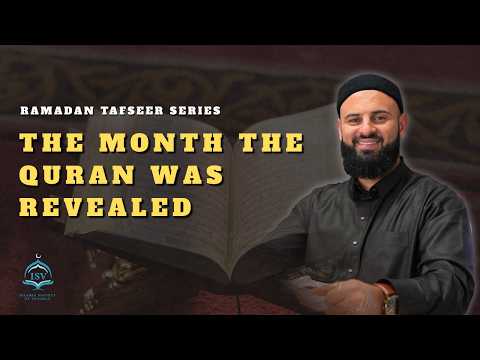
[0:00]My dear brothers and sisters, may Allah be pleased with you and may Allah protect you all. Today is the second day of the month of Ramadan. And Subhanallah, I always say Ramadan is time, Ramadan is not a place. Ramadan will go fast. Two nights of Ramadan gone. And very soon we will speak about and we will speak about the Ahkam al-Eid. So the winner of Ramadan, the one who used the time of Ramadan for the sake of Allah Subhanallah wa Ta'ala and will work hard for his here after. Because there are so many people were in the life of Dunya last Ramadan and in this Ramadan they are not here, they left the life of Dunya. And Allah knows from us who is going to meet next Ramadan and who is not. We ask Allah Subhanahu wa Ta'ala to make us from the winners of Ramadan. Today to complete the fasting, Allah said, "Bismillahir Rahmanir Raheem, Shahru Ramadan alladzi unzila fihi al-Quran." "Hudan lil-Nasi wa bayyinatin min al-Huda wa al-Furqan." Shahr, Shahru Ramadan is not week, is not few days. At the beginning when Allah said, "Ya ayyuhallazina amanu kutiba alaykum al-Siyam kama kutiba alallazina min qablikum la'allakum tattaqun ayyaman ma'dudat." Allah said, "some days, few days." But how many days? Allah did not mention them at the beginning. But here, Allah explained. So the first ayah what I was talking about yesterday, it was from the Mansukh. And this ayah al-Nasikh, which means the new update came from Allah. That new update came with new rules that everybody has to follow it, not to follow the old rules. As al-Khamr ayyat al-Nasikh wa al-Mansukh. At the beginning al-Khamr was halal. Then al-Khamr, better to leave it. While you are praying, then al-Khamr it's not good for us then Allah revealed the last ayah that we have to follow all of us that al-Khamr is haram. So same thing. Al-Khamr means alcohol. And now al-Siyam, yesterday the ayats was al-Siyam was optional. Okay? But today, no, Allah is speaking about some that you must fast. Shahru Ramadan, Allah said Shahar, that means complete month. So the Islamic calendar is 30 or 29 days. We do not have 28 days in Islamic calendar. Shahru Ramadan. Ramadan means what? Ramadan means has two meaning. The first meaning, they said why they named this month Ramadan? First meaning that comes from the word of ar-Ramda'. The word of ar-Ramda' means the land that super hot. So the month of Ramadan has been or has been named from that land, which means the the the land when you be there you have to be prepared. When you be on that land walking you have to be prepared even in the month of Ramadan you have to prepare yourself. Another meaning, Ramadan, because they said Ramadan has been revealed from Allah in the summer. And Ramadan, the word of Ramadan means the hot, the extreme hot. So that's why they named the month of Ramadan based on the season of that time when the Ramadan has been revealed. Shahru Ramadan. Allah said, "Shahru Ramadan alladzi unzila fihi al-Quran." Here is the meaning now. I want you to focus. "Shahru Ramadan," the month of Ramadan where the Quran has been revealed. Allah Azza wa Jalla raised the month of Ramadan more than any other month because of al-Quran. Because al-Quran has been revealed when? In Ramadan. What is the proof? What is the proof that al-Quran has been revealed in Ramadan? I just said it, "Shahru Ramadan alladzi unzila fihi al-Quran." And there is another another one. "Inna anzalnahu fi laylatul Qadr." "Inna anzalnahu fi laylatim Mubarakah." So al-Quran has been revealed in the month of Ramadan. So when al-Quran has been revealed in the month of Ramadan, Allah Subhanah wa Ta'ala put Ramadan in a high rank. And we are celebrating and thanking Allah by what? By fasting and also by reciting the month of Ramadan. So Allah said, "Shahru Ramadan alladzi unzila fihi al-Quran." What's al-Quran? "Hudan lil-Nasi." Al-Quran, why has been revealed? First one, "Huda," guidance. If someone asks you a question, He said, "Why al-Quran has been revealed from Allah?" Tell him, "Huda," guidance. Guidance for me and guidance for my family, I guidance for every single one. Without al-Quran, we will be in misguidance. So, "Hudan lil-Nasi wa bayyinatin min al-Huda wa al-Furqan." And "bayyinatin," clarification. Clarification to what? To answer all the questions and to give a Shifa' and to guide you to the right path. From what? From two types of sickness. Two types of misguidance. And register this point. The first misguidance is what? Ash-Shubuhat, doubtful matters. Shubuhat that it may come to you in your faith. Some people disbelieve in Allah. Some people disbelieve in the last day. Some people disbelieve in some ahkam of al-Quran. Some people disbelieve in some matters from al-Halal and al-Haram in al-Islam.
[6:19]So al-Quran came to give the clarification. Okay? And the second type of sickness, ash-Shahwat. What's ash-Shahwat? The desires. Al-Quran came to answer which one is Halal, which one is Haram. For example, from we have Shahwat al-akl. So we have desires to eat. What's from our desire that we have to practice from a food and what's the desire that we should not eat? So we are allowed to eat meat, we are allowed to eat chicken, fish, whatever. We are not allowed to eat pork, we are not allowed to eat from the dead meat and so on and so on and so on. Also in the matter of the relationship, we are allowed to have a relationship with women, women with men, in al-Halal way under the Islamic rules, under marriage. And out of marriage, we are not allowed to have a relationship with women. And so and so and so. We are allowed to drink the water, but we are not allowed to drink alcohol. So that's why al-Quran came to give the clarification. "Wa bayyinatin min al-Huda wa al-Furqan." "Min al-Huda" means here going back to al-Quran. Al-Huda means the guidance that came from al-Quran and "wa al-Furqan." Al-Furqan means the dividing. Al-Quran came to divide, to divide what? The truth from the false. Allah Subhanah wa Ta'ala named al-Quran what? Named al-Quran Al-Furqan, where? In Surah al-Furqan. "Bismillahir Rahmanir Raheem, Tabarak alladhi nazzal al-Furqana 'ala 'abdihi liyakuna lil-'alamina nazira." Al-Furqan means what? I said. What's al-Furqan, Ahmad? Divide the truth from the false. So Allah named al-Quran, the divider of the truth from the false. You have to focus, do not sleep. We are going to finish in two minutes.
[8:09]So, "wa bayyinatin min al-Huda wa al-Furqan, fa man shahida minkum ash-shahra fa li yasumh." Whoever, whoever reached the month of Ramadan, he must fast. If somebody tells you what is the proof from al-Quran, that I have to fast the month of Ramadan. Tell him Allah said, "Fa man shahida minkum ash-shahra fa li yasumh." Whoever, whoever reached the month of Ramadan, he has, he must fast, "fa li yasumh." "Wa man kana maridan aw 'ala safarin fa 'iddatun min ayyamin ukhar." No here, "fa man shahida minkum ash-shahra." This is an-Nasikh. What's an-Nasikh mean? This is the last update came from Allah about the month of Ramadan that we must fast.
[9:03]In the first ayats it was optional, "Ya ayyuhallazina amanu kutiba alaykum as-Siyam kama kutiba alalladhina min qablikum la'allakum tattaqun ayyaman ma'dudat." "Fa man kana minkum maridan aw 'ala safarin fa 'iddatun min ayyamin ukhar." It was optional. And at the beginning was Ashura. Fasting, listen to this important point. Fasting in general was only Fard on Ashura. To fast the day of Ashura. Then the ayats of fasting from the month of Ramadan came and Ramadan became optional. If you want to fast, fast, by "Ya ayyuhallazina amanu kutiba alaykum as-Siyam kama kutiba alalladhina min qablikum." Then the last update came from Allah by "Shahru Ramadan alladzi unzila fihi al-Quran hudan lil-Nasi wa bayyinatin min al-Huda wa al-Furqan, fa man shahida minkum ash-shahra fa li yasumh," Allah said. Here became wajib, fasting the month of Ramadan. "Wa man kana maridan aw 'ala safarin," and whoever was sick or whoever is in travel, "fa 'iddatun min ayyamin ukhar." So I spoke about this yesterday. Whoever is sick, whoever is in travel, he can fast another days. Then Allah said, "Yurid Allahu bikum al-yusra wa la yuridu bikum al-'usr." Here by to fasting and to fast the month of Ramadan, Allah wants just to make it easy for you. Allah want to give you the easy way. Allah want you to practice the ease. "Wa la yuridu bikum al-'usr." Allah doesn't want to make it difficult for you, especially for those who cannot fast the month of Ramadan. Do not make it difficult for yourself. "Yurid Allahu bikum al-yusra wa la yuridu bikum al-'usr." The religion of al-Islam, religion of ease. Allah Subhanah wa Ta'ala said, "Innama'al 'usri yusra fa innama'al 'usri yusra. Innama'al 'usri yusra." So the religion of al-Islam, religion of ease, and ahkam al-Quran came to make our life easy. So what Allah said here? "Yurid Allahu bikum al-yusra wa la yuridu bikum al-'usr. Wa li tukmilu al-'iddah." Aha, "wa li tukmilu al-'iddah." It's explaining what? The ayats at the beginning when Allah said, "ayyaman ma'dudat." "Ayyaman ma'dudat," how many days? Three days, five days, one month, one year? We need to know. Allah Azza wa Jalla answered here, "wa li tukmilu al-'iddah." Means to complete the month. "Wa li tukmilu al-'iddah wa li tukabbiru Allaha 'ala ma hadakum." And to say the Takbir. To keep saying the Takbir for the guidance that Allah gave it to you, for the ni'mah that Allah gave it to you, that Allah blessed you with this Mubarak month and revealed al-Quran in you. How to make the Takbir? Make the Takbir day and night. One Ibadah and Sunnah Mahjurah. When I say Sunnah Mahjurah, that means this practice, this Sunnah, people left this Sunnah. The Takbir in Ramadan. Very hard to see people making the Takbir in the month of Ramadan. The Takbir this is a sign of happiness, sign of to be thankfully to Allah Azza wa Jalla. One Ibadah that you should do it that Allah Azza wa Jalla advised you to do it, the Takbir in the month of Ramadan. "Wa li tukabbiru Allaha 'ala ma hadakum wa la'allakum tashkurun." So when you say the Takbir, when you fast the month of Ramadan, and when you recite al-Quran,
[12:47]that mean you became thankfully to Allah Azza wa Jalla. Remember what I'm saying? When you fast the month of Ramadan, when you recite al-Quran in the month of Ramadan, and you say the Takbir, you will be thankfully to Allah Subhanah wa Ta'ala. And I will stop here insha'Allah and tomorrow I will take another ayats belong to al-Siyam from "Wa idha sa'alaka 'ibadi 'anni fa inni qarib." Allahumma waffiqna lima tuhibbu wa tarda wa khudh binawasina lil-birri wa al-taqwa. Allahumma yassir umurana. Allahumma aghfir dhunubana wa astur 'uyubana. Allahumma adkhilna al-Jannah. Allahumma anfa'na bima 'allamtana. Allahumma waffiqna bi tawfiqika wa ayyidna bi ta'yidika wa arhamna bi rahmatika, ya Arham ar-Rahimin, ya Rabb al-'alamin. Allahumma aj'al ijtimana hadha ijtimana marhuma. Wa tafarruqana min ba'dihi tafarruqan ma'suma. Wa la taj'al fina wa la ma'ana wa la min baynina shaqiyyan wa la mahruma. Allahumma aghfir lana wa li walidina wa li jami'i al-Muslimina wa al-Muslimat. Allahumma aghfir li zawjatina wa abna'ina wa banatina. Ya Arham ar-Rahimin, ya Rabb al-'alamin. Allahumma a'tina su'lana. Allahumma a'tina su'lana. Allahumma inna nas'aluka al-Jannata wa na'udhu bika min an-nar. Allahumma inna nas'aluka al-Jannata wa na'udhu bika min an-nar. Allahumma a'tiq riqabana min an-nar, wa a'tiq riqaba walidina wa zawjatina wa dhurriyatina min an-nar. Ya Arham ar-Rahimin, ya Rabb al-'alamin. Allahumma salli 'ala nabiyina Muhammad wa 'ala alihi wa sahbihi ajma'in wa akhiru da'wana an al-Hamdu lillahi Rabbil 'alamin.


