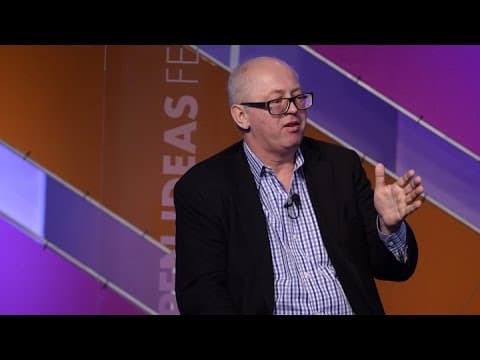
[0:02]So we're very lucky to have here Matthew Bishop, who is the U.S. business editor and New York Bureau Chief of The Economist. He was the business editor in London and he's a member of the World Economic Forum's Global Agenda Council and role of business. Uh, he has a co-author Michael Green, who I'm sure he would want me to mention, with whom he's written several books and he wrote Philanthropism. Um, and has done such an intimidating list of special reports for The Economist that those of us journalists who know what it takes to write and assemble these special reports, for example, Kings of Capitalism, uh, the collapse of Enron, um, watching the boss in 1994. Um, and he was on the faculty of London Business School. So he comes with an intimidating set of credentials. But I was going to ask when you got the idea of writing a book about the changes in philanthropy and how you coined the term philanthrop capitalism, which should trip off all our tongues by the end of this session. Well, I mean, the the original uh, interest in philanthropy came when I wrote a special report on, uh, the new wealth that was being created during the last 20 years of the the last century and how that was changing, um, how the wealth creators themselves felt about the world and how society operated. And in the course of that, I I guess I was struck by how many people who had, uh, been successful entrepreneurs were finding themselves, uh, really focusing on on giving back, giving in interesting ways that they hadn't expected to be able to do. And that this was something they were far more passionate about really than talking about their how they made the money in the first place. And and and in the course of that, I interviewed Bill Gates for the first time and was just astonished at how, um, you know, how how passionate he was about, um, how this philanthropy was going to change his life by giving him the chance to really make a difference in and perhaps save millions of lives through his giving. And I I I went away thinking, this is a big deal, um, and tried to persuade The Economist for five years to let me write a special report specifically on the new wave of giving, which they finally did about three months before Warren Buffett made his big announcement at the New York Public Library that he was giving away most of his money. And I was there in the audience that day and it just struck me that this was a unique moment in human history, the two most successful business people of of of our age and perhaps any age, um, standing there pledging to give away the vast and bulk of their fortune, and to do it to solve some of the most intractable problems of poverty and, uh, in the education system in the United States. Um, and it just I I wanted to know how this moment had come to be. Um, was this an exceptional part of a broader trend, which I find it is part of a broader trend, and can they actually achieve what are incredibly difficult goals, which I think is the question we really care most about. Um, with Warren Buffett at that day saying, you know, this is much giving money away effectively is much harder than making money in the first place. You know, these are really tough problems and can individuals as opposed to governments really, um, find solutions to to these long-term, deep, big problems. And were you finding that this kind of approach, well, I'd like you to take us back, one of the fascinations of, uh, Mr. Bishop's book, and I hope you're all going to buy it, is that it talks about the history of world philanthropy. And the idea that it was people who had, you know, lofty goals or had very specific politically and business-minded driven goals. So, what were some of the examples in history that struck you as being particularly influential now? Well, what we found, which which I was surprised by as we looked back at the history of philanthropy, is that we probably since modern capitalism began, had about five golden ages of philanthropy, starting in the Middle Ages with the first sort of mercantile traders who were very big on endowing schools and, um, hospitals. And then subsequently, once you had the creation of the joint stock company in, uh, Holland and the UK in the early 18th century, you you saw almost the invention of joint stock philanthropy where the social entrepreneurs of their day would actually get 100 people to subscribe to their organization and and fund it. And so there were there were these, you know, amazing periods where it seemed like the successes in capitalism, it seems to be that certain number of them will apply their whatever skills made them successful in business to solving whatever the social problem of the day is. So this isn't to a unique moment. It's it may be a return to a to a history and and and America's first golden age was with Carnegie and and Rockefeller and so forth. What's the trajectory between the guilds of the Middle Ages, in which capitalists pulled their money, right? To to endow hospitals and schools. And then Andrew Carnegie, who is an individual who decides on a set of goals. Well, now, I think some of the the the mercantile people in the Middle Ages were also been individual actors as well. I mean, you see a lot of the schools and buildings of of Continental Europe and England with names on them, which is the is a is a key indicator. But I mean, I think that as Carnegie came along, he he really was the first to realize you had to you you have he had more wealth to give away than he was ever going to be able to give away on his own in his lifetime. And so he set up the institutional form and endowed it of of the foundation, which we now have, um, a lot of. Do you mean there weren't individually begun foundations in the U.S. before Carnegie? There were a few, but nothing that was endowed with, you know, the equivalent of billions of dollars, um, that was going to go on for a very long period of time. And what about the history of, um, shaming by example that Carnegie was awfully good at? Uh, by saying if you don't follow these ideals, you have not made your money for any higher good and you should not be dying with any. When does that start that idea? Is that particularly Presbyterian? I think it is quite Presbyterian. I mean, it's uh, and there's always been a a culture of, you know, religious duty to give and so forth, which he was very much shaped by. But I think he took it further in that he was very concerned, and I guess it's a concern that's reawakening today with the Piketty analysis and so forth around inequality. That if the rich, the successful people didn't, uh, invest in the sustainability of society by looking after the needs of the poor and giving poorer people the best chance they could to succeed, then communism or whatever would take would take over. And so that that was a big part of his message and he, so not only was he shaming other rich people on the basis of if you die rich, you die disgraced if you haven't given away your money, um, he was also saying, look, this is in your self-interest as a as a believer in capitalism. And he was a he had a sort of social Darwinist view of the world that the people who did succeed did so on merit. He said, if you believe in that, then you you know that the people that didn't succeed to some extent didn't succeed on merit, um, but your duty is to keep them happy in some sense and keep them busy and and give back and make sure they have fulfilling lives. Which I'm not sure is a view that we would take today, but it's a but I think the underlying message that, um, philanthropy can be an important part of the response to the the Piketty analysis and in the the sense that, um, a lot of people have that we're getting we're moving to a world ruled by the 1% and that that's a bad thing. Um, I think he's he's very relevant today. Can you talk about what you have made of Piketty, which the Atlantic's website has devoted reams of space to, I everyone has. Whether you think it's something that should make philanthropists of today particularly anxious and also when you say that Carnegie was responding to the precursor of the Piketty idea of inequality, was he actually aiming to level society or bring disequity closer together and have a more level playing field?
[8:45]And is that a goal that you think you will start saying philanthropists have today? Yeah, up to a point. I mean, I think that clearly during his lifestyle, his life, I mean, there there was a sense in which he was a he and his class were a wealthy group, although he was probably a more austere person in how he lived his life. Minister But, you know, I think that he certainly didn't believe that there should be a hereditary, uh, class that would, uh, continue to dominate for generations. Um, he was very much shaped by, uh, looking at the British experience, Continental European experience, and seeing that as a very bad bad bad result of wealth creation and so he did want, um, a very meritocratic society and saw philanthropy as part of the creation of that. And I think that's very much what's going on today. I mean, Bill Gates is interesting in that he will never talk about the duty to give or would never use the kind of Carnegie language around your disgraced if you don't do it. For him, it's very much about how good it makes you feel to give and that you really can solve big problems and that's a fantastic thing to be able to be part of.
[10:01]And so that is a is a an egalitarian mission up to a point. And can you contrast more the history of U.S. philanthropy as it begins with Carnegie as a kind of reaction to what he saw as the European class system and primogenitor? Um, and is that has that had an influence across Europe and then we'll talk about other parts of the world that might or might not be influencing? Well, I mean, in in a funny sort of way, I mean, in Europe, because they didn't buy the Carnegie message so much, you you probably didn't have the kind of, um, investment in tackling some of the problems that were were affecting society that, um, that America did at the start of the 20th century in building up some of the great institutions, uh, that the philanthropists helped helped develop. Um, and Europe did get socialism and it did get, um, communism in in and it had two World Wars. And out of that, you do have people that have a lot of wealth and a lot of that is inherited wealth, um, and they have been very reluctant to be public about philanthropy in a way that, um, is still very normal in in America and becoming more so. Is that simple classy discretion or fear? No, I think there's a lot of, there's a lot of, um, there's a lot of fear underlying that if you put your head above the radar above the wall, you will, um, you will be shot at in some sense. Either the tax man will come calling or you will, um, have your money confiscated in some other way. And I guess the Piketty analysis again, it seemed to me what was interesting about that was not that he provided compelling evidence that the 1% are getting richer and richer relative to the average. I think we all knew that, but that it's had such a political response in that it's suddenly seems to have provided a lot of people in the mainstream of politics with, um, a populist, uh, excuse to to sort of to advocate a whole bunch of policies that in some ways seeing how it goes, could reverse 30 years of pro-market policies that or start to see some backtracking on those at least. Do you have any idea? Piketty has made such an a wave in this, in this country.
[12:19]But do you see that, since you are often in England and you know about Europe, do you see that happening now in Europe and do you think that philanthropists in Europe felt that they were kind of off the hook because social policies had been trying to equalize societies, so why should they have to bother? Yeah, I mean, I think to some extent if you're a German philanthropist, your focus is going to be probably outside of Germany or or on some very new breaking issue that is not covered by the German welfare state because that is such a comprehensive, uh, system that that there isn't a lot of, uh, opportunity for the traditional type of American philanthropy. Um, so, so they do feel to some extent, you know, they pay their taxes, they they do the right thing, they they their ancestors gave a lot of their wealth back to the state and therefore, um, the state has a duty to sort out a lot of these problems. I think that's starting to change because they're huge problems like what you do with, um, older people and the fact that dementia is becoming a big challenge to all, um, aging developed societies. And the existing healthcare system doesn't seem to have a response, uh, the issue of youth unemployment is a big issue, the issue of obesity. None of these really fall into traditional, uh, welfare policy solutions and so the philanthropists are starting to feel under pressure or or engaged excited about the opportunity to get involved in doing that in Europe as well, but, um, it it's it's still, you know, noticeably different that, um, America is really the one country, one of advanced country where you feel that this culture of philanthropy is is part of being successful and you don't feel embarrassed about it, you feel proud to talk about the work you're doing and and and and to be visibly seen to be wealthy but giving back. And this trend that you saw that made you want to write the book, can you tell us more about the traits underlying it and then when you started interviewing people who were actively engaged in it? What surprised you, what you saw actually uniting them and not uniting them or differences? Yeah, I mean, I think what's what's been going on in America in the last 10 or 15 years has been that successful entrepreneurs have wanted to actually apply their entrepreneurial skills to tackling some big social challenges. And I think, um, that is turning out to be quite valuable in in terms of there is a, they they have brought an energy to a whole bunch of of of social environmental problems that maybe the political system was running out of and so it's it's given a fresh impetus, um, a willingness to experiment and innovate and to back new kinds of social entrepreneurs, um, with different who who are challenging the conventional wisdom and that, I think, is very much out of the entrepreneurial mindset that helped a lot of, uh, Silicon Valley and and other, uh, groups of entrepreneurs take on the sort of incumbent business world in the, uh, seventies and eighties.
[15:20]And so, the two things are of of one, uh, and I think they are actually showing after, you know, a few hiccups along the way that they can start to do some really innovative things. I mean, I I wrote Mike Bloomberg, for example, as mayor of New York. His use of philanthropy to fund experiments that he thought were just too high risk to put straight into the political process and then once succeed once they were successful to to be able to say we have a proven model, you the taxpayer should now scale it up. I mean, that model, I think, is being looked at very widely around the world as a way that, um, philanthropists become the kind of risk capital for social innovation. And I think we'll see a lot of things happening there. Can you name other names of models that you think, uh, are worth studying of people who decided to go in and try to make this social change? Yeah, um, I mean, I'm very interested in, for example, Pierre Midio, the founder of of eBay who has created a foundation, uh, that in fact, he very quickly found he didn't want to do old style giving. He felt that actually some social challenges are better met through a for-profit company, and others are better achieved through, um, traditional grant making. And so his program offices and his foundation are really focused on what's the what's the problem we're trying to solve and how do we best solve it and their agnostic about whether whether to put equity into a company or to make a grant to a social entrepreneur who's a non-profit. And so they've now, I think, given away probably 800 million, half of which has gone into for-profit entities and about half into non-profits. And they're trying to figure out now how the whole ecosystem of a market works. And so you maybe need some non-profit regulators in there that you need to set up or standard setting organizations and you fund those simultaneously with funding the businesses that they will oversee and regulate and that actually, then you build a whole market much more quickly. And I think if you look at micro credit, which was an area which went from being philanthropy to being, uh, increasingly driven by for-profit companies, um, they learned from some of the mistakes that was that were made along that trajectory of growth that you needed to put in place consumer protection agencies and various other groups that there wasn't a for-profit model for and so you had to fund that as a as a grant maker. But this very question of should you make grants or should you make investments, which is going to have better results, it's if I'm right, the heart of your book about applying business principles to philanthropy. And do you think A, that that is necessary for effective philanthropy and B, do you have any kind of rules of thumb about whether a grant is a better use of money than an investment? I mean, I think this question of, you know, how how data driven you should be is a very, um, difficult one because I think some problems are more suitable to measurement than than others.
[18:34]And what I do think is clear is that you need to have before you start some kind of theory that you of of what change will look like if you're successful, uh, that you're going to hold yourself to account against.
[19:00]In some sense, in advance of markers along the way to know if you're going in the right direction. Yeah, and and so I think having a model of change and having a sense of what your role in that is should be and and and having a constant dialogue about whether you're achieving what you should be doing is the real challenge. And I think the biggest problem with this whole field of philanthropy is that there is just very little rigorous external analysis of what's going on and so because the media is largely uninterested in it. Um, the there are no standard metrics for comparing one one organization to another. When you say organization, what kind of organization? Well, whether it be a foundation or a philanthropist or whether it be the organizations that they're funding, there are there is measurement going on, but it tends to be kept fairly secret within, uh, the philanthropists own, uh, records and so forth. And so, you are operating in a world where if someone said to said to you, I'm interested in, I don't know, the subject of tackling math addiction somewhere in Oregon or something. You wouldn't actually be able to tell them who the best organization was to invest in, um, from public records. It there's no kind of equivalent of the research industry in the stock market. Um, and so you're really down to the philanthropists themselves being willing to embrace rigor and accountability. And I think that's something that hopefully will change over the next few years that we'll get a lot more transparency. But at the moment, it's a, it could lead to an awful lot of money being wasted in, um, ineffective giving because simply there's no information about what works and what doesn't work. And so a lot of money keeps going to reinventing square wheels and not enough money goes to to where the real progress is being made. This really surprises me because I thought that Gates was setting the example not only for applying business principles and metrics and measurable targets that had to be met before investment continued. But I thought it was also committed to the kind of transparency that would make exactly this kind of comparison possible. Well, I think Gates is, but Gates is, in some sense, so far ahead of the field and so much bigger a player that, um, it takes a long time to pull everyone along behind him. I think one of the things that's been interesting with the giving pledge, this this this pledge that he's he and Warren Buffett and Melinda Gates launched to get people to publicly sign up to giving away half their wealth during their lifetime. I mean, initially that was just going to be a uh, sign a letter and make a commitment and then they would have a gathering once a year just to, you know, pat each other on the backs. And then that is now gradually becoming a group where billionaire philanthropists actually start to do peer review or at least share ideas with their people who are interested in the same issues. And it's interesting to as you talk to people around that area, just how good they're actually starting to feel about it because they initially thought it would be a difficult process to compare notes and that they they would be, um, reluctant to get into stories of what didn't work and what they learned from failure and so forth. But in fact, they seem to be finding it quite liberating. And so I think that message of, you know, people who are interested in similar causes actually at least sharing information, even if they don't necessarily actively collaborate, is is is something that could lead to a could lead to the start of that more. Well, a risk of this kind of rigorous application of business principles to philanthropy is the anecdotal stories I've heard of people who raise money. And it it it once was that personal idiosyncrasies had a lot to do with how one could, you know, the the kind of gamut one ran in order to achieve a donation for one institution. But now it's this person has given 800 million with the following conditions that are incredibly tricky. It's a structured investment. We have to meet certain targets and goals before the rest of the money will come in and he or she is running us the way he or she ran the business and we're not business people. We're not hedge funds, so it's very difficult. Do you actually advocate that and think it results in more effective investment philanthropically? I mean, one of the striking things, uh, that that seems to be improving, uh, that I noticed when I first started writing about this area was that there is a huge culture clash. That business people come towards a non-profit often with a with a view that anyone in the non-profit sector must be a bit of a loser because, um, you know, essentially they would have gone into business if they hadn't been. Um, and the people on the non-profit side regard, uh, the business people as sort of an evil capitalist who's going to come in and make their life miserable. And and it's, but the common factor is that there is this money and there is this need to to work together. And so you you see often a lot of misunderstanding at first, but I think that organizations, the the the non-profits in particular, are getting better at talking the language of the of the philanthropists and figuring out how to, you know, how how to not lock yourself into a bunch of conditions that are inappropriate to your mission because you just want the money. That that I think they're realizing it's worse to be in that situation than it is to say, no. This is what we need. It takes pain. And there's a certain, yeah, there is a certain, there's a certain number of the who I'm very impressed by the venture philanthropists who are coming in and saying, actually, just as in venture capital, we will, um, back an individual more than we'll back the business plan because we just believe this person is a winner and they they understand the world and we're going to give them the capacity to succeed. You're seeing a new wave of of philanthropy that is doing that, which is much more saying, here's an interesting social entrepreneur. Not quite sure about the business model, but I'm going to back them and and and take them through and we're going to plan together on how do we take this into a large scale organization. And so that isn't so much about really locking people into very precise commitments and plans. It's much more about trying to think through what growth looks like and and how how can you build in capacity from day one as you would do with a with a Silicon Valley startup, rather than the traditional grant funding, which is often very would regard a lot of what you what is capacity building as in fact overhead and therefore something to be avoided. And so, you know, I think there's a whole different sort of different strands going on and some of which are very positive. So if if if one is a beginning philanthropist, and I think this is part of your book, you kind of give a how-to guide of how to do this. But one thing that underlies the people in your book, and he has, you know, marvelous interviews with lots of these philanthropists who have just started this new model, is are you obliged to set down a kind of list of moral imperatives, specific results you want, one's own political, even religious ideology that should guide these principles? I mean, what's the beginning, uh, worksheet one should assemble before starting to think about how to give away money? I mean, I think the, I mean, the impulse to give is something that's fairly deep in a lot of people. So, I'm less, I think, there's less to say about that. I think people the evidence that it makes you feel good that that that in fact, thanks to Bill Gates and others, you know, it there's a sort of role model of this is what success looks like to be involved in philanthropy. All those sorts of things, I think, are leading to more giving and we'll continue to lead to more giving, um, not just here in the states, but all around the world. I mean, it's striking in China, in Latin America, in Africa, now that as people become successful business people, they are quickly turning to philanthropy and actually turning to the American model as as their model. I think the difficult where the opportunities come, I mean, I think once you decide what, uh, that you want to give, it's it's giving to something that you feel passionate about and that you want to engage in. It's, um, becoming very, I mean, very expert in that area and trying to figure out, you know, what is it that you can uniquely bring as a philanthropist to that area. Um, because, you know, today, maybe compared to 100 years ago, the philanthropy, the money that you bring to philanthropy is not going to be able to solve a problem and unless it is applied really intelligently, either to sort of unblocking a bottleneck or where there's a tipping point in a system where a little bit of a push can make a big difference. And so, it's it you do need to really understand the system that you're trying to change and and have a model of where your money and energy and network can have a huge difference.
[28:09]And I think that's where the lack of transparency in the system is a real problem in that it requires a lot, actually, a lot more work than it ought to do to be able to figure out the existing model that's operating around a particular problem and and and how you therefore intervene in that system.


