[0:03]Hello, and welcome everyone to I'm sure will be a great conversation about Cornell's College of Agriculture and Life Sciences, or as we refer to it, Cals. My name is Heather Marcot, and I'm the director of admissions here at Cornell Cals, and I'm thrilled to be able to share some information with you about our incredible college. As you may be aware, while Cornell offers instruction in any study, we are organized into several different undergraduate colleges and schools. So it's your role during the admissions process to decide not only that you want to apply to Cornell, but within Cornell, which college or school will be the best academic home for you. With the understanding that the different colleges and schools have various academic offerings, philosophies and approaches. So we're so excited that you are taking a closer look at Cornell Cals. Cals is one of the largest of the undergraduate colleges at Cornell with about 3,500 undergraduate students who enter through both the first year and transfer admissions processes. Our mission statement is highlighted here. As a premier institution of scientific learning, we connect the life, agricultural, environmental and social sciences to provide world-class education, spark unexpected discoveries and inspire pioneering solutions. So let's break this down a little bit. You see, we are committed to the idea of purpose-driven science, tackling real-world questions and problems and helping change lives for the better. Cals is one of Cornell's contract colleges, which means we have maintained a long-standing, mutually beneficial relationship with New York State. Which includes state funding and a reduced tuition rate for students who are New York State residents, as well as a significant outreach and extension efforts to benefit communities across the state, as well as across the globe. New Yorkers make up a little less than half of our student body, and the rest come from all over the country and about 60 different countries internationally. Our areas of academic focus span the life, agricultural, environmental, and social sciences, and we offer Bachelor of Science degrees in over 20 majors. I specifically want to point out the important word connect in our mission. As we seek to make progress on addressing complex, real-world problems, we know that interdisciplinary thought and cross-expertise collaboration is essential, and our academic approach facilitates this. At Cals, you're going to be hearing about cutting-edge work in areas like digital agriculture, computational sustainability, food justice, and science communication, to name just a few. When applying to Cals, you select one of our majors as part of the admissions process, and your application materials are reviewed within the context of fit for this major at Cals and within Cornell. In making this major selection, you set your focus by choosing where you start. Your major serves as your academic home base, and you are able to dive into taking classes and making connections with faculty and peers within your area of interest from the very beginning. With this approach, we think you'll have the best of both worlds. The size and breadth of Cals offers significant opportunity, diverse networks, and great support resources. But at the same time, you'll experience a more intimate feel as you build community within your major. We truly see this as a value add to the academic experience and is not meant to be or feel limiting. That said, it's a good point to check in with yourself about. For Cals to be a good fit for you, you do need to hone in on one of our majors as an academic interest that you are excited to jump into pursuing, while also keeping an open mind as to where that will lead. You will be supported to explore your interests, whether that means selecting a concentration within your major, choosing elective coursework, adding a double major, or possibly changing your major within Cals or internally transferring to a different college or school at Cornell. To look briefly at the list of our majors, you'll see the life, agricultural, environmental, and social sciences all represented. Though many of our majors crossover multiple areas. For example, animal science is life science focused with many students preparing to apply to veterinary school. Though it also has an agricultural focus with the dairy science pathway, as well as a conservation lens with some students focusing on protecting endangered species. Communication is a social science, but we have some students who are focusing on communication in relation to health or environmental concerns, in addition to media studies and persuasion and social influence. Landscape architecture, for example, includes aspects of plant sciences, environmental preservation, technology, and community development. In thinking about the major that may be the best fit for you, I encourage you to consider some of the critical, urgent, real-world questions and issues that Cals is committed to addressing. Then, also consider from what vantage point you can picture yourself plugging in to make a positive change. Some of these priorities include health risks and challenges, things like cancer, insect-born diseases, and certainly COVID-19, climate change, food security at both the local and global levels, conservation and remediation of critical natural resources like clean water, economic and community development and vitality, and the role of media and emerging technology and all of this as we move forward. In addition to a major, students are encouraged to broaden the scope through our minor offerings. Cals offers more than 30 minors and across Cornell, there are more than 120 minors available. As a Cals student, you could have more than one minor, and you can minor anywhere within Cornell, so it's a great way to expand your academic landscape. The Cals curriculum is designed to be flexible and encourage exploration, while also enabling you to dive into your major and specialize within your area of focus. We encourage all applicants and those who are supporting applicants to use our website as your go-to resource. There is so much information on there, not only about the Cals student experience and societal impact, but also in terms of admissions, including academic preparation by major, visiting in-person and virtually, and more. We understand that students want to hear from students, so please visit our Meet Cals Ambassadors page to hear from our current student ambassadors about their own experiences. If you have any follow-up questions at all, you can email Cals_admissions@cornell.edu or give us a call at 607-255-2036. Our team is excited to begin working with you.
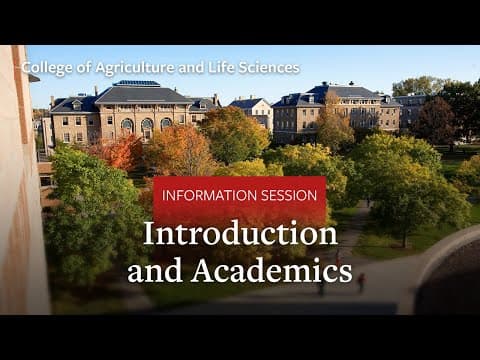
Cornell University College of Agriculture and Life Sciences Info Session Part 1: Introduction
Cornell Admissions
6m 30s1,084 words~6 min read
AI audio transcription
Transcript source
AI audio transcription
This transcript was generated from the video's audio because no usable YouTube caption track was available. The transcript below is server-rendered so it can be read, searched, cited, and shared without opening the original YouTube player.
Pull quotes
[0:03]Hello, and welcome everyone to I'm sure will be a great conversation about Cornell's College of Agriculture and Life Sciences, or as we refer to it, Cals.
[0:03]My name is Heather Marcot, and I'm the director of admissions here at Cornell Cals, and I'm thrilled to be able to share some information with you about our incredible college.
[0:03]As you may be aware, while Cornell offers instruction in any study, we are organized into several different undergraduate colleges and schools.
[0:03]So it's your role during the admissions process to decide not only that you want to apply to Cornell, but within Cornell, which college or school will be the best academic home for you.
Use this transcript
Related transcript hubs
Watch on YouTube
Share
MORE TRANSCRIPTS


