[0:00]Welcome. It is so nice to have all of you with us. Uh welcome to the Bright Star family. Um here at Bright Star, we focus on personal and leadership development that helps you to win at work and life, so that you will experience true joy. We will have a session now for uh 15 minutes. After the 15 minutes, you're welcome if you need to leave. If you have any question regarding Bright Star or anything or just want to chat with us, you're welcome to stay longer. But until then, uh we will be busy. Our um facilitator, uh Lena Lawrence is from Somerset West. Liana, we're excited about your session. Can't wait to hear more about ourselves. Thank you very much.
[0:57]Thank you, Amandla. I'm going to start sharing my screen. Uh let me just get that. While you're busy sharing the screen, welcome to everyone joining us. Uh we're glad that you are with us. Lena Lawrence is our facilitator for the day. I just need to to get to it again. Sorry, my dear. I'll there now.
[1:38]While Leona is sharing the screen. there we are. Sorry. Sure, when I started with off with this theme, I never realized what impact it actually would have in my own mind and in my own mindset and thinking about things the past week. Um, so I had all these wonderful, I'm usually very, uh demonstrative and pictures and I had all these ideas to share with you. And then as the week went on, all of the arms and the legs and all the paraphernalia was like cut off and we got to, I got to a space where I realized if we don't get back to the basic things of things, we can't progress. Because if we're not built on solid ground, when the storms come, we won't, we won't stay. Um, so I chose this theme of being truthfully true to myself because within the, within the, the kind of things that we do, we talk so much about and we, we tell somebody so easily, just be true to yourself. And then if you go and you Google at the university of Google, there's this lists and lists and thousands and thousands of articles that you can go and read about what it means to be true to yourself and how you can apply it and how you can change yourself. So, when I, when I went through all of those, I just came back to something within myself that I asked what is truth? If I say I have to be true to myself, then one of the questions I have to ask, but what is the truth about myself? And then I realized many times I am not so truthful with myself about myself. It's busy, very easy to to judge the, not not judge, but to to look at the world and find truths and half truths and not truths within everything around us. But once we just need to look a little bit inside ourselves, we tend to not be so open to the truth about ourselves. So I went on this journey, so and that's all I'm going to share with you this afternoon, my my journey. There's a definition if you, if you go just to to the definitions about truth that just says it's acting in a way that agrees with your beliefs and your values. Not somebody else's beliefs and values or your, it's your acting in in agreement with your own beliefs and values. And you are behaving according to your beliefs and doing what you think is right. And I realized that, um, my values and beliefs differ from somebody else's. So what happens then? Can I be truly myself if I'm not, if I don't believe the same as you do? If my belief system and my values is different than the the people around me, can I still truly be myself? So, I got I love dissecting coming back to words. And then I came to but what does it then mean if I say you have to be yourself? What is that being means? What does it mean to be? And then, um, I just I like, uh, to understand or I like to remember things in a way, so I came to the ing and uh,
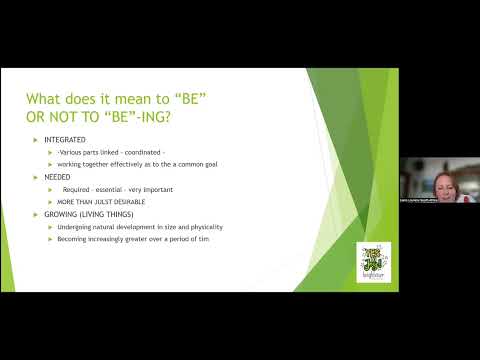
[5:22]being yourself means to be integrated, that every, all these various parts of yourself really works together towards a common goal. So, it's it's like the oil, um, if you are oil and everything just works together and do what it does, I'm not judging what you're going to do or what you believe or where, I'm just saying you, you are being when everything is working together nicely to get to where you want to go with your life. Then, um, being means really believing that the world needs you, that you are important.
[6:08]Because um, if you get to a state where you say, ah, I don't matter, I have nothing to give. You won't even miss me. If you have that mindset of not knowing that you have something important to give. Then, um, and and what they say is that it's not only the feeling of being needed, but, uh, it's more than just being desirable. It's more than I, I just want people to be in my, uh, friendship circle or, it's it's deeper than just functioning with the people around you. It is really knowing that you are needed. And then growing, the they say, um, growing just means for a living thing, it's undergoing a natural development in your size and your physicality. Becoming increasingly greater over a period of time, I typed that very quickly. That's supposed to be time. Um, I tend to get stuck on forgetting that I'm growing. Thinking that I have to be everything I need to be right now. And that and being means a ongoing growing into what you are supposed to be.
[7:37]So I asked myself what is the truth then? Now, in in the judicial system, uh, truth is nothing without proof. And if we think of truth, people will say, oh, it it's very complex and confusing because there's my truth and there's your truth and there's our truth and there's the truth and, in between of that, it it sometimes becomes a little confusing to know and to decide what is truth.
[8:14]So, in context of what is, if I have to be true to myself, um, what, what are the things that are going to prove to me that I actually has got this machine together to give to the world? So, in the judicial system, they say proof is not a document stating facts. It's not something tangible. It's a body of evidence, a group of things, the whole collection of evidence. It's a process of assembling all of this evidence and then you take that evidence and you test it, you refine it, you reinforce it until it gets to such a solid enough state that it can withstand any contradiction and counter claims.
[9:08]Now, that is a mouthful. So, I just went on and said, okay. In context with myself, if I want proof that I really have something to give and that I know what it is.
[9:25]Then, this theory I have about myself had to be tested. And what does test means? Test means establishing the quality or the performance and reliability of something before it is ready for widespread use. So, you really have to find out what is this, what am I made of? What are my characteristics? And then what, what are my limits because the, what is the context and what what am I supposed to do and there your purpose starts playing in.
[10:10]If I take a rubber band and I have to test it, I can't just pull it and say, yes, it's stretchy and I have all the characteristics.
[10:20]I need to know how far it can stretch before it breaks because then I will know how I can apply this the best I can. And in in, yeah, in life.
[10:55]So then in the judicial system they say the proof is when you refine it as well. Now, refining, we usually think firstly about silver getting refined in the fire, but, um, there's another refining of of taking off everything that is not necessary. So, it's not only clearing away that which is bad, but it's also shaping you to be the best to what you could be. Refining doesn't need to be always just taking away everything that's bad, but is taking the things that are good and even taking some of them away until you just have specifically what is good for your application. And then the third one is being reinforced. Now being reinforced um gives myself the picture of of a little plant hanging like this and then you stick something next to it so that you can bind it up to grow. But it's more than that. It's not just taking your weaknesses and giving you something to make that stronger, but it is actually looking towards where you need to go and having guides stronger than yourself to lead you towards what you could be and what, what your purpose would be. So I'm just going to leave leave read that. The choice of the material are dictated by the state of the subject and what is needed to fulfill its purpose. What is needed to enhance the performance above expectation.
[12:43]Now in the judicial understanding of truth is nothing without proof. We get to that, it has to go tested, refined, reinforced until it is so solid that it can withstand contradiction and counterclaims. Now, that is a mouthful. So I just went on and said, okay. Everything worth anything costs something. Nothing in this world that is really worth having, being becoming costs something and and the question is are we willing to pay the price for what it, what it costs us to be ourselves, to be ourselves.
[13:38]Amanda would know that I don't like what I'm doing here at the moment at all. I'm not being true to myself in a sense of having all these, because what is in my heart, I want to tell you that if, if we don't face the full truth about ourselves, we will never be able to grow. If we are not, um, willing to even look at our shadows and deal with those, we will not be able to grow in the way that we really want to be ourselves.
[14:23]Lena, I just think for time's sake, we're at 15 minutes now. So maybe we can you'll, uh, wrap up the conversation and then we can allow people that want to stay to stay with us. So do you have one Yeah, let me show you this. These are the three things that can keep us away from really being for other people, who we want to be, our knowledge, our feelings and our character. And the questions I wanted to ask for today is, are we willing to pay the price for what it, what it costs us to be ourselves, to be ourselves?


