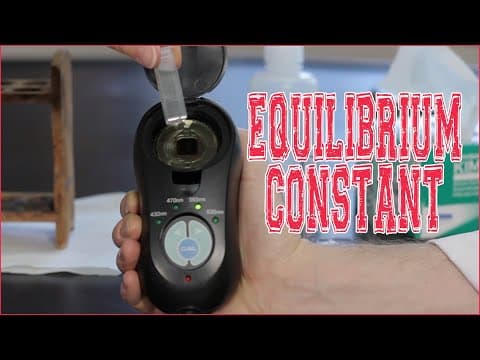
[0:06]Chemical equilibrium one: The equilibrium constant. This experiment uses the technique of spectrophotometry to determine the equilibrium constant for the reaction of iron ions and thiocyanate ions.
[0:19]This experiment contains two parts. Part one: Preparation of the calibration curve. Materials. Take eight clean, dry, medium-sized test tubes and number them from one to eight. Take the test tubes to the bench marked A and record the concentrations of the solutions provided in the burettes. In each of the eight labeled test tubes, measure out the volumes of the solutions as specified in table one. Make sure there are no bubbles in the burette tip. Remember to read the meniscus at eye level. Add Fe(NO3)3 to the test tube. Add KSCN to the test tube. Add HNO3 to the test tube. Stir the solutions with a glass rod in a piston motion. Be careful not to strike the bottom of the test tube as it can break the glass. It is normal that the liquid level between two test tubes is different since the diameters of the test tubes are often quite variable. Calculate the concentration of the thiocyanate in the eight solutions and record their values as they are needed for Logger Pro. Record the temperature of each of the eight solutions. The variation in temperature should not exceed 2°C. Make sure the thermometer is rinsed and dried before inserting it in the test tube. Obtain two cuvettes. When using cuvettes, you should always hold cuvettes by the top edges of the ribbed sides. They should never be more than three-quarters filled. Make sure there are no bubbles in the solution. If there are, flick the cuvette. Two cuvettes are provided. Rinse one cuvette with the reference solution, which is in test tube 8, two times. Discard the rinsates, fill the rinsed cuvette with the solution, and then cap it.
[3:07]Always cap the cuvette before inserting it into the colorimeter. Use a Kimwipe to clean the cuvette which contains solution 8. Open the Logger Pro program and the appropriate file for the experiment. The colorimeter must now be calibrated. The cuvette must be clean and dry. Make sure to position the cuvette so that one of its clear faces is directed toward the white reference mark. On the colorimeter, use the two arrows to set the light wavelength to 470 nanometers. Press the Cal button, and a red light will blink 10 times. The colorimeter has now been calibrated. Remove the reference solution from the cell wall and replace it with the cuvette containing solution 1. Rinse the other cuvette with solution 1 two times. Discard the rinsates, fill the rinsed cuvette with the solution, and then cap it.
[4:05]Be sure to wipe the cuvette with a Kimwipe. Follow the instructions in your lab manual to collect the absorbance measurement in Logger Pro for solution 1. Remove the cuvette from the cell wall and discard its contents. Rinse the cuvette with solution 2 and measure its absorbance. Repeat the previous steps with solutions 3 to 7 in that order. Once the absorbance readings for the seven solutions have been taken, you can then prepare a calibration curve for the absorbance of the equilibrium concentration of iron thiocyanate, as described in the lab manual. Part two: Determination of the equilibrium concentration of iron thiocyanate. Take six clean, dry, medium-sized test tubes and label them from one to six. Take the test tubes to the bench marked B.
[5:04]And record the concentrations of the solutions provided in the burettes. In each of the six test tubes, measure out the volumes of the solutions as specified in table 2. Recalibrate the colorimeter as in part 1 using the reference solution of part 2, which is solution 6.
[5:33]Absorbance readings are made again at 470 nanometers. Measure the absorbances for the solutions from 1 to 5 in that order. Read the absorbances from the status bar and record the values on the data sheet. Clean the glassware and put away the equipment. Dawson College Pre-Lab Video Series: Chemistry of Solutions chemists Yann Brouillette and Carmen Leung, filming and editing Vincenzo Nappi, technical support Daniel O'Malley, music by Bensound.


