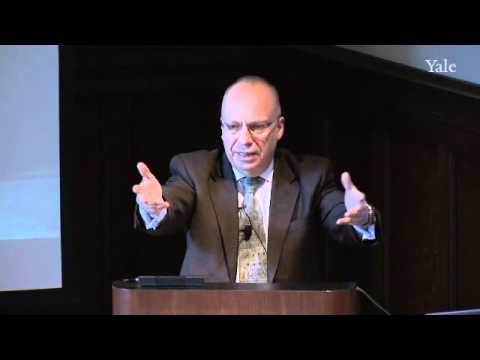
[0:02]This course presumes no prior knowledge of its subject matter. That is to say, you can take this course without having done any political philosophy before. The materials we're going to look at in this course can be approached at a number of levels of sophistication. Uh indeed, you could teach an entire course on on just John Stuart Mill or John Rolls or Carl Marx or Jeremy Bentham. Um, and that this means that some of you who may have had some prior acquaintance with some of these texts will be able to explore them in a different way from newcomers. But the course is designed as I said to be user-friendly to people who are doing this for the first time. There are a few parts of the course in which I make use of technical notations or diagrams. Now, it is true, it's just a fact about human beings that if you put a a graph or a chart or a a curve up on a diagram. There's certain people, some subset of the population, they get a knot in their stomach, they start to feel nauseous and their brain stops functioning. I can totally relate to it because I'm actually one of those people by disposition. Uh and what I can tell you about our use of charts and diagrams and notations in this course is, they're simply shorthand for people who find uh it useful. But I will do nothing with um diagrams and charts that I don't also do verbally. So if you don't get it the one way, you'll be able to get it the other way. Um there are plenty of seats down here and there are also seats upstairs if you want. Um, so you should never feel intimidated, you know, as I said for people who find graphs and charts useful. They're a form of shorthand, but if obviously if they intimidate somebody and they they make what's being said opaque then they're being self-defeating. Uh and as I said, I will always walk verbally through anything that I also do with charts and diagrams. Secondly, related to that point, um, it's my commitment to you that this is a course that's done from first principles and everything's explained from the ground up. I might forget that contract sometime and use a term that you don't understand. I might use a word like deontological, and you'll sit there and you'll be thinking, what does that mean? And the high probability is that if you don't know what it means, there probably 70 other people in the room who don't know what it means either. And so if you put up your hand and ask what it means, every you'll be doing those 69 people a favor. Um because they wanted to know what it means as well. So we shouldn't have any any situation in this course in which I'm using some term that you don't and you you can't follow what I'm talking about because you don't understand what it means. Um, it is a rather embarrassing fact about political philosophers that they don't say in words of one syllable what can be said in words of five syllables. But part of my job here is to reduce them to words of one syllable. Uh that is um to to take complex theoretical ideas and make them lucid and intelligible to you. And I see that as as a big part um of what we're doing here, so that your takeaway from this course three months ago, three months from now, um, will include feeling very comfortable with the language of political philosophy and the central uh terminology in which it's conducted. So, um hold my feet to the fire on that if you need to. If I use words you don't understand, put up your hand and stop me. I will from time to time throw out questions and we'll have a microphone uh that we can pass around so that uh people can answer the questions. It's one of the ways in which I gauge um how how well the communication between us is going. Um so you should expect that. Any other housekeeping matters before I get into the substance of the course.
[4:59]Good.
[5:03]So, this is a course about the moral foundations of politics. The moral foundations of political argument. And the way in which we organize it is to explore a number of traditions of political theorizing. And these are broadly grouped into a bigger distinction that I make between enlightenment and anti-enlightenment thinking. That is to say, we're going to start off by looking at the enlightenment. Now you might say, well what is the enlightenment? How do you know it when you trip over it? And that is a subject I'm going to get to uh next, on Wednesday and Friday, because Friday, as you all know, is going to be Monday's classes because of Martin Luther King Day. Um, but for right now, I'll say just dogmatically and I'll elaborate for you later, that the enlightenment revolved around two ideas. The first is the idea of basing our theories of politics on science. Not on religion, not on tradition, not on superstition, not on natural law, but on science. The enlightenment was born of an enormous optimism about the possibilities of science. And in this course, we will look at enlightenment theories that put science at the core of political argument. The second main enlightenment idea is the idea that individual freedom is the most important political good.
[7:12]And so if you if you wanted to get the bumper sticker version of the enlightenment uh account of politics, it it is how do you scientifically design a society to maximize individual freedom. Now, we will within that, we will look at three enlightenment traditions. We'll look at the utilitarian tradition, the Marxist tradition, and the social contract tradition. And uh again I'll just give you the one line version now and then we're going to come back to all of these, of course in much greater detail later. The utilitarian tradition says that the way in which you create a scientifically organized society is you maximize the greatest happiness of the greatest number.
[7:54]This is the the uh slogan of utilitarianism. Maximize the greatest happiness of the greatest number. You will find there huge disagreements among utilitarians about how you measure happiness and how you maximize it and how you know when you've maximized it and so on, but the utilitarians all agree that that's the goal and that if you can do that, you will do more to maximize human freedom than anything else. The Marxist tradition has a very different theory of science, what Marx called the science of historical materialism, but it too was based on this idea that we can have impersonal scientific principles that give us the right answer for the organization of society. One of Marx's famous one-liners was that we we will eventually get to a world in which politics is replaced by administration. implying that all forms of moral disagreement will have gone away because we'll have gotten the technically the right answers.
[9:08]Another formulation of that um same idea actually comes from a different enlightenment thinker who are not going to read in this course, David Hume who said if if all moral if if all moral disagreements were resolved no no uh political disagreements would remain.
[9:33]So that's the idea of a scientific uh solution to um what appear to be the moral dilemmas that divide us. So for Marx, we'll see a very different theory of science, but for him too, he thinks that freedom is the most important good. That might surprise you, most people think, well, Marx was about equality, he was egalitarian. We'll see that that's um only true in a in a somewhat derivative sense because in the end what was important for marks was that people are equally free. Um that they are in a situation of not being exploited. Uh and he too therefore is an enlightenment thinker. Then the social contract tradition says that the way we get a scientific theory of society is to think about what agreement people would make if they were designing society for the first time. If society was going to be based on a contract, what would it look like?
[10:41]And this is what gives us the right answer uh as to what is rational scientific principles tell us we we should how we should organize society and it's a society, a world in which people's freedom is preserved because it's what they choose to do. Again, as in these other enlightenment traditions, there's massive disagreement about who makes the contract, how they make it, um what the content of it would be, but it's it's the metaphor of a social contract that shapes all reasoning about the way in which you can organize societies scientifically in order to preserve freedom. So in the first two-thirds of the course, we're going to work our way through those three enlightenment traditions. But every current has its undertoe and even though the enlightenment was this enormously uh energetic, um and captivating tradition that really starts in the 17th century, and uh get steam in it gathers steam in the 18th century, there was always resistance to the enlightenment both its preoccupation with science and its view that individual freedom is the most important good. And so after we've done looking at the enlightenment, we're going to look at anti-enlightenment thinking. Um, and the tradition that resists the idea that there are scientific principles around which society can be organized and resist the idea that the freedom of the individual is the most important good.
[12:26]We'll explore that tradition and then in the last part of the course, we will turn to the democratic tradition, which tries at least in the way I will present this to you to reconcile the anti-enlightenment critique of the enlightenment uh with those elements of the enlightenment that survive the anti-enlightenment critique. If you see what I'm saying, so democracy becomes the resolution, at least in the way I'll uh describe democracy in this course.
[13:01]Thereby hangs another tale that I want to tell you about this course. The course is uh introductory and presented in a user-friendly way to to newcomers, but it also is an argument. That is I'm presenting an argument, a point of view, which some of you will be unpersuaded by, and that is totally fine. The idea is not to make you think what I think or what your teaching assistant thinks. It's rather to make you understand the logic underlying your own views better than you have before, and perhaps see the appeal of views you have hitherto rejected more clearly than you have before. So it's the idea is to enhance the sophistication of your own understanding of politics, not to have you parrot my views or teaching fellows views or anybody else's views. Um, it's rather to to understand the nature of your own views and how they might connect uh or live in tension with the views of others. One thing you're going to find, I should also say just as a as a matter of truth and advertising, of the we're going to look at a number of what I would call architectonic theories of politics that theories that try to give the whole answer. This is, you know, Jeremy Bentham, this is his scientific theory, these are all the pieces, these are how they this is how they fit together, and this is what it means for the organization of schools and prisons and parliaments and all the rest of it. He's got an architectonic theory of the whole thing. John Rolls as well, you'll see an architectonic theory of the whole thing. One of the things you one of the takeaway points of this course is going to be that architectonic theories fail. That there no there is no silver bullet. You're not going to find a takeaway um set of propositions that you can plaster onto future political dilemmas. What you're going to find instead, I think what's going to help you in this course, what's going to be the useful takeaway, uh is rather small and medium-sized insights. You're going to find things to put in your conceptual bag of tricks and take and use elsewhere. And they're going to be very helpful to you in analyzing uh a whole variety of problems. I think if you talk to other students who've taken this course, that tends to be the most useful uh the most useful takeaway uh that you get that you'll find when somebody brings up an argument say about what people are entitled to. You'll have a whole series of questions you would ask about that argument that you wouldn't have asked if you hadn't taken this course. So, you'll find a lot of um small and medium-sized bits and pieces that you can take and use in other contexts, but you're not going to find a a one-size-fits-all answer to the basic dilemmas of politics. Um let me say one other thing I see we we're actually got five extra minutes here. Generally speaking, we have a lot to cover.
[16:36]We will stick to the syllabus. Um, this course runs exactly as described in the syllabus. But we don't have a lot of uh there's not a lot of dead time, and it's really important to me that we be able to start right on the button.
[17:15]Um and I will I will not run over.
[17:35]I will always finish at 10 at 11:20. I know you people have other places to get to, but it's really important that you try and get here uh as promptly as you can so that we can start.
[17:59]Okay, uh we'll look forward to seeing you on Wednesday.


