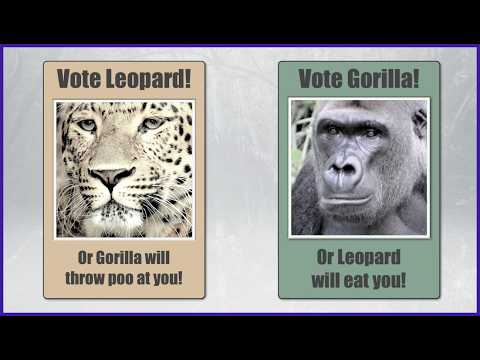
[0:03]Welcome to The Problem with First Past the Post Voting explained by me CGP Grey. The Royal Family has a problem, but this isn't just any Royal Family. These are the lions, rulers of the jungle since time immemorial. There are protests over the monarchy's absolute power and the citizens of the Animal Kingdom want a say in how they are governed. Bending to the pressure, Lion has abdicated his crown, and King is to be an elected office. To ensure a smooth transition, and because she is craftier than her husband, the Queen Lioness is remaining on the throne with the power to set the rules for all elections in her kingdom. She has declared that all citizens get one and only one vote and that the candidate with the most votes wins the crown. This method of voting is most often called First Past the Post, awkwardly abbreviated as FPTP, or Winner Take All. The system is simple, fair, and logical. Right? Actually no, it's a terrible, terrible idea. Why? Well, to see the problems with First Past the Post, let's watch the first election unfold in the Animal Kingdom! It's an exciting time for the burgeoning democracy and seven hopeful candidates come forward to run and represent their parties. They put on their best campaigns, citizens head out to the polls, and the votes are counted. The results come in as follows: Turtle gets 9% of the vote, Monkey gets 18, Gorilla gets 19, Owl gets 13, Leopard gets 20, Tiger gets 15, and Snake gets 6. Under the rules of First Past the Post, Leopard is crowned the winner and she gets to rule for the length of her term. But take a look at the results and you'll see the first problem with this system, minority rule. The vast majority of citizens, 80%, wanted someone else as king, but Leopard still won. There were only seven candidates in this race, but if you imagine if there had been 20, she might have only gotten 5% of the vote but still been elected. This problem of minority rule is only the beginning. The second problem with First Past the Post is that, given enough time, it results in an inevitable, unavoidable two-party system. Why? To see, let's watch what happens over several election cycles. Leopard has had her term in office and it's again election time in the young democracy. Only now, all the citizens of Animal Kingdom remember the results from last time. This information changes how they'll behave. Particularly Snake and Turtle voters, who must face the reality that they backed unappealing extremist candidates who don't have a chance of winning. Turtle voters, who were unhappy under Leopard rule, decide to back the candidate who has the best chance of winning, Gorilla. Now Snake voters want to vote for Tiger, who is the candidate they have the most in common with, but they're afraid to because Leopard is running a negative campaign against her competitors. Snake voters, not liking the idea of Gorilla rule, vote strategically for Leopard. The final result looks like this, with Leopard getting 26% of the vote and Gorilla getting 28, making him the new King. Snake and Turtle, seeing their dismal results and knowing the cost of their campaigns, decide to drop out of future races. What started out as a seven-party system is now down to five. Fast forward to the next election. Only five candidates run, and again, the voters remember what happened last time. In this election, it's Owl voters who recognize that their candidate cannot win. They are centrist voters and less ideological than the rest of the Animal Kingdom. As such, they don't really like Gorilla or Leopard. Both Gorilla and Leopard know this, so they each run negative campaigns to capitalize on the fears of the centrists. Owl voters split their vote and are mostly voting against the candidate they dislike rather than supporting the candidate they do like. After this election, Gorilla gets 33% of the vote and Leopard gets 34, making her the winner. Owl, as did Turtle and Snake before her, drops out of the race. In the last election we'll look at, Monkey and Tiger voters are unhappy. They both really like the candidates they have supported, but they now have to compromise. Monkey voters agree with Gorilla on few issues, but they really don't like Leopard. And Tiger voters agree with Leopard on some issues, but they really don't like Gorilla. They strategically abandon their preferred candidate out of fear of the one they disagree with the most becoming King. The final results are Leopard 49% and Gorilla 51, with him being crowned the King. Monkey and Tiger are the last candidates to drop out, and now the Animal Kingdom is left with the two-party system. Because of the centrist and swayable Owl voters, in future elections, Leopard might take the crown, then Gorilla wins it back, only to lose it to Leopard again, but the two parties never change. The citizens of Animal Kingdom ended up with the system not because they are lazy voters or because that's what they really wanted, but because the mathematics of how the system is set up. Inevitably, given enough time, all First Past the Post systems trend towards two main parties. But the choices of the voter still hasn't changed since that first election. Only two-fifths of them wanted either Leopard or Gorilla as their first choice, and three-fifths of them wanted someone else as their first choice. It's this majority of the voters that becomes disinterested in the democratic process because they feel they have no meaningful way to express their real preferences. It only gets worse. If the citizens of Animal Kingdom are divided into groups before they vote, they are susceptible to gerrymandering. Gerrymandering is a bit tricky, but imagine a block of 10 homes, each with one voter inside. Three are Leopard voters, three are Gorilla voters, and four are Owl voters. If they're divided up into groups before they vote, whoever decides where the lines are drawn has enormous influence over who wins the election. For example, if you group the three Leopard voters with the two Owl voters, and do the same with the three Gorilla voters, you can eliminate Owl from the election. Even though Owl voters have the largest minority and would win under a straight First Past the Post vote. If the Leopard or Gorilla parties are in charge when the voting boundaries are drawn, they have enormous incentive to carve out safe seats for themselves. But more on gerrymandering in another video. Bah, I hear you say, vote third party and change the system! This brings us to the final, and possibly worst, problem of First Past the Post: the Spoiler Effect. Imagine now that it's been years and years of Gorilla or Leopard rule. Tiger decides it's time to enter the race. He thinks that the voters are tired of the status quo and he has a shot at winning. He sets up his campaign office, gets a surprising amount of gold and donations, and gets on the Animal News Network to debate with the main candidates. Election night comes around, but alas, Tiger gets only 15% of the vote, mostly from Leopard voters, who are closest to him on the political spectrum. Gorilla easily beats Leopard and gets to be King. This is the First Past the Post system at its worst. The better a third party candidate does, the more it hurts its own voters by guaranteeing a loss for the party they most agree with and a win for the party they most disagree with. And don't forget, Gorilla is no fool. He knows how the system works. Where do you think some of those gold donations came from? Meanwhile, the Queen Lioness is displeased. She's been observing the elections and sees that the system is bad for her subjects. And she's been thinking, what makes a good voting system? Well, you should be able to vote for the candidate who you like the most, without worrying. More choice in representatives is better. The system shouldn't be susceptible to gerrymandering, and it should be open to new political parties. Luckily for the Queen, there are several different voting systems to choose from, including the Alternative Vote. But that will have to be discussed in detail at another time. Thank you very much for watching.
Why Your Vote Doesn't Count
CGP Grey
6m 31s1,418 words~8 min read
YouTube auto captions
Transcript source
YouTube auto captions
This transcript was extracted from YouTube's auto-generated caption track. The transcript below is server-rendered so it can be read, searched, cited, and shared without opening the original YouTube player.
Pull quotes
[0:03]Welcome to The Problem with First Past the Post Voting explained by me CGP Grey.
[0:03]There are protests over the monarchy's absolute power and the citizens of the Animal Kingdom want a say in how they are governed.
[0:03]Bending to the pressure, Lion has abdicated his crown, and King is to be an elected office.
[0:03]To ensure a smooth transition, and because she is craftier than her husband, the Queen Lioness is remaining on the throne with the power to set the rules for all elections in her kingdom.
Use this transcript
Related transcript hubs
Watch on YouTube
Share
MORE TRANSCRIPTS


