[0:05]Hello everyone. Welcome to Engineering and Automation YouTube channel. First of all, I apologize for not posting videos for a very long period. A huge thanks to all of your awesome people who is supporting our channel.
[0:17]Going forward, I will try to upload more videos frequently.
[0:23]Okay, let's move on to today's video, which will be about the sequence of operation of a variable air volume system.
[0:31]A variable air volume system is the most popular form of HVAAC system used in commercial buildings.
[0:35]If you want to maintain the temperature comfort of all the rooms served by an AHU which is supplying to multiple rooms, it is not possible to meet the cooling demand of each and every room.
[0:46]As the demand in each room varies, and since AHU works as a centralized control, satisfying the cooling demand of the complete space is not practical.
[0:57]This is where the VAV comes in handy. While designing the office space, the designer will create different zones based on the cooling requirements of each room as per the design calculations.
[1:05]Each zone of the VAV supplied space will be provided with a VAV unit, referred as VAV zones.
[1:13]The VAV system provided in each zone controls the demand of that zone only.
[1:20]The working principle of VAV is that by varying the amount of air supplied to the space, the record space temperature will be maintained.
[1:30]This is done by controlling the air flow using a damper.
[1:40]In this video, we will be looking into the VAV system in detail.
[1:44]Following are the components of a typical VAV terminal unit: VAV box, damper, modulating damper actuator, air flow measuring device, a room thermostat, in some cases, cooling or heating coil, and in rare cases, with a fan.
[1:59]The VAV terminal unit can be categorized into two types, pressure dependent and pressure independent types.
[2:05]As you can see here, both the VAV units look similar with the damper and an actuator.
[2:12]The main difference is that the pressure independent VAVs have a flow measuring device in the VAV inlet, which continuously measures the air flow that being supplied to the VAV unit.
[2:24]So, the pressure dependent VAVs are those which do not have a flow measuring provision. Pressure independent VAVs are those which have a flow measuring provision.
[2:33]Ultimately, the aim of both the type of VAVs is to maintain the room temperature.
[2:39]Let's see these two type of VAVs in detail. First one is the pressure dependent VAVs.
[2:46]The pressure dependent VAV unit consists of a damper actuator, controlled directly by a room thermostat.
[2:52]The damper actuator is modulated based on the room temperature only, that is, when there is more demand for cooling in the space, the damper actuator will open more, and when there is less demand, the damper actuator will close, thus purely depending on the room temperature for air flow control.
[3:08]However, when the system pressure, that is, the AHU supplying the VAV unit pressure changes, the actuator will wait for the feedback from the room thermostat before opening the damper further to compensate for the change in system pressure.
[3:21]Since the pressure is changed and the air flow to the space is reduced, the room temperature will go higher, which will be picked up by the room thermostat.
[3:28]The room thermostat then feedbacks to the damper actuator to open the damper more to compensate.
[3:36]As you can see, this VAV performance is affected by the change in system pressure, thus this type of VAV is called as pressure dependent VAVs.
[3:44]Next is the pressure independent VAVs.
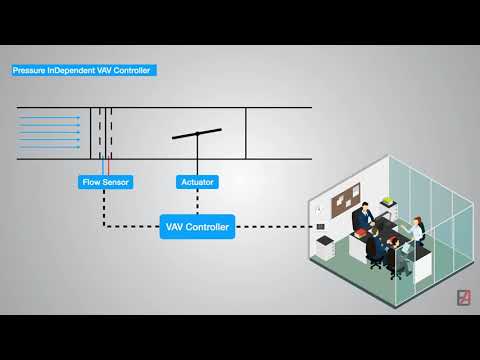
[3:48]As seen earlier, the pressure independent VAVs have a air flow measuring device, which measures the air flow in real time.
[3:55]By monitoring the air flow, the VAV unit will know the change in system pressure, and thus reacts immediately to compensate the deficiency in air flow by opening the damper, which in turn maintains the room temperature set point.
[4:09]The pressure independent VAV does not wait for the room temperature to rise and then react, but it has a proactive approach which keeps the occupied space comfortable.
[4:19]Since these VAVs performance is not affected by the change in system pressure, these type of VAVs are called pressure independent VAVs.
[4:26]Just to recap, the pressure dependent VAVs do not have air flow measurement and pressure independent VAVs are provided with air flow measurement.
[4:32]The pressure dependent VAVs are dependent of system pressure and pressure independent VAVs are independent of system pressure.
[4:40]In this video, we will be looking into the pressure independent VAV terminal units.
[4:46]As seen earlier, this VAV units have an air flow sensor at the inlet of the VAV, a VAV box and a damper with actuator.
[4:54]Here, the damper actuator is an integrated VAV controller with flow sensor.
[5:01]This type is called an integrated VAV controller. In earlier days, these functions come as a separate unit, that is, a VAV controller, a damper actuator and a flow sensor.
[5:09]The controller gets feedback from the flow sensor and outputs to control the damper actuator.
[5:14]In modern VAV controllers, all these functions are integrated into one unit, which provides a much simpler installation and precise air flow measurement and control.
[5:26]The critical component of a VAV unit for the better performance is the air flow sensor.
[5:30]With an accurate air flow sensor, there will be an accurate measurement of air flow, which leads to better temperature control, less hunting with lesser temperature variations, and more energy savings.
[5:42]Since air flow measurement is the key parameter in VAV control, as per ASHRAE fundamentals, an average pitot tube is used for measuring the duct air velocities, which has a very high accuracy in air velocity measurement.
[5:56]An averaging pitot tube uses a concept of differential pressure measurement to calculate the air flow.
[6:01]The pitot tube has one or more small openings that face the air flow.
[6:06]It senses the total pressure and static pressure in the duct.
[6:09]The tube facing the flow direction measures the total pressure and the two facing opposite to the flow direction measures the static pressure.
[6:17]The difference between the total pressure and static pressure is the velocity pressure, and based on the area of the duct, air velocity is calculated.
[6:27]Thus the actual flow rate of air passing through the VAV unit is measured by the controller.
[6:32]Another important component is the VAV box, which must be designed for lesser pressure drop that will result in less energy consumption of the AHU fan.
[6:40]Next is the noise level, which is controlled by designing the VAV box properly.
[6:47]Final component is the room thermostat, which is used to measure the actual room temperature and also to set the required temperature by the room occupant.
[6:54]The VAV controller, which is the brain of the VAV unit, reads the actual room temperature and the set point from the room thermostat, then calculates the temperature difference.
[7:03]The VAV controller then uses PI controller to modulate the damper to achieve the required set point in the room.
[7:10]If you want to learn in detail regarding the PI or PID controller, I recommend you to watch my video on the PID control system.
[7:20]If you have seen my earlier video on the control system, you will recognize this block diagram of a feedback control system.
[7:26]First, see the control system of a pressure dependent VAV controller.
[7:29]Here, the VAV controller gets room temperature set point and actual room temperature feedback from the room thermostat.
[7:36]Then the VAV controller actuates the actuator to open or close to maintain the space temperature by varying the amount of air flow to the space, which is a pretty simple control.
[7:46]However, the pressure independent control is little complicated.
[7:50]It uses a cascade control system, which uses two different control loops.
[7:54]The first control loop is the temperature control loop.
[7:57]The temperature control loop calculates the error between the room temperature and the set point.
[8:02]The output of this control loop is fed into the next control loop, which is the flow control loop.
[8:06]The temperature loop outputs a range of 0 to 100%, which corresponds to the minimum and maximum air flow set point values.
[8:15]The flow control loop measures the air flow from the air flow sensor and calculates the difference between the actual flow feedback from the flow sensor and the range set point from the temperature control loop, which actuates the actuator to open or close to eliminate the air flow set point error.
[8:33]Each pressure independent VAV has a minimum and maximum air flow limits that are preset at the factory based on the decent parameters and ASHRAE recommendations.
[8:43]However, in most cases, the minimum air flow set point is set at 30% of air flow and maximum air flow is set to 100%.
[8:50]Maximum and minimum air flow limits are the most important parameters for a pressure independent VAV to maintain a proper air distribution to the space.
[9:00]As you can see from the graph, when the room temperature rises, the damper will open more to allow maximum air flow to the space.
[9:07]And when the room temperature is achieved, it supplies minimum air flow to the space.
[9:12]The maximum value in the VAV controller ensures that the space is not overcooled when the temperature difference is higher, and the minimum value ensures the room is properly ventilated as required in the design.
[9:23]Pressure independent VAV ensures proper air distribution to the spaces, more specifically, pressure independent VAVs are allow you to feel comfortable since the specified design parameters are maintained by the unit.
[9:36]That's all for today's video. I hope you guys have learned something useful from this. And thanks a lot for watching this video.
[9:42]If you like the contents of this channel, please consider subscribing to our channel and click the bell icon to enable notifications.
[9:48]As always, please leave your feedbacks and suggestions in the comment section.
[9:54]Also, like this video, share this video with your friends and subscribe to our YouTube channel. Thank you.


