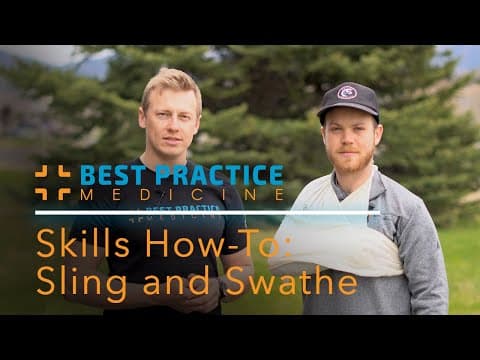
[0:06]Hi. My name is Miles. Welcome to Best Practice Medicine TV. Today, we're going to be talking about extremity splinting, specifically shoulder mobilization using the sling and swath method.
[0:28]Extremity splinting is an important skill for all EMS providers, especially those working in the back country setting, such as wilderness first responders or ski patrollers. Effective immobilization will reduce patient pain and decrease the chance of additional injury during transport. The sling and swath is used to immobilize injuries of the shoulder and upper and lower arm in order to take weight off the affected tissues and may bring anatomy. The standard sling and swath is built using two triangular bandages or cravats and consists of two parts. A sling, which serves to take the weight of the injured extremity off of the shoulder joint and a swath, which binds the injured extremity of the patient's body further stabilizing it. As with any extremity splinting, the first step is to manually stabilize the injured extremity. Can you hold your arm there for me? and to obtain an initial set of CSMs. Checking for a pulse. Sensation, what finger am I touching? My thumb? Can you wiggle them for me? Awesome. To construct your sling, first, you need to make a pocket by tying a knot in the right angled corner of your triangular bandage. The size of knot you tie is determined by the length of the patient's forearm. A longer forearm will require a smaller knot and a shorter forearm will require a longer knot. The corner of the triangular bandage that's resting against the patient's body should go straight up to the shoulder that sits above the hand of the injured extremity. This form a suspension line and help adequately support the extremity. The side further away from the patient's body is then wrapped up over the opposite shoulder, binding the pocket and effective even tensioning of the splitting material all the way across. Once the splinting material is properly positioned, prepare to tie a knot around the patient's back. Before you finish your knot, pull up on the splinting material in order to effectively take the weight off the extremity. You don't want to displace the shoulder so much that it causes the patient unnecessary pain, but by pulling a little extra tension, will account for slippage in the knot and stretching and sagging of the material. It's best to warn your patient that this step might hurt a little bit, but it'll make them feel better, increase their comfort right away. Once the sling has been applied, the next step is to immobilize the extremity of the patient's body using a swath. Surface area is your friend here, so a wider swath is better. Position the swath material over the patient's arm and prepare to make a knot at the patient's back. Before you tie your knot, ask the patient to take a deep breath for you to make sure you don't restrict their breathing. Big deep breath, hold it. Awesome.
[3:33]Okay, you can let it out. After the swath is tied, dress it to make sure it's effectively immobilizing the extremity to patient's body.
[3:48]Wide coverage over the elbow and the hand, leaving the narrow parts on the patient's back where it's less sensitive and less likely to bite in. When practicing, test the effectiveness of your swath by asking your helper to bend over forward and see if his arm swings away from his body. Feel like you're swinging away? Nope, I'm pretty secure. Tight in there? Yeah.
[4:15]Cool. In order to be effective, a sling and swath should keep the patient's extremity immobilized without dislodging, shifting, or sagging, despite bumping, jostling, or bouncing.
[4:32]After splinting the extremity, recheck the patient's circulation, sensation, and motion in the injured extremity. Radial pulse. What finger am I touching? My thumb. Wiggle them for me? Great. Thank you for joining us on this beautiful Montana day. I hope you learned something that was informational and useful to your clinical practice. Tune in next time for more educational content from BPM TV and as always, thanks for watching.


