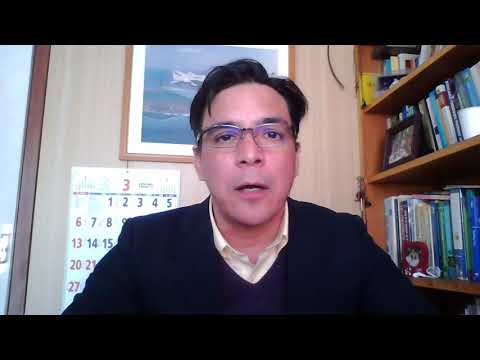
[0:01]Well, hello. I'm Dr. Grant Osterman. And as you can see behind me, uh, this is early in March. It's the first video uh, in a series of videos I hope to create uh to help you navigate and enjoy easy English expressions, uh, the textbook. And, um, based on these videos, I also will plan on giving, uh, some questions and doing some listening activities and things in class, uh, to make it more interactive, more fun. Now, a lot of things I want to cover today, but, uh, first of all, in this first short video, uh, I'm going to try and keep the all the videos short, so you're not overwhelmed, uh, no more than five, 10 minutes, maybe. Uh, and you can always go back and listen again and again and again to absorb the, the things you didn't absorb the first time through. So, we're going to start off with lesson one, which is getting to know each other. One of my favorite topics, and I always like to start off lessons like this, where students get to know me, I get to know them, and everyone gets to know each other in the classroom. And as you notice in the lesson as it starts off, they'll give you a useful expression section. They'll give you the vocabulary and different types of words and phrases you should be using, uh, in the classroom and out of the classroom to help you improve your English. And then we start with a series of warm-up questions, three to five, sometimes six, uh, basic simple questions to get you to transition from your, uh, working life, uh, daily life as a college student, uh, as a student, high school student, or as an adult, um, working, uh, using more predominantly Japanese and now transition into English. So, it's kind of like a one-step, uh, to get you into the English mode. And then we'll go on to the speaking practice where it's a good opportunity to, to actually use some of the vocabulary and the useful expressions in a natural way. And, uh, you'll see at the bottom of the, the page three, where they give you a section, some lines where, in that section is where I want you to to throw in your own questions, create new questions, experiment with the language, and then bring it to class and we can do it together and enjoy, uh, some, some interesting topics and conversations. Then we go into the extension section, uh, where you will, um, extend the language even a little more detail. As you see at the top, questions like, what do you do? Talking about your occupation, are you a student? Uh, are you a lawyer? Are you a truck driver? Uh, and you can extend those to different forms, for example, what is your occupation? And in English, we often use different phrases to mean and to ask the same thing. So, this, this section will help you get familiar with that sort of, uh, uh, speaking technique. And then we go on to what I think.
[3:26]Now, the what I think sections might be difficult for Japanese at the beginning, but I hope by the end of the book, after the 15 lessons, you will be much better at giving your opinion. And you always have to remember to respect the other person's opinion and that they will respect your opinion, and it is your opinion. So, there is not not necessarily a right and a wrong, but an opinion that I want you to explore. Then, uh, each, uh, lesson will have a presentation section. Now, this is a great opportunity for you to actually use the English in a natural way and present yourself, uh, on some topic. Now, the first topic related to getting to know each other is I want you to, to think of yourself in a lot more detail and introduce yourself using new phrases or words. Not just your name and your age, where you live, you should already have mastered that sort of, uh, uh, conversation. But rather you see an example here, I actually use myself as an an example. It says, I'm ambitious, competitive, and outgoing. So, try to explore new vocabulary throughout the week, look in the dictionary, find new words and phrases and try to bring them to class to use. And then, uh, the section will end with, uh, free talk. And here is a series of questions where we kind of put everything together and towards the end of the lesson, if you have time, sometimes we're not always time to do it in the first lesson, where you can ask, continue to ask questions, continue to get to know your fellow students, your teacher. Um, I often like to have the whole class, uh, ask these questions to me or to other classmates, and we can have a group discussion about that. And then, uh, sections will, will come with idioms, maybe grammar points, things like that. Uh, both the grammar points, the idioms, and at the very beginning, the vocabulary used for expressions section is something I would like you to do outside of class where you can, um, look up the Japanese if you need to, um, feel comfortable with the word, know what the words mean and the phrases. Basically how to use them and then come to class and actually do that. That would be the beauty of the textbook where we can do things a little bit of work. I'm not going to overwhelm you again, but a little bit of work outside of class so that when you come to class, we can use our time wisely and actually practice with communication. Now, in a nutshell, that's the book, uh, the, the basic layout of the book and how it will go. Um, there is often times where students will have questions for example, uh, on page, uh, four, what I think. You will see a section where, um, questions one and five are often confused as being similar. Well, they are actually similar, but let me give you a, uh, help you explain, uh, a slight difference between the two. So number one says, uh, you could use it when or what is the best time to get married? Well, time is the key point and compare that to question number five, where what or when is the best age to get married? Now, the difference is that with time, we're referring to like a period of time. Uh, do you want to get married in the spring, summer, fall, uh, afternoon, morning, or even before your younger sister gets married? Anything like that. Uh, a period of time is what we're looking for there. And the difference in five, meaning an age where we're looking for a number. Do you want to get married at 25, 28, 35, 40, 50? That's what we're looking for in that's a slight difference between the two. And some of my students in the past have brought this question up. It's a great question, and often, uh, us native English speakers take this for granted, and we do not, um, uh, understand the difference, or we have a tough time to explain it. So, I hope that helps you, uh, to not only understand that specific section, but probably more importantly to be inquisitive, to ask questions about the textbook. Get to know, uh, more details of the textbook. Uh, and if you have anything that you would like to bring up, class is always a good time. Um, you can always email me. You'll see the my email address at the on the back of the textbook. Please feel free to email me, and again, uh, I hope to create a lot more of these videos where we can interact sort of, uh, asynchronously, uh, outside of class, and you can learn, uh, more vocabulary and, and in a more natural context. So, it's been great talking to you. Um, it's a beautiful sunny day here in Okinawa again. Uh, looking forward to the spring, the new term starting up in April and working with you on improving your easy, easy English expressions. Thank you and have a great day.


