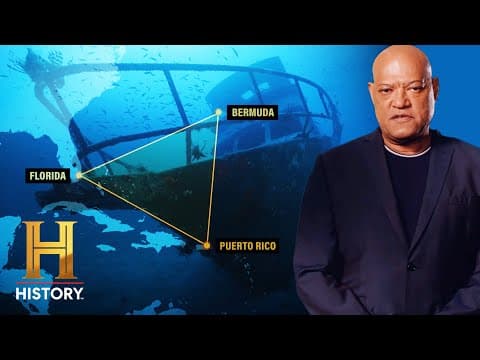
[0:00]In 1800, the USS Pickering disappears on route to Delaware carrying 90 people. In 1814, the USS Wasp vanishes along with 140 passengers. And in 1921, the Carol A Deering is lost and ultimately found abandoned near North Carolina. But the actual location where the vessels go missing isn't defined until 1964. Journalist Vincent Gaddis catalogued some of the strange goings on in an article. And he finally comes up with a name for this mysterious area. He calls it The Bermuda Triangle. The Bermuda Triangle covers about 500,000 square miles of the Atlantic Ocean between Florida, Bermuda and Puerto Rico. It has claimed numerous victims. As the losses have piled up, the area has become infamous, legendary worldwide even. Everyone knows about the Bermuda Triangle, but yet nobody knows what's going on over there. There have been a number of different theories. One of the earliest comes from Christopher Columbus. Columbus is actually one of the first Europeans to cross through the Bermuda Triangle in 1492, and wouldn't you know it, he almost immediately encounters a problem. The Santa Maria and her sister ships get stuck in an abundance of algae, which, in Columbus's diary, he refers to as weeds. The ships are stuck for three days and the sailors become paranoid and panicked. They fear running aground or being tangled in the weeds and being dragged to the ocean floor. The crew would eventually manage to cut their way out, but they remain convinced that this is a dangerous area. All thanks to highly unusual seaweed.
[1:55]What Columbus and his men call weeds, scientists eventually name Sargassum, from the Spanish word Sargazo, meaning seaweed. The area ultimately becomes known as the Sargasso Sea. The Sargasso Sea measures about 700 miles wide and 2000 miles long. It takes up about two-thirds of the Bermuda Triangle and is full of these dense mats of Sargassum. If you get stuck in it, the Sargassum wraps around the rudder, so you can't steer. And barnacles begin to grow on the ship, slowing it down. But getting stuck is just one small part of the problem. When Sargassum groups together and begins to rot, as it decomposes, it produces hydrogen sulfide gas. This gas smells really awful, like rotten eggs, and it's toxic. If you breathe in this hydrogen sulfide, it can irritate your eyes, your nose, and your throat, but it can also cause some serious psychological issues if inhaled for an extended period of time. Possibly even insanity. Obviously, just getting tangled in the seaweed could explain a disappearing or a wrecked ship if it's stuck out there for long enough, but when you take into account this psychological effect, this might explain the wilder Bermuda Triangle stories.
[3:15]The problem is, this doesn't solve all the mysteries of what's been going on here. Could another sailor's tale offer a different explanation? It starts off as something of a legend among weather-hardened sea-weary sailors. As they share stories over a pint in the pub, you may hear a tale of some enormous wave, as big as a mountain, capable of destroying a ship, sweeping away its crew, or just swallowing it whole. The proof comes on New Year's Day, 1995. About 100 miles off the coast of Norway, there's an oil drilling platform called Draupner. In addition to its main equipment, it contains a whole slew of instruments that can monitor wave height, slope, acceleration, etcetera. On January 1st of 1995, a laser rangefinder on the bottom of this oil drilling platform measures a wave headed for the Draupner. The Draupner Wave, as it becomes known, seems to come out of nowhere and measures 85 feet high. It has characteristics that don't fit any previous wave model. Researchers have found that rogue waves differ from regular waves in a few ways. First is that they are greater than twice the size of surrounding waves. These things are massive, and they are also notoriously unpredictable and arise unexpectedly from directions other than the prevailing wind. So, these things could potentially come from anywhere. These rogue waves, because they are so gigantic, so tall, so steep and moving so quickly, they can carry up to 16 times the amount of force than a regular wave. And in fact, the bigger the ship, the worse you fare when it comes to rogue waves. Because these rogue waves, they don't come on slowly, they're not giant wide things. They're very sharp, they're like cliffs of water, and so when a ship encounters a rogue wave, it gets sent straight up the side of the cliff and then when it reaches the top, it teeters over and slams back down into the water. But scientists still aren't certain what causes them. One idea is that they're caused by constructive interference. This is when different waves travel at different speeds and start to pile up on each other. Constructive interference can occur when huge storms converge from multiple directions at once. The Bermuda Triangle is well known for such storms. The triangle is right in the middle of Hurricane Alley, where storms from the North and the South can come together. If there's a third storm that comes in from Florida, forget about it. You've got the recipe for a deadly rogue wave. This still doesn't explain every incident. Ships aren't the only things that have disappeared here. What about all the airplanes?
[6:17]Methane itself is a colorless, odorless gas. You might be familiar with methane as natural gas to heat your home. But in very special cases, especially at the bottom of the ocean, these pockets of natural gas can get so compressed that they turn essentially into an ice, into a form of solid. If the sea floor cracks or that ice gets pushed up to touch the water, an exceptional amount of gas can be released. The gas heats up the surrounding water and surges quickly to the surface. Methane is highly flammable, so the intense heat from the plane's exhaust could cause a massive explosion, enough to blow the plane to smithereens. If true, this story could also explain the triangle's lost ships. When the gas explodes underwater, it creates this giant sinkhole at the surface. Think of a toilet flushing with extreme force. The suction created from the blast would suck any large object down below the surface, never to be seen again. Over the last 500 years, the Bermuda Triangle has claimed some 8,000 lives and hundreds of ships and airplanes, none with a definitive cause. But in 2019, a shocking new theory emerges, thanks to a scientist who experienced a surprising event in the area. Bermuda is a volcanic island, like Hawaii and many others. But researchers have discovered that Bermuda has one major difference. Most lava comes from about 20 miles deep, but the lava that formed Bermuda came from a whopping 400 miles below the surface of the Earth. That's immensely deeper and obviously much closer to the Earth's core. This is entirely unique to Bermuda. This geologic feature turns out to have surprising consequences. Because this volcanic rock in and around Bermuda originated so deep within the Earth, it has a heavy concentration of a mineral called Magnetite. In fact, Bermuda is 18 to 20% magnetite, nearly 20 times more than typical soil. Magnetite is the most magnetic naturally occurring mineral on the planet. And this is what could be making so many ships and airplanes go haywire in the triangle.
[8:37]In other words, Bermuda is basically a giant magnet. This phenomenon can be pretty easily demonstrated. If you pass a compass over a small amount of Bermuda's magnetite-rich limestone, it can throw it off by several degrees. And that's just one little rock. There's 500 billion tons of this stuff in the Bermuda Triangle. So just imagine what that could do. Without a trustworthy compass, ships could easily veer off course and crash into the rocks. But what about planes? Planes would have problems with not only their compass, but also their altimeter readings. A pilot could get quite disoriented and potentially make a fatal mistake. According to one pilot, Magnetite could also be powerful enough to generate a literal cloud of magnetism. In 2017, Bruce Gernon published a book called Beyond the Bermuda Triangle. In it, he recounts many pilot stories saying they've been in this electronic fog. Until the modern advent of GPS navigation, the compass is the tool that enables travelers to accurately navigate the globe. It does this by always pointing in a constant direction, magnetic north. It can, however, be instantly rendered inaccurate by the presence of a strong magnet. According to Gernon, electronic fog is like a grayish cloud of electromagnetic fields that form above the ocean. It can appear out of nowhere and completely engulf an aircraft. Gernon himself says he experiences this phenomenon while flying through the heart of the Bermuda Triangle. His airplane is suddenly surrounded by a strange fog that he can't break through. It seems to stick to his plane and he experiences the sensation of zero gravity as it propels his aircraft forward. According to Gernon, once he's out of the triangle, the cloud disintegrates. When his instruments work again, he realizes that he just traveled 100 miles in only 3 minutes and 20 seconds. He landed 30 minutes ahead of time. The fog practically teleported him. Gernon and the others he cites in his book believe that the natural magnetism in the Bermuda Triangle may be giving the droplets within the fog an electromagnetic charge. If this is true, then those droplets would naturally be attracted to anything they encounter and once they're attached, they're dense enough to carry a vessel right along with them. We generally talk about the Bermuda Triangle like there's only one explanation for this mystery, but given the numerous disappearances across more than 500 years, there's absolutely no reason why it needs to be only one of these things. There's a combination of deadly factors that are existing here. One day we may finally get some substantial evidence or capture a video of a destructive rogue wave or of the mysterious electronic fog, or, I don't know, maybe a wormhole open up right over Bermuda for the whole world to see. But until then, I think it's best not to limit our minds to what the Bermuda Triangle could or couldn't be. Because there could be a new scientific explanation next year. The possibilities are endless, and that's what's kept people fascinated by the Bermuda Triangle for so long.


