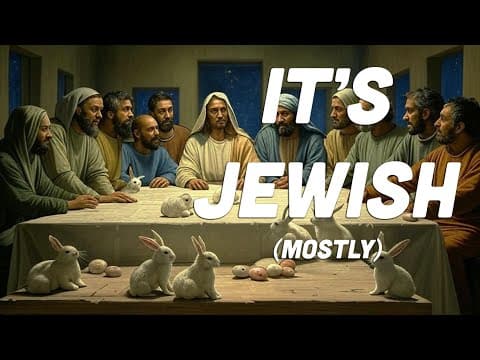
[0:14]To know where Easter comes from, you need to know two things. The first is you need to know about Passover, which takes us back more than 2,000 years ago to ancient Judea. And here the Jewish people observed Pesach, or Passover, a festival rooted in the Book of Exodus. Passover commemorated the liberation of Israel from slavery in Egypt. The story of divine deliverance marked by the blood of a lamb smeared on doorposts, sparing the firstborn from the angel of death. Each year Jews gathered to eat unleavened bread, bitter herbs and the Passover lamb, retelling the story of their Exodus. By the first century AD, Passover was now a major pilgrimage event. Jerusalem would swell with worshippers streaming in from all across Judea, exchanging of money, the buying of sacrificial animals, and prayers in the Temple courts. And it was during one such Passover, around 30 or 33 AD, when the second part of the origins of Easter occurred. During that Passover, a man named Jesus of Nazareth entered the city. He was known as a teacher and a healer, but to his followers, Jesus was the Messiah, the anointed one, promised to deliver God's people. And his arrival coincided with Passover, and that was not a coincidence. The Gospels, Matthew, Mark, Luke and John, tell us that Jesus shared a final meal with his disciples, a Passover seder. Only he reimagined what Passover is. He broke bread and called it his body, and he poured wine, naming it his blood. And he offered a new covenant. Within hours, he was arrested, tried, crucified, dying at Golgotha, while Passover continued down below in Jerusalem. Three days later, the gospels tell us, Jesus arose from the dead, what Christians call the resurrection. Okay, pause there. The story I've just told you, those two pieces, is the true origin of Easter. Now, it's not the name we call it, nor is it the origin of all of the traditions of Easter that we have layered upon this holiday ever since. But this is the practice or the origins of Easter. Easter, in other words, is Jewish. And for some of us, that Jewish background is foggy. While others may be familiar with Passover and the Lord's Supper, but they have questions about all of the rest of Easter and where it comes from. But we have to start here. Easter is Jewish. And if I can offer just a little hot take, the attempt to see Easter as just a pagan dressed up festival is often, I find, at root just to gin up antisemitism. And I'm not being flippant when I say that. There are scholars of old, many of them German, who sought to unmoore Jesus from his Jewishness. They didn't like the fact that Jesus was a rabbi, that he was thoroughly Jewish, that he walked the streets of Jerusalem. And that, therefore, what he's doing at Passover, as he is establishing the Lord's Supper, is a very Jewish thing. So to say Jesus is less than Jewish, is the kind of miss the point of Easter. I mean, just picture it. Jesus and his disciples, 13 folks, all Jews, gathered at Passover, used to the history of that tradition. And Jesus said, break this bread, drink this wine, and do this to remember me. And so, perhaps, just perhaps, those Jews in the room continued to do that to honor the sacrifice of Jesus. Just to put it simply, there are no Gentiles in the room. This is a Jewish thing. No talk about Acadian or Samarian deities named Ishtar, no concern about springtime festivals or rabbits or bunnies and certainly no eggs. So Easter, in other words, is not a borrowed myth. It's actually coming directly out of Passover. And for the earliest Christians, Jesus death and resurrection were seen as inseparable from the Jewish Passover. They saw Jesus as the ultimate Passover lamb, the sacrifice that transcended the old law. They even do this in how they name it in Greek. For centuries, Christians always referred to Easter as Pascha, which is the Greek translation of the Hebrew Pesach. It's not exactly spaghetti pizzaghetti, but that might help you remember it. While Passover celebrated the physical liberation of Israel, Pascha, or Easter, proclaimed that the physical liberation of God's people would come, but for now Christ had brought spiritual salvation and a command to go and make disciples. So that's it. You have early Christian Jews seeking to commemorate Jesus sacrifice during the time of Passover. Now, if you just stop human history at that point, that's it. But there's one key issue, is that for the Christian church, it will not remain Jewish, but they will begin to convert Gentiles into the faith. And so, for the first time, Passover, which had been exclusively Jewish, probably at best only loosely understood or appreciated by anyone outside of the Jewish faith. Now, because of the Christian expansion into Gentile territories, you have all of these new folks, non-Jewish folks, with all of their traditions and things, start to come into the church as well. So this exclusively Jewish Passover now becomes as the Christian Church goes throughout the world, an almost universal expression of the extension of Passover through Pascha, or Easter, in the Christian Church. That's it. Okay, so I hear you ask, but where do all the bunnies, eggs, vernal equinox, Ishtar, Eostre, where does all that come from? Well, let me tell you that story.
[6:09]In my experience, there are three things that people want to know when it comes to Easter. One, why are there so many different dates? I mean, this year alone, Passover, Eastern Orthodox Easter, and the Western, meaning the Protestant and Catholic Easter, are all falling on different dates. That's weird. Secondly, why is it called Easter, and is it related to some pagan fertility deity of some kind? And third, what's with the bunnies and the eggs? So those are kind of the three big questions. Now, first, when it comes to all this dating and calendar stuff. Okay, listen, okay. I'm going to go on a rant here just briefly about calendars. You see, in the ancient world, unlike today, calendars are a bit of a hot mess. Or at least they can be tricky. You see, we're very used to in our modern age of having one calendar and a standard time. When our phones update without any problem. In the ancient world, it is not quite that easy. Let's just start with one fact. You could have a lunar calendar or you can have a solar calendar. And in this case, as we'll see in a minute, the Jews follow a lunar calendar, and the Roman world follows a solar calendar. And then you add on top of that, the occasional likelihood that people are going to date their own calendar wrong, meaning they'll get the math wrong. And that is actually something that happens. You see, there was a Julian calendar named after Julius Caesar, from the Roman world. And it was a solar calendar like I just said. The problem is, is that it was off by about 11 minutes. And so slowly, over time, the calendar got off. So much so that by the later Middle Ages, the calendar was off by about 10 days. I mean, if you think people were weird doing a pandemic, have them wake up and tell them that you've somehow misplaced 10 entire days of their life. Just to see what happens. I mean, it was a bit of a consternation. And so finally, in the 1580s, Pope Gregory reforms the calendar as we know it. And it is now called the Gregorian calendar. And with some slight modifications, it's the calendar we still use today. It's got the leap year built in, all this type of stuff. But if you go back to the ancient world, it is very common to have disputes over the dating of important events. And that is a bit of what happens here. And you do, by the way, see some of this in the New Testament itself when you're looking at early Christians. The Apostle Paul, for example, critiques those who are complaining about new moon Sabbaths. That that's this kind of thing. It's this dating of the lunar calendar and which Sabbath is the most important, this kind of thing. Paul's like, y'all settle down, stop debating all of your calendar calculations. So one of the important things with the date that is about to happen, is that the lunar versus solar issue is going to come into play. But there's one more wrinkle here that is almost never discussed when it comes to Easter. You see, in most textbooks and in most popular accounts, you start with the Jewishness of Easter. And then people jump all the way to 325 AD and the Council of Nicaea. And they point out that at this council, the date of Easter was officially enshrined. And that's fine, and we're going to talk about that. The problem with that, though, is that narrative makes it sound as if Christians had nothing to do with the dating of Easter for several hundred years. And then along comes Constantine, and he just ruins it. But when it comes to Easter, Constantine didn't start the fire. You see, by the second century, there was actually a very, very important fight over the dating of Easter in the church. Believe it or not, it's actually one of the biggest and the loudest fights in the ancient church that we have on record. It predates Arius and other fights that people are more familiar with. This fight, the dating of Easter, actually gets going in the church within about two or three generations of Christians after the time of the Apostles. It is really early. Which again goes to the point that I was just saying that the church from the beginning was always concerned about commemorating the death of Christ around Passover. Now, what most Christians did, most churches did, is they celebrated Easter according to a very specific calculation. The early church again, the majority of them would have Easter on the first Sunday after the first full moon of spring. What we today call the vernal equinox. And this view was eventually standardized. The majority opinion was get close to Passover, and then move the celebration to the next available Sunday. The exact date, in other words, is not important. Having the service on Sunday is. But there arose a controversy with Christians down in Asia Minor, or modern-day Turkey. They did things differently down there. This group of Christians was known as the Quatordecimians. That is quite a mouthful. I will probably mispronounce that. You will probably make fun of me in the comments for mispronouncing that. But the Quatordecimians, it comes from the Latin, the 14ers, the Quatordeci. And these believers insisted that Easter must be celebrated on the exact same day as Passover, the 14th of Nissan, it was called. Regardless of what day it falls on. So you have to understand, with their argument is, Easter must coincide at the exact same time as Passover. They wanted to keep the old tradition, that Jesus held the Last Supper during Passover. So we must commemorate that during the same Passover season. The issue for folks, the majority of folks, was that it made no sense to them to have the Easter service on a Tuesday or a Thursday. Move it to the next available Sunday, and all is well. So you have to understand this issue, Quatordecimians. It's not just a scheduling quirk, it's actually a theological divide. The Quatordecimians saw their issue as going back to the original intent of the apostles. They argued that sticking to the Jewish dating of Passover, honor that historic tradition. But people that were the majority, people like Bishop Victor of Rome, said no, we're going to do Easter on Sunday. The Quatordecimians were often accused of being too rigid. So again, notice, Christians are arguing about the date of Easter. And it actually comes to a head. At one point, Victor of Rome threatens to excommunicate the Quatordecimians. It turns into a whole fight, it's like, no, your date is wrong, no, your date is wrong. And at the end of the day, Irenaeus stepped in, a very influential theologian in modern-day France in the city of Lyon. And he urged peace. And he pointed out that this difference of dating, this difference of following the Passover style or following the new Christian style, had been allowed and tolerated from the beginning. It was essentially, it whichever one you prefer, that's fine. It's not an essential issue, no reason to break fellowship. And that was the final word at that point. And then, finally, much later, after more fights and at least some accusations back and forth, in 325, the Council of Nicaea is called. Constantine's only command on Easter at this point was to solve the already existing fight. So this claim that Constantine just decides to make Easter some new pagan festival, ignores the fact that Christians have been fighting about this already for centuries. Constantine's point is, y'all cut it out, get on the same page. You're all in the same room. This is the best time to figure out how you're going to do it. And the Council of Nicaea did two things. One, they ruled pretty much unanimously in favor of using the Sunday formula. And Easter would occur after the first full moon following the vernal equinox. Which means that now officially, the church is going to date Easter independent of the Jewish Passover. And the problems don't stop there, because eventually the differences between the Julian and the Gregorian calendar rear their head in the 1580s. Because to this day, the Eastern Orthodox Church still uses the old Julian calendar, the one I was just describing that was off by 11 minutes. Meanwhile, the West, Protestants and Catholics, now use the Gregorian calendar. So you can have all kinds of weird dating, and yes, it can be a little confusing. It's just the calendars, y'all. That's all it is.
[14:24]Okay, if that's the dating of Easter, what about the name? Well, as I've said, the Christian name for centuries was not Easter, but it was always Pascha. Which is why you see Jesus often called the Pascal Lamb, or Easter referred to as Pascaltide. Well, the answer as to where the name Easter comes from, is it comes from the Germanic lands. And please understand, Germanic does not mean Germany, modern Germany. It means basically northern folks, the folks above the Ryan. So when I'm talking about the Germanic lands, I'm talking mostly about modern Germany, France, and the Netherlands and those regions. Because it's there that the name Easter comes. So as Christianity spreads up in Northern Europe, it encounters local customs, spring festivals honoring fertility, renewal, and the cycles of nature. If you saw my video on Halloween, you're going to be familiar with what's about to happen. Essentially the Catholic Church's position in the Middle Ages is that the church will bring in festivals or seasonal type things as long as it's tied to nature. So, harvest festivals, things related to the soil and the seasons, that was all fair game. If it was part of a pagan ritual, the Catholic Church's position was, well, let's put something Christian in its place. For the Catholic Church, that, by the way, was seen more as conquest than accommodation or syncretism. It's basically the takeover. Now, in the Germanic lands, the springtime was named Easter, and as a result, Easter is what we call it ever since. You've probably heard the claim that the Scandinavians or the Germanic folks worshiped a deity by the name of Eostre. And to our ears, that sounds like the word for Easter, right? And you've probably heard something like this. The goddess Eostre was a spring fertility goddess, and Christians, during the Middle Ages, co-opted that season, and sort of made it the Easter time to celebrate the resurrection of Christ. That it was somehow an accommodation. Hey, these folks are worshiping the resurrection of nature. Let's just include this as part of Easter, so you have this mingling of pagan and Easter times. Well, that doesn't pass the eyeball test again because as we've already said, there were three or four centuries of arguing about the dating of Easter related to the vernal equinox. So Christians were already there when it came to springtime celebrations. Now, what's interesting about this Easter question, the naming of Easter, is that I rarely find anyone who wants to stop and say, well, where did all of this come from? Can you give me the hard data? If there is a goddess Eostre, I want to see inscriptions, I want to see burial sites, I want to see all types of archaeological evidence. Or I want to see this in hymns and heroic sagas from these lands as well. We know a great deal about their mythologies. So if Eostre is that important, let's go find the original sources. The problem with that is there are no sources. The only place, literally the only place where Eostre is mentioned, is from a Christian source by the name of the Venerable Bede. In his book, De Temporum Ratione, or the reckoning of time, Bede is the one to suggest that there was a deity by the name of Eostre, and that that is where the name for Easter comes from. Now, it's important to say this. Bede is a very important figure in the history of literature. His historical research, though, was spotty. Historians love and hate Bede in equal measures. He will just as much tell you something that we have later found to be true, and he will often repeat tall tales and legends that we know are simply not the case. In this case, one would think that if there was this important goddess being worshiped, that at some point in the archaeological evidence or in the literature, we would see actual folks in these dramatic lands mentioning or praying to or doing anything in relationship to Eostre. Well, we don't have it. So all we have is this stray comment by Bede. And here is the comment, by the way. Eosturmonath has a name which is now translated 'Paschal month,' and which was once called after a goddess of theirs named Eostre, in whose honor feasts were celebrated in that month. Now they designate that Paschal season by her name, calling the joys of the new rite by the time-honored name of the old observance.
[19:05]That's it. That's all we have. And just looking at the quote objectively, all Bede is saying here is that there used to be a month called after this season. He refers to some deity that used to be worshiped, a deity we haven't discovered in the archaeological record since. But he says that she's worshiped. But he points out, it's just the naming of the season, and the new right, as he says, is being performed. In other words, it's Bede from which all of this Eostre stuff comes from. Bede's comment was actually later picked up by no less than Jacob Grimm, one of the Brothers Grimm, those who gave us all the Grimm's fairy tales. And the Brothers Grimm are really important because they are essentially linguistic historians. And some of the best in the world at this. But Jacob Grimm especially was very interested in codifying and writing down German ancestral traditions. And so Grimm noticed that Bede mentions this Eostre in his Deutsche Mythologie, German mythology from 1835. And importantly, Jacob Grimm says, we don't know anything about this Eostre. We don't know if this is a deity, or perhaps it's just a personification of the East where the sun rises. And Grimm goes on to suggest that, well, if she is a goddess, then perhaps all of these spring fertility seasonal things was the source of later Easter customs. Grimm, though, himself admitted that there is limited direct evidence for the worship of Eostre, beyond Bede's stray comment in his book. So there's a lot here and I'm not going to go too deep into it. But needless to say, a speculative comment by Grimm carried a lot of weight. But there is actually very little evidence of this existing, at least we have no clear indication if there was a goddess named Eostre, who was she? And besides, all Bede's comment is, is that this is where the name Easter comes from, despite the fact that for centuries, the church always referred to it as the Paschal Tide. So that's where Easter comes from. More on that in a second when we get to bunnies. Even less historically accurate is this story of Ishtar, which is the Sumerian deity worshipped 3,000 years before the time of Christ. You see, there's this again, somewhat trolly comment that's often put out there that Ishtar was this goddess of resurrection. And that she, because Easter sounds like Easter, again, is the origins of Easter. I really don't have any time to go into that. It's so obviously fake, because what I just read to you, Venerable Bede, saying, I know the origin of where the word Easter comes from. And unless Bede is reading Acadian and Sumerian texts from the ancient world and deriving his mythology from there, and then pretending that that mythology is actually from Eostre, the Ishtar stuff makes absolutely no sense. First of all, that's not what her name was. It was also she was also called Inanna. There is no connection at all between Ishtar and Easter. There is a connection between Eostre the name and Easter, but as we just said, it's a one of the name, not of a religious perspective that's carried on. And my point here is not to make a largely argumentative point about Easter. All I want you to know are the facts. The dating and naming of Easter began as a Jewish ceremony that was called Pascha, directly related to the Passover. Its dating got changed, and then as Christianity spread to the West, the fact that Easter already coincided with spring festivals, meant that the church had to deal with this question of the existence of the Eostre month. And Bede just says, well, we took it over and we call it Eostre, but it is actually Easter or Paschal in a different name. And that's really all the evidence we have. Everything else is speculation. And put a pin in that, because I'll show you how much of this is speculative when we get to bunnies and eggs. But for now, you just need to know, the evidence is largely not there, that Easter was somehow invented in the Middle Ages by these Germanic or Scandinavian folks. Now, having made that point, I do want to offer a weakening of my own point here, and just simply point out, what I'm talking about here is mostly the pop history that you see when you go on social media, or your crazy uncle starts spouting opinions about the history of the world. The point is, is that often pop history ignores the evidence. And so I just want you to have the evidence, make your own assessment. But I do want to acknowledge that within the realm of actual hardcore history, the question of syncretism is a real one. Because there is some syncretism. There's actually in some places a great deal of syncretism. One of my favorite stories is of a Scandinavian man who was seen wearing two necklaces, a cross and a Thor's hammer. And when he was asked why he had both, he said, well, I worship Jesus when I'm on the land. And then he pointed to the stormy North Sea. And he said, out there I still feel like I need Thor. So there is a lot of that, but that's true of any religion or any culture whenever it crosses barriers into other territories, other religions, other languages. This is true now, if some Christian groups spread into a remote part of the world, these same questions would arise. How much of the culture that exists remains and how much of it is replaced? That tends to be a very normal thing in the process of conversion. Here, though, what we have is a Easter established system from the ancient world that as it comes into the Northern European world, starts to take on new life and new playfulness, you might say. With what Easter and spring can be. That brings us to the bunnies.
[25:02]Okay, the bunnies, the eggs, the candy. Here again, we have a problem of there's a standard pop culture view about where these things originate. And then there's actual hardcore historical fact. You see, it's very common to just assume that if Eostre is a fertility goddess, that all this bunny and egg stuff is just the same birds and the bees fertility paganism that you see in Northern Europe. The problem is, is that there is zero evidence for this. In fact, as I'm about to say, there is a smoking gun that proves the opposite. And not to pick on him again, but the person who actually makes the first speculation that eggs and bunnies were related to Eostre, is again, Jacob Grimm. And I'm not picking on him. What he's doing here is actually solid historical hypothesizing. I mean, he is like the Patrick Mahomes of this world. His brother is the Tom Brady. I'm not here casting aspersions. The point, though, is is that what Jacob Grimm suggests, is that because Eostre, again, was a fertility goddess, it only makes sense that probably, maybe, that's where all the eggs and the bunnies come from. From a scholarship standpoint, by the way, that is a shrug emoji. He's just saying, I don't know, something. And so it's often even said today, bunnies and eggs are just this pagan fertility practice. The problem is, is that there's actually hard evidence to the contrary. You see, the Easter bunny, my friends, it's actually Protestant. In the 16th century in Germany, during the Reformation, Germans started referring to something known as the Osterhase, the Easter Bunny. And it even became a game. We know this because in 1572, a German physician named Franckenau, actually wrote a treatise, a short, actually short little essay, about 20 or 30 pages, describing how children in the Rhineland hunt for eggs on Easter. He thought of it as a playful custom and something he wanted to write down. And here is the text, you can go find it online. I'm not the first to see this text. I have no idea why it doesn't ever get mentioned. Everyone acts like the Easter egg and the Easter bunny are just hard to figure out where they came from. It's right here. You see it right there in the middle. De Ovis Pascalibus. Pascalibus, by now you've noticed Paschal Easter. Ovis is eggs. So this text is on Easter eggs. And in 1572, this is what he says. In Alsace and neighboring regions, these eggs are called rabbit eggs because of the myth told to fool simple people and children that the Easter Bunny is going around laying eggs and hiding them in the herb gardens. So the children look for them, even more enthusiastically, to the delight of smiling adults. That's it. In Lutheran Germany, the Osterhase becomes a figure, actually a bit like Saint Nick for a while. Parents would tell their children that if they were naughty, they would get nothing. If they were good, then the Easter Bunny would bring colored eggs, sweets, and gifts, but only if you had been good. And the kids would play along, and they would build little nests out of hats or baskets, and place them around the garden, waiting for the Easter Bunny overnight to come and fill it with presents and goodies. Now, one question that often is brought up, is why would eggs even be important? Well, the answer is that they still practice Lent back then, in a very strict way. Eggs had been off the menu for 40 days. Now, some of their favorite dishes were coming back. And kids loved the eggs. I mean, it might not be Cadbury eggs, but don't yuck their yum. So the Easter Bunny is not Eostre. It's beer-drinking, Pope-hating Lutherans. So how did it come across from Germany to the New World? Well, all those German immigrants, especially the Pennsylvania Dutch, or the Deutsche, they're the Pennsylvania Germans. They settled in the 1700s, and they brought the Osterhase tradition to the New World. Everything after that, I always joke, is schoolyard proselitizing. I mean, you can just imagine the kids, right? They say, oh, the Easter bunny's coming, and it's going to bring us gifts. And all the Baptist and Presbyterians and Anglican kids turn their head and they're like, I'm sorry, what did you say? Easter bunnies bringing you treats. And everything else is sort of spirals from there. They go back and like, mom and daddy, have you heard about the Easter Bunny? And it's just spreads. It's a game. That's all it ever was. The Easter Bunny tradition and the Easter eggs is little more than elf on the shelf. It's just a game. Even the painting of eggs is Eastern Orthodox, where they paint eggs red. And that comes from a tradition of Mary Magdalene, when she went to visit Jesus' tomb, carried a basket of eggs with her. And when she arrived at the empty tomb, the eggs turned red. So even painting eggs is just an old medieval Christian tradition. They're all just games. And then finally, of course, you have the confection industry, Cadbury, and everything else from the 20th century that we call Easter. And besides, it is worth noting that a lot of the concerns people have about Easter bunnies and eggs and fertility and Eostre is a problem exclusively for German and English speaking folks. You see, if you just travel the world on Easter, you'll see that Easter celebrations take on a lot of different shapes and sizes. Just go to France, for example. They have no clue why we keep talking about bunnies and eggs. You see, for the French, they believe in the Easter bells. You heard me. Actual bells. Like literal bells. Personified bells. And the bells fly the night before Easter, from France to Rome. France is Catholic after all, remember? And they bring back treats and presents for the kids who'd been good. France is also known for their omelet feasts for Easter as well. Again, eggs are back on the menu. In Finland and Sweden, children dress as witches in a sort of spring Halloween for Easter. I've read that in Bermuda they fly kites on Good Friday to celebrate the resurrection. I've even been told that in Australia, they consider rabbits to be pests, so they much prefer the Easter Bilby, the native marsupial. I need someone to fact check that for me immediately. And in Greece, Easter is all about firing off fireworks a bit like the 4th of July in America. In Hungary, for Easter, the men run around spraying women with water or perfume in order to be given treats or a shot of alcohol. The Hungarians want to make sure that there's some flirting involved with Easter and the springtime. I told my son that story, and his exact words were, zero rizz. Anyway, that's Easter. That's all I got.


