[0:00]How to grow bigger biceps with calisthenics? Here's my top three exercises for building muscle using the power of rings. I'm going to keep it real. 80% of my biceps growth was from chin ups. I've been working out for 15 years now and in the first five years of my journey, I only did compound exercises. I'm talking chin ups, pull ups and inverted rows. I never touched any isolation exercise with weights or with calisthenics. I know it's surprising, but I was able to build up my biceps without any direct work. But I was strong. I was able to lift plus 80 kilos on my one rep max on the chin up, which was essentially my body weight added for one rep. Now, I know this is N of one, but it still does show the transformative effects of chin ups for growth. I'm not recommending this approach, a smarter way is to sprinkle in some isolation to put those finishing touches on your physique. The Pelican curl is unique biceps exercise using your body weight as resistance. For those of you familiar with incline curls at the gym, the ones where you've got your bench set up around 45 to 60 degrees, the Pelican curl targets your biceps in a similar way. Just take a look at the arm position. When we're curling, our shoulders are extended, the arms are behind the torso. This stretches and it elongates that long head of the biceps, emphasizing its involvement during the curl. Now, of course, the Pelican curl will grow your biceps as a whole. It's just that this specific angle of the curl does put a little bit more emphasis on that bicep peak. So if you're looking to get a more prominent, most muscular pose from the front, having those capped biceps, this little attention to detail may help your physique development. But why are we doing eccentric only reps for the Pelican curl? The truth is that most people aren't strong enough for the full range of motion, or they can only squeeze out maybe one rep of the Pelican curl down and up. This is riskier, it's not efficient for muscle growth and there's a smarter way to do it. Because we're stronger on the negative than on the positive with Pelican curls, we're able to do more reps, build more volume and actually improve our bicep development as a result. You see, most calisthenics exercises challenge your biceps most at full elbow flexion. Think about the chin up as an example. By comparison, the Pelican curl strengthens your biceps at full elbow extension. It's going to build your biceps resilience in a different way compared to your normal chin ups. So you're less likely to get any acute injuries if you've strengthened this vulnerable position. Time under tension is what makes Pelican curls so effective. We're using our muscles as brakes, slowly lowering down through that full range of motion into the stretch. Eccentric only training harnesses the muscle damage effects of using negatives as a workout method. You have to know that this is going to be a recipe for causing brutally sore muscles. You're going to wake up the next day or two with bicep doms like you've never had it before. Negatives are such a potent tool in your toolbox for bridging the gap between exercises that you can't do through a full range of motion, but also building up muscle and strength at your own pace. You want to set up the rings around waist height, adjusting this higher or lower based on your level of strength. You're going to begin each rep in the bottom of a push up, and then you're going to slowly lower down with control until your elbows are straight. Body posture is really important to stay mindful of. You want to keep your hips extended and your torso upright. This is going to keep all of the tension on the biceps. It keeps things reliable and repeatable as you progress your Pelican curl journey. A cheeky little hack to boost your strength on Pelican curls is to use a false grip. This shortens the lever arm of the movement, and it makes it easier for your biceps to display their strength, increasing your reps and allowing you to use harder postures. In terms of progressing, once you're comfortable and strong at eccentrics, you're going to move on to the full range of motion. These are humblingly hard, even if you're a really strong fella, because our biceps are working at a mechanical disadvantage, long muscle lengths. You need to be really strong to pull these off. But once you're able to do reps of the Pelican curl full range of motion, there's just no way that you're not going to have beefy biceps. There's a big risk, big reward with Pelican curls. You must patiently progress this exercise. You have to respect it because there is room for injury with this one if you are very negligent with what you're doing. Take your time, build up slowly and you'll have no problems. With big risk comes lots of tension, so you're going to develop two pairs of aesthetic, strong weapons of mass destruction. Once you're able to do three sets of eight plus reps full ROM on the Pelican curl, expect your bicep strength to be absolute domination. Any gym lift that you do isolating the biceps will be such a breeze by comparison to the sheer tension that you have to overcome with this Pelican curl. So the hard work is rewarded across the board. In the interest of balanced development, we can't neglect the short head of the biceps either, which is the next exercise on our list. The ring curl is your go-to option for biceps growth with calisthenics. Ring curls are like preacher curls at the gym using weights. We just have to look at the arm position relative to the body. The arms are extended in front of your body. This naturally shortens the long head of the bicep, which crosses that shoulder, so it can't help as much during your curl, which shifts more of the workload to the inner biceps, just like it would in a preacher curl. If you're looking to get a fuller, more aesthetic arm, especially when viewed from the front, you're going to get increased width of your bicep to a certain extent when you're doing an exercise like this. Why rings are incredible for curls is because they suit your anatomy. They're free to move around wherever you want, which means if you want to take a wider grip, go for it. If you want a closer grip, that's cool too. You can also choose your degree of supination based on what your anatomy can actually handle. The biceps, they don't discriminate, muscles only understand tension, whether that's with weights at the gym, free weight dumbbells, barbells, machines, or using your body weight as resistance. If you train them hard and progressively with that tension, you will grow your biceps using rings. It's great knowing you never have to miss an arm day. With rings, you can train at home, you can bring them to the park, you can take them while you're traveling. There's just no excuse now for not getting in those gains because rings are so cheap, accessible to everyone. Or if you're just looking for some exercise variety to tick the box of bicep training, it's nice knowing that you have calisthenics options to get the job done. Start each rep with your elbows straight, then curl up towards your face, gaining that elbow flexion, as well as shoulder flexion for a complete bicep contraction. Don't just stop at technical failure. A common mistake people make is they end their set when they can no longer get that full range of motion. If this is the case, you're likely leaving muscle gains on the table. Instead, go closer towards muscular failure. On your last few reps, you should be struggling and shaking, only able to get up half or even a quarter range of motion. This tells me that you're using honest intensity, working your muscles close to their limit, and your results will reflect this hard work. Don't be afraid of failure on isolation exercises. It's not that taxing, it's not that fatiguing. It's not like we're doing heavy deadlifts to failure, especially as a beginner, you're just not going to generate that much fatigue to make yourself tired. So go hard. If you never train with real effort or you never get close to failure, how do you know what intensity actually means? How do you know where your limit actually is? If you're looking to make your ring curls more difficult, try training one arm at a time. With unilateral exercise, you're pulling the entire weight of your body with a single arm. These are really difficult. So you can see how there's plenty of progression capacity with the ring curl using just one arm at a time. Unilateral training has been clearly proven to help with any muscle asymmetry in terms of size or strength in your biceps. So if you're someone looking to iron out any deficiencies arm to arm, single arm ring curls are a good choice. Otherwise, make them harder by adjusting the ring height lower over time to increase that difficulty going through your biceps and play with your posture relative to horizontal. You're going to start like this and progress towards this and eventually feed elevated curls for badass biceps. Expect your chin ups to get stronger after ring curls. This is because with a better hardware, bigger biceps, you can then improve the software, nervous system by doing our chin ups, which is the next exercise in today's video. If you want to build muscle with calisthenics, body by rings by fitness FAQs, is the best workout program to build an aesthetic physique using just body weight exercise. Shop fitness FAQs.com to get our workout system. The ring chin up is guaranteed to blow up your biceps if you get strong enough. The benefit of ring chin ups is we're using that supernated grip. It's been proven to use more biceps when you're doing vertical pulling exercises. The problem with doing chin ups using a straight bar is that it forces us into an awkward position. You see there's something called the carrying angle of the elbow. It's the distance between the forearm and the humerus when the elbows are extended and supernated. For people that have poor shoulder and elbow mobility or a greater carrying angle of their elbows, they're the ones that when they do chin ups with a bar, find them painful and uncomfortable. Let's drive this point home with the straight bar bicep curl. This exercise isn't popular in gym culture because it's uncomfortable for most people. It hurts the joints, causes tendon issues, and it works these areas more than the actual bicep muscle itself. The same thing can be said for straight bar chin ups. By doing your chin ups on rings, it's a much more friendly joint and tendon option. Because of the freedom of movement, you can use a natural pulling path. This feels so much better on your elbows, shoulders and your wrists, allowing you to pull pain free and get those huge muscular gains. The instability of rings is a feature not a bug. Because of this freedom of movement and instability, you're working more on your stabilizer muscles by comparison to fixed equipment. This builds a high degree of joint stability because you've always got to be mindful and dominant during your exercise. A bonus benefit is you're also getting core strength for free because of this exercise environment. People will argue that rings are bad for hypertrophy because of this instability, you can't produce as much force. You can't build muscle if you're sidelined by injury. You can't train at your peak performance if you've got aches and pains. By using the rings, it circumvents these problems, which tend to plague many lifters or people doing calisthenics. It's about the long game. With rings, you're still getting plenty of muscle stimulus, but you're reducing that risk of injury, allowing you to progressively overload long term. Keep things simple, it's not rocket science. In the hang, you want to have your elbows straight, and at the top, you want to get your chin at least above the bottom of the ring, or full elbow compression if you're able to. When doing ring chin ups, you're more likely to swing around and use momentum because of the instability. Simply use a vertical body path. This is going to minimize waste of energy and it's going to automatically correct your technique through your entire kinetic chain. Progress your chin ups by working on the mantle variation. This one is a unilateral exercise where one arm is doing more of the work, and the other one is just assisting as little as needed. I much prefer this over say something like an archer chin up, just because it's a more scalable exercise. The value is you can slowly take away fingers on that assisting arm as you get stronger, or you can change how much assistance you're giving in a more accurate way so you can work high, moderate or low rep ranges. This is great for hypertrophy because there's a ton of mechanical tension going through your back as well as your biceps for growth. The mantle chin up also builds specific strength towards the one arm chin up, which is a bucket list goal for any calisthenics bro. You see, chin ups allow you to get bigger and stronger forever. It's always a good idea to have a compound exercise in your workout program such as chin ups to allocate some of your weekly bicep volume. For naturals who are looking to build muscle, performance is one of the most important training metrics. Forget about adding tons of sets. Forget about doing endless reps in order to chase the pump. Just lift heavier with weighted chin ups. You have to choose exercises that have an endless progression potential. How much you can lift on a chin up is going to correlate with how big your biceps are. A beginner who's doing five reps with their body weight on a chin up is likely smaller than someone who's advanced, doing five reps with plus 40 kilos on their chin ups. Keep in mind that the length of the strap makes a difference. If you're doing your ring chin ups on a squat rack and the length of the strap is quite short, there's not going to be that much instability and you're going to feel stronger as a result. By comparison to really long ring straps, there's much more instability, so don't be surprised if your chin up performance is lower when training with longer straps. Here's an important tip about ring workouts that most people don't do. Track your training by writing down your workouts. You wouldn't go into the gym and have no idea how much you're lifting on a bicep curl. You shouldn't go into your ring workout without any idea of what height you're using on your curls. For measuring intensity with calisthenics isolation, it's about your body posture. Take note of the length of the straps. What number are they set up? If you don't have numbered straps, you can always use your body as a reference. The bottom of the ring at stomach height, waist height, mid thigh, etc. I stress the importance of writing down your workouts in a log, if it's an app, if it's a spreadsheet, if it's paper, because it allows you to stay motivated in your journey. I see a trend. The people that don't write anything down, they go into their workouts and they have no motivation. The reason for this is because your exercise lacks meaning. You don't know what you did previously, what you should do currently, or what you're trying to progress to in the future. Instead, write things down. You can coach yourself, and over time, you'll be surprised with what you've been able to achieve. We can't discount that genetics play an important role. We've got our parents to thank with what we're born with. Our muscle insertion of the bicep determines the look, the shape, and also the strength of our biceps. Some people have a more pronounced peak. Others have more biceps width. What is in your control is consistent training, progressive overload and doing the best with what you've got. Alright, everyone, check out this playlist here to learn everything you need to know about using rings effectively.
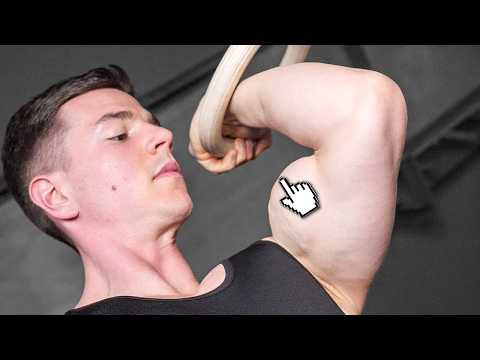
How I Got Bigger Biceps With Calisthenics
FitnessFAQs
15m 3s2,820 words~15 min read
YouTube auto captions
Transcript source
YouTube auto captions
This transcript was extracted from YouTube's auto-generated caption track. The transcript below is server-rendered so it can be read, searched, cited, and shared without opening the original YouTube player.
Pull quotes
[0:00]I've been working out for 15 years now and in the first five years of my journey, I only did compound exercises.
[0:00]I know it's surprising, but I was able to build up my biceps without any direct work.
[0:00]I was able to lift plus 80 kilos on my one rep max on the chin up, which was essentially my body weight added for one rep.
[0:00]Now, I know this is N of one, but it still does show the transformative effects of chin ups for growth.
Use this transcript
Related transcript hubs
Watch on YouTube
Share
MORE TRANSCRIPTS


