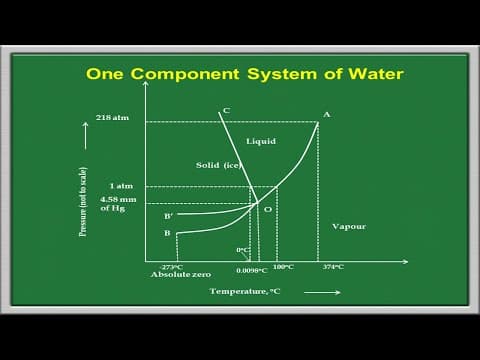
[0:00]Hello friends, today we are learning one component system. I am taking example of water. We know that water exists in three phases, that is solid, liquid and gas. Even though they exist in three different phases, but all three phases are expressed by same chemical formula, that is H2O. Hence, water is a one component system. Let us see the phase diagram for the system of water. As we can see, the temperature is on the X-axis and the pressure is on the Y-axis. The phase diagram consists of three curves: curve OA, curve OB, and curve OC. There are three areas, area AOB which consists of vapor phase, area AOC which consists of liquid phase, and area BOC which consists of solid phase. All these three curves meet at the single point O which is called as triple point of water. We study phase diagram because phase diagram allow us to understand in what state matter exists under certain conditions. Now let us understand this phase diagram. First we will study the curves. We will start from the curve OA. The curve OA starts at point O which is triple point of water and ends at point A which is called as critical temperature. Above critical temperature there is negligible amount of water which is in the liquid state. Along this curve OA, liquid and vapor phase are in equilibrium, therefore this curve is called as vapor pressure curve. In the curve OB, it starts at point O and ends at point B which is absolute zero. Along this curve, solid phase and vapor phase are in equilibrium, therefore this curve is called as sublimation curve. The third curve that is curve OC starts at point O, ends at point C, and along this curve solid and liquid phase are in equilibrium, therefore this curve is called as melting point curve or fusion curve of ice. The inclination of the curve OC towards the pressure axis indicates that the melting point of ice is lowered by increasing pressure. So if we observe any curve, there are two phases are in equilibrium. Therefore, when we apply the phase rule that is F is equal to C minus P + 2, where F is degree of freedom, C is number of components, P is number of phases. So we are studying system of water and we have already seen that the number of component is one and in case of curve there are two phases which are in equilibrium. Thus, the number of phases are two, so 1 - 2 + 2 = 1. So all the curves are univariant. That means if you select a particular temperature, the pressure is automatically fixed, and if you select a particular pressure, the temperature is fixed. So to decide any point on the curve, you require any one variant that is temperature or pressure. Next we move to areas. In area AOC, only liquid phase exist. In the area AOB, only vapor phase exist, and in the area BOC, only solid phase exist. That is the ice exist. In any particular area, there exist only one phase. So number of component is one, number of phase is also one. So 1 - 1 + 2 = 2. That means you require two variants to fix any particular point or to understand any particular state in the particular area. Therefore all the areas are bivariant. All these three curves meet at the single point O which is called as triple point of water. That is ice is in equilibrium with water, which is in equilibrium with water vapor. So if we apply the phase rule F = C - P + 2, component is one, phases are three, so F is equal to zero. That means such system is possible only at specific temperature and specific pressure. So it is a zero variant. The specific temperature is 0.0098 degree Celsius and the pressure is 4.58 millimeter of mercury. In addition to this we can see one additional curve, curve OB dash which is called as meta stable state. It states that it is possible to super cool the liquid water below zero degree Celsius, keeping it in the liquid state. That means water can be kept in the liquid state below 0° Celsius, provided there is no impurity present in water. So this is called as super cool water. But any disturbance from the temperature or pressure or if any impurity is present, the whole liquid will turn into a solid. This is because the curve OB dash is above curve OB which is in the solid area. Mathematically, if you have to fix any particular point along the curve, you require any one variant that is temperature or pressure. If you fix the temperature, the pressure is automatically fixed. Therefore, the curves are univariant. But if we have to fix any particular point in particular area, we require both the variants temperature and pressure. Because if you fix only temperature, the point cannot be fixed without knowing the pressure. Hence, all the areas are bivariant. Thanks for watching. If you like, click subscribe for more such videos.
5m 28s865 words~5 min read
YouTube auto captions
Transcript source
YouTube auto captions
This transcript was extracted from YouTube's auto-generated caption track. The transcript below is server-rendered so it can be read, searched, cited, and shared without opening the original YouTube player.
Pull quotes
[0:00]Even though they exist in three different phases, but all three phases are expressed by same chemical formula, that is H2O.
[0:00]As we can see, the temperature is on the X-axis and the pressure is on the Y-axis.
[0:00]There are three areas, area AOB which consists of vapor phase, area AOC which consists of liquid phase, and area BOC which consists of solid phase.
[0:00]All these three curves meet at the single point O which is called as triple point of water.
Use this transcript
Related transcript hubs
Watch on YouTube
Share
MORE TRANSCRIPTS


