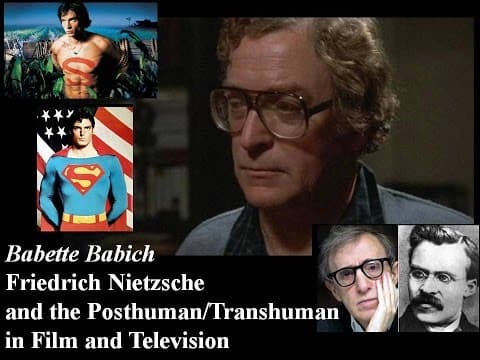
[0:32]This is Babette Babich, and I teach philosophy at Fordham University, and here I'm going to be reading a chapter, it's the first chapter in an encyclopedia of Transhumanism in film and television and this chapter is on Nietzsche. Friedrich Nietzsche and the Transhuman in film and television. It begins with an epigraph. That which doesn't kill you makes you stronger. That's taken from John Milius's film, Conan the Barbarian, 1982. If any philosopher is identified with Transhumanism in film or television, it would seemingly have to be Nietzsche, whose Zarathustra proclaimed the doctrine of the Uebermensch, the Over-human. Traditionally transmitted to the English dramatic world via George Bernard Shaw in his 1903 play in four acts Man and Superman rendered in 1982 for television and starring Peter O'Toole. And thus, the association with Superman, the Post-human. Of course, and this too is not surprising. The association is a caricature and a dangerous one embracing the various instorations of Transhumanism in the celebration of Nazi Eugenics. In Leni Riefenstahl's 1935 Triumph des Willens, Triumph of the Will, to the variously padded and coifed versions of Superman in film and in a range of television series, including, most recently, the teenage Transhuman Clark Kent, in televisions Smallville that ran from 2001 to 2011.
[2:07]10 years is a lifetime for an actor, and the preternaturally beautiful Tom Welling may eventually have outgrown his own charms. Indeed, it could be argued that the omnipresent nostalgia for empowering bodily enhancements may be traced to adolescence itself, the original inspiration for transhuman advantages, transpiring spontaneously or by themselves. Aided to be sure by the Dionysian and in our era that's to say sex, alcohol, lifestyle drugs and the right kind of youth music. What the adolescent ideal precludes as Nietzsche points out, is everything and anything to do with, I quote Nietzsche, death, change, age as well as procreation and growth. All of which are regarded not as part of life but to quote Nietzsche again as objections to life. Thus Nietzsche invokes the philosophers age-old ressentiment of life as indeed of the inconveniences of the body. Imprudent enough as Nietzsche says to behave as if it actually existed and in addition to Plato and Descartes, this hatred of the body also animates religious fantasies of salvation and the scientific versions of the same. Post the eugenics-driven bio-punk science fantasy of the 1997 film, Gattaca, directed by Andrew Niccol, and starring Ethan Hawke and Uma Thurman, and post the add mechanicals and stir combo biomedical technology with its celebration of scanning the body for illness. As if diagnostic technologies might also and simultaneously cure while they were at it. Alas Star Trek, in the 2013 Matt Damon vehicle starring a malevolent Jody Foster, Elysium. Today's ideal of Posthumanism can be at least loosely connected with the figure of Nietzsche, although Transhumanism might better be connected to the 2007 Transformers film series on the toys of the same name. The tech geek documentary film or infomercial on Ray Kurzweil entitled Transcendent Man 2009 repeats the under estimation of the scientific, technological problems involved with Kurzweil's surprisingly literal filmic vision of the technological singularity. Thus the 1966, not even 70, 66 film starring Raquel Welch, Fantastic Voyage down to the technical notion, sending small spaceships into the body, seems to adumbrate Kurzweil's vision. Updated now as nanobots sent in to make repairs on the body's failing system. I discuss this in earlier essays that I've published elsewhere, but the point of Kurzweil's singularity in the culture industry, it will never do to forget the trademark, copyright sign is its new age Hegelian and ergo non-Nietzschean dimension. The inattention to technological details, like Marxist materialism or Deep Pack Choper-like automatism, isn't an accident. The singularity to come will come through itself by itself and that once again is a parallel to adolescence. If its original coinage in science fiction is part and parcel of this notion, it also corresponds to the Holy Grail and the nightmare of AI, artificial intelligence, in the Steven Spielberg film of the same name.
[5:54]Which plays on the old fairy tale dream of an artifact, here, a late 20th century robot, longing to be human. The technological singularity, otherwise expressed, is the problem of robots becoming conscious, for Stanislav Lem, as indeed for Isaac Asimov. The desire is fraught and known since Milton's Paradise Lost, where to rule if not in heaven and solved by the efficient Azimov, namely via code or rule, the so-called law of robotics. Indeed, the San Diego computer scientist Verna Vinge via John von Neumann can claim that he has, as he writes, predicted the end of the human era. And we should add other names here, as such claims are routine enough among pulp science fiction authors. Jack Vance is the Dying Earth is all about that, but Kurzweil owns their trademark. The technological singularity as depicted in film reflects the conflict between the human and the machine. Scholars note this alliance in the 1999 film The Matrix, starring Keanu Reeves, but already appears in Ridley Scott's 1982 Blade Runner, which was itself a dark quotation, rather than a remake of the 1956 so-called B horror film, the black and white Sci-Fi Invasion of the Body Snatchers, directed by Don Siegel.
[7:22]Itself duly remade in 1978 and directed by Philip Kaufman with Donald Sutherland as well as Jeff Goldblum and Leonard Nemoy. Stanley Kubrick's 1968 film 2001, A Space Odyssey, drew on one Cold War fantasy after another, international violence given iconic lip service to be sure, but turning, as all science fiction films ultimately do, on the relationship between man and machine. And towards a life lived on mechanical terms, including, in the case of 2001, the iconic fantasy projection of an intractable and controlling computer unbrained, decognitized by the expedient of unplugging it, a Turing machine running backwards. It's a short step, albeit without a Nietzsche connection to the recent AI sex fantasy, directed by Spike Jones, the 2013 film, Her.
[8:26]As the plausibility of the joke in Phoenix Phone sex film, starring the voice of Scarlett Johansson and thereby improving on Siri, suggests more in its easy realism than in its unremarkably fantastic aspects, have our machines not already woken up? What do we do these days that's not done mediatedly by machines. The question belongs to every sorcerer's apprentice involved in a certain transfiguration in the olden days involving roses and an ass and then in Goethe's cautionary fairy tale, the sorcerous apprentice, a broom and a bucket. Or else, an array of body parts in the old transhumanist projection of a body on a slab robbed from the grave, exposed to lightning and all technologies as dramatized in the film version of Frankenstein, electricity being the life choice life force of choice, excuse me for the late 17th and early 18th century for Mary Shelley in 1818. And enduring into the 20th century with the iconic 1931 version starring Boris Karloff. We may add, if we like, Mel Brooks' 1974 Young Frankenstein or any of the several television or TV instorations. The question of how to control the work of our hands, if we create life, happens to correspond to the question of how to control our machines, the server problem, our servants, if and when they become conscious. Thereby we overlook the difficulty of making this a feedback question, a decently functional prosthesis much beyond the technology for contact lenses, where you don't really need feedback apart from drawing out. The same notion has been revised in the fashion of product updates, so that one may speak of Zarathustra 2.0 to match the sociological entrepreneurs humanity 2.0 according to the title of Steve Fuller's book on the topic. Technologically stipulated in this way and with a clear reference to the marketing strategies of technological products at all level, the Transhuman is the human, once again on the progressive way to the more than human. Thus, futurist utopian articles date back in the popular literature to the post-war enthusiasms of the 1950s and 1960s. Then ingendering less the technologies that so-called to use this word eliminate aging, to quote Nick Bostrom's language, then serial television cartoons like the Jetsons and motion pictures like Fantastic Voyage, already cited and regular television programs like Lost in Space and Star Trek. A seemingly tailor-made sci-fi tale in David Simpson's self-rendered, that is to say self-published e-novel, Post-human, published in 2009, speaks to us in the bad future genre style that we know from films like Blade Runner or Mad Max or the sequel, Road Warrior, or indeed, the original, and it has to be the original, RoboCop. Simpson's Post-Human begins by depicting everyday life in the ultra-longevity lifestyle paradise that he imagines will be created by nanotechnology, which the author, just to show his harmless familiarity with this technology, speaks of as so many fairy beings, called Nans, in quotes, NANS. A paradise which is then undone by Nans, whereby in the predictable, I hope this screenplay version gets made a movie before the book disappears from Kindle radar, sense of predictable course of events, the devastation is revealed to be the fault of the usual caricature evil doers, not really the Nans. Only to end with a new world made by the always neutral Nans, but in this case, good ones. Parsing the Nietzschean ubermensch for the popular mind, Nietzsche remains the stock character. His name alone fulfilling Nietzsche's ambition expressed at the conclusion of his extended array of aphorisms, Expeditions of an untimely man, confessing his ambition to say in ten sentences, as he writes, what everyone else says, he interrupts himself, what everyone else doesn't say in a book. And there are liabilities and Ricky Gerve's YouTube Hitler, Nietzsche gag, awkwardly illustrates the shadow influence of Nietzsche on television and film. Corresponding to his influence on popular culture overall and like much pop cultural influence, there's good deal of free association and license. Nietzsche, who famously insisted in his Echomo, I will not be misunderstood, would seem to have had the market on being misunderstood. It doesn't hurt for film and television that Nietzsche mustache and all, I won't be understood, he says both, and one of the things that's important about that is he doesn't want to be understood, he doesn't want to be misunderstood. And all we do, of course, subsequently is misunderstand him. But we also recognize him instantly. He has one of the most physically identifiable characteristics. And we see him, we identify him instantly in the 1972 Monte Python sketch, the philosopher's football match. And Nietzsche's name alone emits of caricature as well owing to his association with nihilism and dark, vaguely existentilist themes. Thus the director Woody Allen, no slouch when it comes to negative vibes, foregrounds Nietzsche's nihilism in a key voiceover to one of his most autobiographical films, the 1986 Hannah and Her Sisters. Indeed, here the director takes the direct expedient or shortest double Gango route to Transhumanism. Transplanting brains into new bodies will eventually be the next best thing, but Allen simply cast Michael Caine as himself. Much to Caine's own discomforture, who recalls the awkward character of the substitution in a later interview, substituting, as Woody Allen does, the tall, blond, and abundantly curly-haired actor for himself, as Mia Farrow's partner, or husband in the film, sex scenes and all.
[15:00]And as if that weren't enough, having Kane play the philander to boot. For and this is a Transhuman technique, while it is not at the time, Michael Caine was a mere two decades advanced and hence relatively fresh from his 1966 Alfie days.
[15:18]Longevity as we realize matters when it comes to Transhumanism, and thus well before Caine's Alfred the Butler days of more recent Batman fame. Thus, one Transhuman ideal dramatizes body doubles, not Patty Duke and her British cousin, played by herself, but ideally improved bodies. And by contrast with the time-dated vulnerable replicants in Blade Runner, by the effectively deathless Schwarzenegger Android complete with operating system in the 1984 Terminator and sequels and updates, or less recognizably human, but more special effects friendly, in James Cameron's Avatar. Nietzsche's name suffices for most purposes, not only in quotes associated with military and masculinist and montremold or barbarian violence, as in the case of the various versions of Robert E. Howard's Conan the Barbarian, including, in Milius's initial version, the palimpsest for the eventual corruption or decadence of evil turning into itself. In James Earl Jones' portrayal of the decadent oriental king, Thulsa Doom, on his way to the voice of Darth Vader in the 1977 Star Wars. The science-fantasy author David Smith has a useful discussion of this masculinist project in the Conan films and I recommend you take a look at that in the footnotes to the article. Hence, the wildly popular, and by definition, there's only the wildly popular in capitalist movie or HBO land. Think of the short-lived Carnivale's HBO series, The Sopranos, as this dramatized the troubled young son of Tony Sopranos' emergence into puberty, adolescence again, by mentioning Nietzsche's name with a screenshot of the cover of the Will to Power. Nietzsche is a symbol of subversion. The illustrative device, showing a book cover on film, had already been used in Woody Allen film, but the philosopher was Martin Heidegger, and the book was Heidegger's introduction to metaphysics. The difference has everything to do with Transhumanism, but what's more, and by contrast with Heidegger, a mention of Nietzsche requires neither reading nor thinking. Indeed, the popular mind's tendency to favor a one-dimensional characterization of Nietzsche affects even scholars of his thought who write on Nietzsche and Transhumanism. It's no stretch to connect the Transhuman or the Post-Human, understood, not as Nietzsche Zarathustra offered the image of the Over-Human as a parallel and model, and even, let's underline that, a mockery of the human all too human desires of the crowd. Echoes here of the contradictory notion of the genius of the crowd mind for Nietzsche, who marked the general one of humanity, even where he found it in himself, but proclaimed as the coming or future superior human being. The ideal itself dates back to Plato's program for selective breeding, today designated by way of some technical admixture of Transgenics, associated in the academic mind and also the popular mind with the human genome project. And which efforts work so much better practically speaking in film or television fantasies, whether they are utopian, the good ones, that wants to work out or dystopian. Thus the 2014 season of the AMC series The Walking Dead features as a plot teaser, the theme is instantly taken back. Hints of a US government research project gone arr in the form of a runaway bio-weapon designed to take out large swaths of the enemy population. Though in today's day of rampant human overpopulation, who among us wouldn't qualify as the enemy? Manufacturing a virus more deadly than AIDS or Ebola in the nicely self-replicating just about will do it, an all too literally post-humus, Nietzsche's word, power of the zombie. Television's fondness for vampires, that's zombies and vampires and vampires a true blood goes so far as to feature a seemingly Nietzsche style blonde beast. In the blonde-haired and personally superior style of the obviously named for Aryan tastes, Eric Northman played by Alexander Skarsgård. The eponymous True Blood of the title of the HBO series referred to the technological advance of technically or literally un-true blood. A kind of sugar substitute for the undead, a synthetic human blood that made it possible for the Post-Human, co-dead Transhumans, qual vampires, to associate with the not at all undead, and all too human inhabitants of Bontemps. In that echoes, one supposes, in its title, the good times or happy days of television past. Never mind that Sookie, the most human of them all, was a self-fari, and hence her charms for vampires transcended more than a southern accent and a seeming uniform of white t-shirts and short shorts. A pretty monotone view of strength expressing or oppressing weakness, or indeed, simple self-assertion or even self-aggrandisement would lead Ein Rand to insist upon Nietzsche's influence in King Vidor's 1949 film version of her 1943 novel, The Fountainhead, starring the quintessential actors, Gary Cooper and Patricia Neal. Hence, and in the same respect, this genre of film could also be regarded under the rubric of the Trans or the Post-human in film. In the same vein, a certain finance industry Nietzscheanism rules the recent The Wolf of Wall Street along with the Great Gatsby, at least in versions, those versions that star Leonardo DiCaprio. The need to emphasize Leonardo DiCaprio is significant for sheer associative force. Because even the film Titanic could be said to exemplify Nietzschean themes, American style. Albeit more Horatio Alger-meets-Shakespeare's Romeo and Juliet, Transhuman Love being the essence of life affirmation. A key Nietzschean theme here encountering another key Nietzschean theme in the indomitable will meeting the world will itself. James Cameron's version of Titanic is all too Schopenhauer, all too Nietzschean marine monstrosity and the visceral excess in the form of the iceberg and the cold dark of the night sea. The world of the frozen sea wins and loses at the same time. Speaking with television's Charlie Rose, Slavoj Žižek repeats his interpretation of Titanic in good Lacanian fashion, as a misogynist's revenge on woman via a deliberate misprision. Claiming as Žižek does, that K shoves Leo into the brink, deciphering the letting go of a frozen corpse, not as a burial at sea, but a deliberate letting go, a deliberate pushing Leo away, all the while claiming, never to let go. The scandal for Žižek is that the lady, wealthy and spoiled as she is, also has the temerity to save herself. That and that her lover has already sacrificed all his vitality, no Wagnerian love death here. For Žižek, Leo Post-Human, already dead, is irrelevant shades of Lacan's famous exchange with Luce Irigaray regarding Bernini's Saint Teresa. Men see what they like. Thus Lacan declares that it's obvious that the statue of Saint Teresa is an ecstasy, literally having an orgasm, whereby Irigaray simply points out that the saint Teresa in question is a stone statue. Woman, this remains the key for the intro, French or otherwise, do not get a break. Still, Titanic is replete with instances of Žižekian pushing, if not contrast with Žižek's insistence on the bit of flotsam where Kate and dead Leo find themselves under the starry heavens of the real revealed. This is the Lacanian imaginary after all, as all too real. But shoving and overreaching desperation in the hold as Nietzsche describes this at an immigrant seaport in the Gay Science, also appears in Cameron's film in the details of the capitalist symbolic order. And this includes Žižek's homoerotic vitality ordered by money and by class. Quay style, counting from the first class cabin down the levels of the ship in the doomed layers of the lower cabin classes.
[24:34]Nietzsche's thought of death matters, because the Overhuman tells the truth of the Post-Human condition of our day. Nietzsche means to say, as he tells us, as a posthumous insight, be true to the Earth, he reminds us, almost in an Ash Wednesday voice, or voiceover. Remember man that you are dust and unto dust you shall return. The locus mentioned is the gay science, in this case, is the Port of Genoa, not unlike the port from which the original Titanic took its leave. As Nietzsche himself also departed from such a port for his voyage to Messina, about which scholars pretend to know everything as revealing, this is the secret of Zarathustra's secret. Nietzsche's fancied homosexuality and so on. Associations with death are inevitable for Nietzsche given the tragedy of his own death and the protracted end of his life, contra his idealization and thus spoke Zarathustra, and the unmistakably named Twilight of the Idols of, I quote, dying at the right time. Nietzsche himself wasn't to have that same grace, any kind of grace in fact. Another motto, if you like, or motive of today's Post-Humanity is our dear pharmaceuticals, modern drugs, with their late 19th century versions, accompanied his life. Directing its every expression for the last ten years of his life, from psychopharmacol or what what drugs that are known as nootropics, the entire chemical panoply of remedies, including, including physician prescribed mercury in the form of a salve applied directly, all of that was at hand. In the spirit of chemical enhancements, Nietzsche is the subject of at least one film on madness, not counting Liliana Cavani's surreal 1977 Ay-dela, del Bene, del Male, or Pinkas Perry's 2007 When Nietzsche Wept. A perhaps calculated the kitsch style film on Nietzsche and the inventors of psychoanalysis, setting Freud and Jung in finde-siecle Vienna and facially including Nietzsche. The fancy works because Lou von Salome was a collaborator of Freud's and association augmented by the salacious, taking us back to all the Nietzschean secrets. Did he have sex with Lou? Did he not have sex with Lou? Was he gay? Or was he merely, as Wagner tells us this, an inveterate onanist, given to self-abuse? The complexities of Nietzsche's supposed syphilis, the drama of his unluckiness at love, along with his inordinate enthusiasm for, and so his association with Wagner, who supposedly dispatched the young Nietzsche on shopping trips to buy Wagner's underwear. Silk underwear to be ordered at certain stores, all to the embarrassment of the sensitive young professor. What is biography and what's history? Complex questions, indeed, and Nietzsche's philosophical perspective can be difficult to untangle from such questions, not least, because Nietzsche is also associated with Hitler. Owing to an important visit Hitler paid to the Nietzsche archives, a visit immortalized in a photograph, showing Hitler in profile looking at a bust full on of the philosopher. If almost no film or television documentary illustrates the story of the class assist Nietzsche's reflections, he was a philologist on tragedy or on music, much less his important reflections on the pitch or strex Ictus, as this aided his reconstruction of Greek prosody. That means the way Greek is pronounced, I discussed this at length in the last few chapters of the Hallelujah effect, or his reflections on statues and antiquities and so on. The popular vision of the Nietzschean political strong man is visually dramatized in Bruno Ganz's proclamation of Nietzsche's name in his portrayal of Hitler in the 2004 German film Downfall. Oliver Hirschbiegel's Der Untergang. The association of Hitler with Nietzsche is about as strong a connection as it gets, and it persists, despite the fact that Nietzsche himself could never have taken part in the political movement known as national socialism. Still, Nazi politics deliberately sought to adopt Nietzsche, and in the case of film, his name remains, if only because, once again, of Riefenstahl's Triumph of the Will. A film that arguably continues to set the bar for commercial television, even Super Bowl programming, and that's the point to this day. And that echoes the title of Nietzsche's own, that would be sports programming for the British, this is a British publication after all, the title echoes Nietzsche's own The Will to Power, triumph, triumphs of his will.
[29:37]A book compiled from Nietzsche's notes by his sister. Yet the Frankfurt School theorist, Max Horkheimer, collaborated with Adorno, reminds us to put just this constellation in the context of the culture industry itself. Including the contradictions of Western Hollywood style capitalism, as Horkheimer reminds us that, and I quote Horkheimer, the consummate Superman against whom no one has warned more than Nietzsche himself is a projection of the oppressed masses. King Kong rather than Cesare Borgia, the hypnotic spell that such counterfeit Supermen as Hitler have exercised, derives not so much from what they think or say or do, as from their antics, which set a style of behavior for men. Who, stripped of their spontaneity by the industrial processing, need to be told how to make friends and influence people. I say that from the Eclipse of Reason, which was written in English. To this extent, according to Horkheimer, and also as I've noted Adorno, the popular image of the Nietzschean Superman is a projective overcompensation serving mass culture. But if, as already suggested, Christian Bale's Dark Knight Rising as the culmination of Christopher Nolan's Batman trilogy, details this projective overcompensation in a, once more, with Žižek, a Lacanian schema. Imaginary, symbolic, real, the dead actor, inevitably life imitating heart, that is Heath Ledger's Joker in the second of Nolan's Batman trilogy, The Dark Knight, brings a negative Nietzschean Superman. Like the bizarro Superman.
[31:21]The distorted dwarf, the spirit of gravity, is played by Ledger with an uncanny combination of levity and grim gravity. The lightness matters in the dark, and we cannot forget that Zarathustra's dwarf leaps constantly, whether springing over the tightrope walker at the start of Thus Spoke Zarathustra, or else, and some argue that's a different dwarf, but it's the same figure, springing to Zarathustra's shoulder to weigh him down, as he attempts his own ascent on the mountain, dripping led thoughts, like printed letters, into his brain.
[31:58]Film fantasies on Nietzsche's eternal return and Superman. Woody Allen's Hannah and Her Sisters, I've already mentioned, features another kind of Transhumanism. Much better than a replicant in Blade Runner or Invasion of the Body Snatchers, or the more literalized gaming Avatar fantasy, like a suit of clothes in the 2009 Surrogates, starring Bruce Willis, but by way of the ultimate kind of catfish style movie star version on the part of the director Woody Allen. One reading of the Superhuman looks at the question of life and death, transcending by extending it, Ray Kurzweil style. And another looks at the life and the afterlife, be it in heaven or in hell, or worse yet, the hit the reset button method. Wrench and repeat. Nietzsche's famous eternal return of the same. To be sure, Nietzsche's notion of eternal recurrence isn't Woody Allen's, as Allen details his idea of Nietzsche's eternal return in the initial voiceover that introduces Hannah and Her Sisters, in addition to exploiting the director's advantage of using a movie star version of himself.
[33:14]A perfect illustration of Transhumanist technique, what I just mentioned is the ultimate catfish move. Allen's film has stark quality in spades. Not only Michael Caine's always extraordinary touch, but pure raw star power, especially at the time, featuring Barbara Hershey and Maureen O'Sullivan, along with Mia Farrow as as Hannah, Max von Sydow and Carrie Fisher, and even Louis Black. Woody Allen appropriates his allusion to eternal recurrence as much from the Schopenhauerian Tolstoy, the director quotes as saying that, I quote Woody Allen quoting, the only knowledge, I quote Woody Allen quoting, the only absolute knowledge obtainable by man is that life is meaningless. The film cuts into a less than obvious or cliche shot of Rodin's the thinker, adding Woody's own voiceover, using, in a filmmaker's animus or Nietzschean ressentiment, contra the printed word, and especially contra philosophy, as such. We hear the voice over, millions of books on every conceivable subject, by all these great minds, and in the end, and here to stop the quote from Woody Allen, cutting with a touch of homophobia and an uncanny art resembles life illusion to Pedophilia, to the bit on ressentiment, quoting now again, none of them knows more about life than I do. I read Socrates, you know, this guy used to knock off little Greek boys. What the hell's he got to teach me? And Nietzsche, with his theory of eternal recurrence, with this, the voice over reverie settles into the reality of the figure of Woody Allen, walking across the dream landscape of the Manhattan pseudo intellectual, the Columbia University campus. We pick up the voiceover again, he said, that the life we live, we're going to live over and over again, the exact same way for eternity. Great, that means I'll have to sit through the Ice Capades again. It's not worth it. And Freud, another great pessimist, I was in analysis for years, nothing happened. My poor analyst got so frustrated, the guy finally put in a salad bar. Look at all these people jogging, trying to stave off the inevitable decay of the body. Boy, it's sad what people goes through with their stationary bike and their exercise. Maybe the poets are right. Maybe love is the only answer. Allen's monologue, which I of course had just reached an end, is interrupted, supposedly, by an encounter with one of Allen's fascinatedly breathless lady stars, Diane Wiest, asking the director to please go on. Dialogue is a device in the self-turned monologue, and Allen largely continues. About a month ago, I really hit bottom. I just felt that in a godless universe, I didn't want to go on living. Allen proceeds to talk of suicide, almost as Nietzsche does when he invokes voluntary death, the idea of voluntary death, pointing out that if one has no choice in being born, continuing to live or not, is really utterly within one's own control. Allen continues, now, I even own this rifle, which I loaded, believe it or not, and pressed it against my forehead. And I remember thinking at the time, I'm going to kill myself. Then I thought, what if I'm wrong? I mean, no one really knows, what if there is a God, after all? Nobody really knows that. Then I thought, maybe isn't good enough. I want certainty or nothing. And I remember very clearly the clock was ticking, and I was sitting there frozen with the gun to my head, debating whether to shoot. What is argument for the existence of God and contra the claims of nihilism and meaninglessness is simply that he, Woody Allen, and in this, Allen's argumentative schema, echoes both that of Descartes and Bartleby, the Scrivener, is just that he, Allen, just prefers not to live in a world without God. This is the same response that inspired suicides among philosophers and poets after Kant's critique of pure reason made it plain that one simply could not prove the existence of God. Thus the suicide ego pact that Allen almost completes with himself before Allen, still playing himself, talks himself out of it. Allen opts to leave the question of God open and thereby positively decided. What's of interest here is less the argument of a theodicy, the horrible things that happen in the face of an omniscient God, then that of optimistic, if dark hope. And for the purposes of this discussion, at this moment, what's at issue is that this for Woody Allen is sufficient to dismiss the notion of the eternal return. For it is not simply the terrifying or the abysmal, but the small horrors of life that count as objections. Just of course as Nietzsche had originally put the proposition into his demon's mouth, I quote Nietzsche now, what if everything in your life, everything great and unutterably small would return to you? And this who can better understand than a filmmaker, who would want to sit through all those unbearable moments in pop culture one more time? The thought of eternal recurrence doesn't mean that Woody or anyone else will be condemned to having to endure the Ice Capades again and again. Nor, rather in the same way, is another film typically taken to illuminate the thought of eternal recurrence on target either. That is the 1993 film directed by the late Harold Ramis, Groundhog Day, starring Bill Murray. Popular statements of the eternal return such as Allen's bit about Ice Capades nicely miss the central point of the thought for Nietzsche. Eternal recurrence of the same in as much as the point of Woody Allen's thought experiment is that there's no repetition. One loses, this is what makes the thought Nietzsche's most difficult, the new. Even the literally new, it terribly knew and thereby one loses boredom and the future, and of course for the Nietzsche, who thought and taught the death of God, one loses any possibility of redemption. Still, we are talking here about film and television, and film qua film, and television qua television. And these exemplify the Nietzschean idea of the eternal return of the selfsame. What else is a revon? To this extent, even the video artist, Nam June Paik, may be said to replicate Nietzschean ideas, thematically, and more mainstream. The same ideas featured in Terry Gilliam's 12 Monkeys. If the idea of eternal recurrence doesn't give us the Transhuman per se, the imaginary ideal image of Nietzsche may stand behind any triumphant filmic vision, even Lawrence of Arabia. And if one takes that line, one can either claim Nietzsche as the inspiration for apocalypse now, rather than as his more technically or literally precise, Conrad's Heart of Darkness, or find him in a series of Westerns. The main character in Shane, for instance, can be seen as the Nietzschean ideal vision of the ubermensch, that is to say, the ideal of the Superman, as Nietzsche himself speaks of this as a combination of genius and saint. We see the extraordinary importance of the cleverness that characterizes a true hero, who's always on top of any turn of event, ideally in advance, or at least with already backup, plan B. This is Bale's Batman in The Dark Knight Rises. Not only physically resourceful in the face of personal catastrophe after personal catastrophe, but expert in finance and coding too. Here, we can recall the quote we began with from Conan the Barbarian. If Schwarzenegger's here was more simple-minded than not, Steve Reeves, another bodybuilder, in The Masterful Thief of Baghdad, searching for a blue rose for his lady, and looking to prove and transform himself before the Sultan, has resplendently higher human qualities. Genial and honest for a thief, clever and resourceful, because he is a thief, and possessed of the famous honor among thieves, which gives him advantages over palace intrigues and palace guards and the stock Grand Vizier in the same way. We had cause to begin by invoking the eponymous Action Comics hero, Superman, in his various instorations above, and we started with that. Including his physiologically Transhuman splendor, which we also mentioned, in the television series Smallville, which shows the close beauty and fragility of the young individual, the young beautiful soul, that is, once again, the teenager. If the figure of Superman counts as Nietzsche's Post-Human or Overhuman, then the career of the television shows featuring Superman, particularly George Reeves' depiction in its television form, Adventures of Superman from 1951 to 1958, echoes Nietzsche's own emphasis on death and down-going. Here in the tragedy of the author's suicide, or or murder, this, we don't know. This down-going would be echoed with the paralyzing fall of Christopher Reeve, who depicted Superman in a series of films that were at the time heralded for more realistic portrayal of flight. The number in versions of Superman on screen, and as a character in in a television series, shows little sign of coming to an end. In fact, they've announced one to come, and we wouldn't be done still, if we didn't neglect the Saturday morning and daytime children's characters. Were the 2009 film comic book realization, Watchmen, featured an obviously Transhuman naked blue giant, like the naked Schwarzenegger in the first Terminator. The 2012 film Prometheus, or as the video trailer prelude still available on-line, indicates the title Prometheus now, features the same thematic of Transhuman Superman, not too dissimilar to Tony Stark. The name is almost uponymous. Iron Man plus sequels, which themselves draw on the anthropomorphically enhanced RoboCop. Where the original, one that's shot in 1987, far more than the 2014 RoboCop remake is redemptive. But what makes all the difference is Iron Man's Transhumanism embedded in and thus like his nuclear reactor heart, inseparable from the human, all too human. The eternal return of the ideal of the Superman retains its dark side, and if this dark side may be argued to connect Batman and Superman, as well as the vampire on the high side, and the zombie on the low, there's still the dark political danger of the Transhuman fantasy for profit and political advantage. A conflict illustrated not only forever more in Leni Riefenstahl's Triumph of the Will, but in the space of the imaginary, as this always collides, as Žižek reminds us, with real, an ongoing collision illustrated by Simon Temple's 2009 film Uebermensch, with its poster of a pensive young Superman, chest emblazoned with a swastika. All human. All all too human. Nietzsche might have said, who encouraging us to go over to the ideal he taught as the super, the above, the beyond man, the Overhuman. Nietzsche writes, what can be loved in man in the human being is that he is a going across and a down-going. And thus Nietzsche also encourages us to go under. I quote Nietzsche continuing, for thus he, that human being wills his own downfall. Amor Fati, love of fate. Here with a certain distance, Nietzsche, to Kurzweil, who recommends upgrading to the machine, discarding the outdated old body along the way. If Nietzsche's Amor Fati is by definition for everyone, Kurzweil's Transhuman ideal is not. Indeed, this is the thinking of a rich man. The point concerns an upgraded body, to singularize those who, in fact, can afford the latest upgraded version. iPhones go up in price and bring Android versions along with them, so to Blackberry, and part of the point is what the French sociologist Pierre Bourdieu called distinction. If you have one, you tell other people who you are. If Ray Kurzweil and Walt Disney and Ted Williams as Cryonix pioneers of the planned singularity, have their way, you will, indeed, be able to take it with you. Thank you for your attention.


