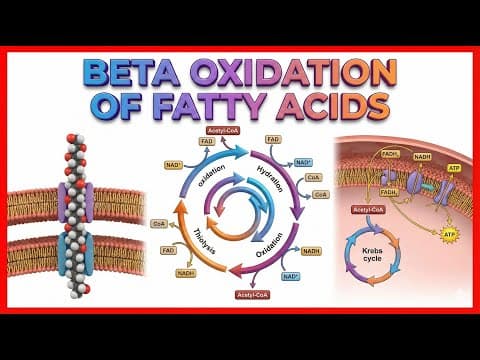
[0:00]Beta Oxidation of Fatty Acid. Beta oxidation of fatty acids is the most common type of fatty acid oxidation. Beta oxidation is the catabolic pathway by which fatty acids are broken down in the cytosol in prokaryotes, and in the mitochondria in eukaryotes to generate acetyl coenzyme A, which enters the citric acid cycle. It is named as such because the beta carbon of the fatty acid undergoes oxidation to a carbonyl group. In the process of beta oxidation, two carbons at a time are cleaved from carboxyl end of activated fatty acid as acetyl-CoA. Nature of pathway is catabolic. As the nature of the pathway is catabolic, it occurs in fasting state/starvation. The site where it occurs is the mitochondria in eukaryotes. Location is liver, adipose tissue, and muscles. The pathway is activated by hormone glucagon. Now let us take a look at the steps of beta oxidation of fatty acids. Fatty acids which are present in the cytosol need to be translocated to the mitochondrial matrix for beta oxidation to occur, for the fatty acids need to be activated at first. So the initial step is activation of fatty acids. Later, activated fatty acids should be transported from cytosol to mitochondria. And the final process is reactions of beta oxidation, which takes place in the mitochondrial matrix. Now, let's discuss these three steps in detail. Step 1: Activation of fatty acids. The site where it takes place is the cytoplasm. The enzyme used is acyl-CoA synthetase or thiokinase, which is present in the outer mitochondrial membrane. This is the only step in the beta oxidation of fatty acids which requires energy in the form of ATP. Two inorganic phosphates are used in this reaction. Here, ATP gets converted to AMP. When fatty acid is converted to acyl-CoA, ATP is converted to AMP plus PP with the help of magnesium ions, and the enzyme is acyl-CoA synthetase. Step 2: Transfer of activated FA from cytoplasm to mitochondria. Acyl-CoA is produced in cytoplasm, but actual beta oxidation occurs in mitochondria. Fatty acids like short chain and medium chain do not need carnitine for transport into the mitochondrial matrix, but long chain fatty acids cannot cross inner mitochondrial membrane. So, they are dependent on a transport called carnitine transport of carnitine shuttle. Long-chain fatty acids which are of 14-20 carbons only penetrate the inner mitochondrial membrane mediated by carnitine transport. Carnitine. Carnitine is a protein, or we can say that it is a carrier protein. Source of carnitine is diet or endogenous synthesis. Skeletal muscle is the important storehouse of carnitine. But it is synthesized from lysine in the liver. S-Adenosyl methionine is the methyl donor. Ascorbic acid, that is vitamin C, is needed for its synthesis. Now let's take a look at the enzymes of the carnitine transport or shuttle. There are totally three enzymes which are present in this shuttle. CPT-1, also known as carnitine palmitoyl transferase-1, or CAT-1, that is, carnitine acyl transferase-1. Translocase. CPT-2, which is carnitine palmitoyl transferase-2, or CAT-2, which is carnitine acyl transferase-2. Let's have a look in detail about this process. Step 1: Carnitine acyltransferase I (CAT-I). This enzyme is located in the outer mitochondrial membrane. This enzyme transfers acyl group present in the acyl-CoA to carnitine to form acyl carnitine. Step 2: Enzyme is carnitine acyl carnitine translocase. Here, acyl carnitine so formed is translocated across the inner mitochondrial membrane. Palmitic acid which is the 16 carbon saturated fatty acid is the most common fatty acid which is translocated by this process. Final step of carnitine shuttle is mediated by carnitine acyltransferase-2. This enzyme is located in the inner mitochondrial membrane. Converts acyl carnitine to acyl-CoA, so this is how acyl-CoA is transported from the cytosol into the mitochondrial matrix. Now, it's the final step that is beta oxidation proper. Reactions of beta oxidation. The reaction sequence is called beta oxidation because it is the beta carbon, that is carbon number three, which gets oxidized. There are four steps in beta oxidation proper, that is oxidation, hydration, oxidation, cleavage. Step 1: Oxidation, also known as first dehydrogenation. Oxidation reaction occurs by removal of two hydrogen atoms, that is dehydrogenation across alpha and beta carbons. The reaction is catalyzed by the enzyme acyl-CoA dehydrogenase, which is the rate-limiting enzyme of the pathway. This step leads to formation of Delta-2 trans-enoyl-CoA, a trans double bond between C2 and C3. In this step, one FADH2 is formed. Note here that there are two types of acyl-CoA dehydrogenase: long-chain acyl-CoA dehydrogenase (LCAD) and short-chain acyl-CoA dehydrogenase (MCAD). Clinical note: Jamaican vomiting sickness. Acyl-CoA dehydrogenase is inhibited by the toxin hypoglycin, contained in unripe ackee, the fruit of the ackee tree found in West Africa and Jamaica. Intoxication results in severe vomiting, coma, and possibly death. MCAD deficiency, also known as medium-chain acyl-CoA dehydrogenase deficiency. MCAD deficiency is characterized by a defective breakdown of MCFA, which renders the fatty acids as unusable alternative energy source in the case of carbohydrate deficiency. Because the liver cannot degrade fatty acids beyond C8 to C10, acetyl coenzyme A and NADH are missing for ketone body production and gluconeogenesis. This deficiency results in nonketotic hypoglycemia, encephalopathy, and lethargy in fasting states. C8 to C10 acyl carnitines can be found in the blood. Step 2: Hydration. Addition of water molecule that is hydration converts Delta-2 trans-enoyl-CoA and converts it to three-hydroxyacyl-CoA. Reaction is catalyzed by Delta-2 enoyl-CoA hydratase. Step 3: Oxidation, that is second dehydrogenation. The three-hydroxyacyl-CoA undergoes further oxidation that is dehydrogenation to form three-ketoacyl-CoA. This reaction is catalyzed by hydroxyacyl-CoA dehydrogenase. In this step, one NADH is formed. Step 4: Thiolysis, also known as cleavage. This is the final step of beta oxidation. Cleavage or thiolysis releases an acetyl-CoA molecule. This reaction is catalyzed by enzyme known as thiolase. Oxidation uses the enzyme acyl-CoA dehydrogenase, and the reducing equivalence produced are one FADH2 equal to 1.5 ATP.
[10:03]Hydration uses the enzyme enoyl-CoA hydratase, and there are no reducing equivalence produced. Oxidation uses the enzyme hydroxyacyl-CoA dehydrogenase, one NADH equals 2.5 ATP. Cleavage uses the enzyme thiolase and there are no reducing equivalence produced.