[0:23]I'm Eleka. I'll be the MC for this session. Following Bruce's presentation, we'll move on to a live Q&A session where Bruce will respond to your questions. You can submit questions at any time through the Swapcard Live Discussion feature, and then after about 45 minutes, we'll bring the session to an end. But now, I'd like to introduce our speaker. Bruce Friedrich is the co-founder and president of the Good Food Institute, GFI. A global non-profit that works on alternative protein policy, science and corporate engagement. GFI is accelerating the production of plant-based and cultivated meat in order to bolster the global protein supply while protecting our environment, promoting global health and preventing food insecurity. Now, on to Bruce.
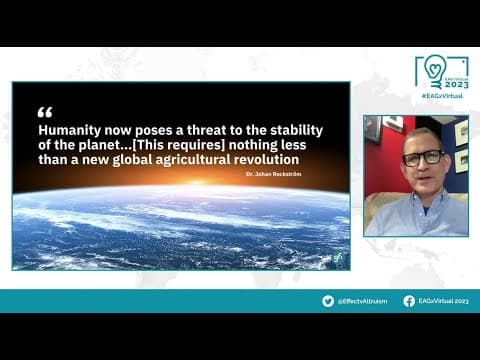
[1:06]Uh, thank you so much, Aleka. I am delighted to be here, and thanks to uh everybody for for turning up uh to hear a presentation about long-termism and alternative proteins. So, um, this is a quote from uh, the one of the lead scientists uh on the Eat Lancet Foundations uh report from 2019. Uh, basically, they dived into the environmental consequences uh as well as the health consequences of the way that we are producing meat, dairy and eggs today. Uh, and determined that it is all unsustainable. Uh, it's horrible for human health, it's horrible for global health, uh, and it's horrible for the environment. And he declared that humanity now poses a threat to the stability of the planet, and that this requires nothing more, uh, nothing less than a new global agricultural revolution. Uh, so, that's where I stole the fourth agricultural revolution, um, concept from. What I want to talk about uh today is this. Uh, meat production, uh, this is what I will, what I will cover. Uh, first, that meat production has risen inexorably uh for many decades, and the growth is going to continue. Uh, second, I am going to suggest that our only strategy for changing this trajectory is support for alternative proteins, that uh, and this is a a bit of a challenge to everybody on the call. If you think, uh you were optimistic about something else that decreases the upward trajectory of meat consumption globally, I will be very enthusiastic to hear from you, um in office hours or offline. Uh, third, that alternative proteins address multiple risks to long-term flourishing and should be a not the priority for long-termists. Um, fourth, just a uh quick GFI primer, a little bit about what we're doing, um, and then we'll have some time for uh, discussion at the end of this. Uh presentation, and then I've got office hours, um immediately after this. So, would love to see anybody who would like to come to that, uh there. You are also welcome to email me. Uh, my email address, everybody's email address is just first name last initial at gfi.org, so mine is Bruce, uh F as in Friedrich, at gfi.org. So, uh, the entire presentation and and GFI's founding, um, is predicated on this observation, um, that meat production uh globally just keeps going up. Um, since 1961, it's up from about uh 700 million metric tons of land animal meat, uh to now more than 350 million metric tons of land animal meat. Um, I keep uh my I've got, uh, there we go. Uh, it's 27 years until uh 2050. Uh, in the last 27 years, meat production has gone up 80%. There have been 11 peer review articles about what meat production's going to look like through 2050. The lowest prediction is 62% more, the highest prediction is more than two and a half times as much. Um, but something like the last 27 years is probably going to be replicated uh in the next 27 years. Uh, a lot of what people discuss about what it looks like to decrease meat production, um is focused on Europe and the United States, um or other developed economies. And I'll just point out that uh when we're looking at this prediction or we're looking at this reality, um, a lot of that uh is China, um, and Asia, and Africa, um, and low and middle-income countries where they're still way below, um, developed countries per capita, but but as they develop, they are, you know, moving toward catching up. Um, so if you've got an intervention somewhere, um, it needs to be scalable globally, would be basically, um, one of my challenges. Uh, so this is the expectation through 2050, according to the United Nations Food and Agriculture Organization. Um, and the main thing, uh, the, you know, sort of observation of GFI and why I founded it, um, is that we have been using the same strategies to address this problem, uh for basically the last 50 years. Um, so 52 years ago, the book Diet for a Small Planet came out. That's the book that caused me to go vegan, um all the way back in 1987. Uh, but the amount of meat consumed uh since I went vegan in 1987, it's gone up every single year. So, um, I definitely think that all of the strategies that we have been implementing, um, they have helped, they help, um, but they are not up to the task of changing the massive upward trajectory that we're going to see through 2050, um, and that we have seen, uh, inexorably for, you know, ever, basically. Um, so we've been educating people about the planetary consequences of meat production, we've been educating people about the health consequences. Uh, there have been a non-stop stream of undercover investigations about the cruelty, um on industrial farms and in slaughter houses. Um, and even in the United States, um, the five highest years for per capita meat consumption in the United States are the most recent five. Um, and meat consumption just keeps going up and up and up. Uh, but of course, the United States, uh, if we have solutions in the United States, we need we at least need a theory of change for how they can scale, um, globally, um, because education is not going to be enough globally. Uh, GFI's, um, observations, sort of our, our inspiration, um, was the founding of Beyond Meat, um and Impossible Foods, um, and then Hampton Creek, now Eat Just. Um, and the observation of the people who founded those companies, um, was that meat is made up of fats, proteins, minerals and water. That is everything that is in meat, fat, mineral, minerals, um, protein and water. Fat, protein, minerals and water. Um, plants also have fats, proteins, minerals and water.
[7:30]We should be able, um, if we put the R&D effort in, uh to create products that replicate the precise meat experience, uh, but using plants. And because it is so much more efficient, we should be able to do that um at a lower cost as it scales up. Um, so that is the theory of plant-based meat.
[8:00]Cultivated meat, um is actual animal meat, um, but instead of, I mean, just like you can uh take a seed or a cutting from a plant, and you can bathe that seed or that cutting in nutrients, um and that seed or that cutting will grow into a full plant. You can do the same thing with a small sampling of animal cells from a chicken or a pig or a fish, um or whatever other animal. You can take uh small sampling of cells, bathe those cells in nutrients, they will multiply and grow, um and become actual animal meat. And because that process is so much more efficient, because it requires so, you know, four, three to four fewer stages of production, um, we should be able to scale that up, um and produce actual animal meat, uh but at a lower cost and without the external costs of industrial animal agriculture. Um, we believe this is the one solution to the increase in meat production that analogizes to renewable energy and electric vehicles. Uh, which is to say that uh, if you're talking about electric vehicles and you're dealing with uh the carbon, uh the emissions coming from gas powered vehicles, um, we absolutely should have more walkable cities. We absolutely this is Tigger by the way. Um, She wanted to come by and say hi. Uh, we absolutely should have more walkable cities. Uh, we absolutely should have great public transit, uh, but there's nobody who thinks we're going to convince the world uh to buy fewer passenger vehicles as uh populations go up, um and as economies develop, there will be more passenger vehicles, uh, and there will be more miles driven. So, all of the above, we need those other things, but we also need EVs. Um, similarly with renewable energy, um, as the world approaches 10 billion people and as developing economies develop, um, the world's going to consume more energy. So, we should absolutely have everything from more energy efficient light bulbs to more energy efficient buildings. Um, but at the end of the day, we need renewable energy to address the emissions, um of fossil fuels to make that shift. Um, same thing here. Um, unless somebody on this call has some new strategy uh that uh, I haven't heard of, um, and I've been asking this question a lot to people who have been working in food systems and climate for decades. Um, unless you've got some new strategy, uh, the world is going to consume more meat. Um, 11 peer review articles, the lowest prediction is 62% more in 2050, um, and absolutely, we should be educating people, absolutely about uh healthier diets. We should be educating people about uh agroecology, about all of it. Um, but we're going to have more meat. So, let's make it from plants and let's cultivate it from cells, is basically the challenge. So, more energy production through 2050, more cars sold, more miles driven. Um, and more meat. Uh, we need to change the way the products are produced rather than trying to change human nature. Uh, there just appears to be something in human physiology or psychology, I don't know, uh that uh people just want to eat meat, um, so they keep eating more of it. Uh, this is a way to give them the meat that they love, uh, but with a fraction of the external costs.
[11:59]One thing to say about this is this is uh this is not, uh you know, I went vegan in 1987. Uh, this is not the veggie burgers of even a decade ago. Um, up until Ethan Brown founded Beyond Meat and Pat Brown founded Impossible Foods and then Hampton Creek now Eat Just, focused on doing the same thing with egg proteins. Um, the idea of plant-based meat was basically, uh, the soybean oil industry had all this soy protein that was basically a byproduct. Um, and the pasta and bread industries had all this wheat protein that was basically a byproduct. And the idea of plant-based meat was let's take that protein, uh cram it into something that looks like a veggie burger, um and let's force vegetarians to eat it. That was basically the concept. And the idea that you could take plant protein and replicate the precise experience of animal protein, um is absolutely brand new with those two companies plus uh Hampton Creek now Eat Just, focused on doing the same thing with egg proteins. Um, and the thing that they discovered that we discovered, um is that the scientific challenges are not easy, uh but the more people dive into them, the more surmountable they seem. So I want to do a shout out uh to GFI Europe's um science manager, um a couple 80,000 hours podcasts ago. Um, basically just dived into the question of uh, what does it look like. All right, the response time is not great, so I'm not going to flip back slides. Um, but basically, dived into the question of what does it look like um to take plant proteins, um and use science to cause them to function um and have the taste experience of animal protein. Um, and she did the same thing with fermentation and the same thing with cultivated meat. So, it's a two-hour discussion of what it looks like to replicate um the exact same meat experience from the vantage of the consumer, um using plants, fermentation, enabling technologies as well as biomass fermentation, um and cell cultivation, and I I highly recommend it. Um, so this is about long-termism, uh which means it's about existential risks. So the question is, um, all right, um, all very interesting, um, but what's the existential risk? And I will say uh Toby um in the precipice, uh has this chart, um and he also says risks that are greater than one in a thousand um in a century should be central global priorities. Um, and I will suggest and I'll take maybe the next uh 10 minutes or so to posit, uh that a shift to plant-based and cultivated meat, um will slash climate emissions, um will slash other environmental damages, um will slash naturally occurring pandemic risk. Um, I'm going to challenge or at least uh offer some questions around uh Toby's one in 10,000 um chance within the next 10,000 years of a naturally arising uh pandemic, um being an existential risk. And I think, um, I hope convincingly, uh talk about a couple of other things uh that uh, I think place this into, um what uh Toby says in the precipice should be central global priorities. Um, and I will say again that it's not uh alternative proteins should be the uh central focus of long-termists, but that it should be a central focus. Um, and my main sort of thinking goal with this topic, um is sort of twofold. Um, one is just anybody interesting interested in long-termism, as you're thinking about what is my place, uh, in the movement uh to preserve humanity. And you're thinking about, okay, how important is it, how tractable is it, how neglected is it, and what is my counterfactual value? Um, this would be a very reasonable place to dedicate time, um across that analysis, um and also if you're doing something in politics, um, so for example, you're working at NSE or you're working at D-O-D, or you're working at NSF, um, you will have a portfolio, um, of projects that you're working on. They're not all going to be unaligned AI, um and um great powers conflict, um and um bio engineer pandemics, etc. that you will have different things. Um, so if you're in long-termism philanthropy, um, or you're in long-termism, if you're in long-termism and you can have a portfolio, this should be in your portfolio, is uh my uh my main uh focus with this talk. Um, so climate change, one in 1000. Um, the consensus is in. Um, I have not heard any climate scientist or anybody who works in climate, um, disagree with the idea that Paris climate goals are impossible unless meat consumption goes down globally. Um, so even at the 352 million metric tons of land animal meat that we're eating now, plus another roughly 200 million tons of sea animal meat. Even at that, that is going to preclude um hitting Paris climate agreement targets. Um, and the intergovernmental panel on climate change isn't even hand wavy, um in their reports about how we cause that to go down. Um, in their modeling, they just assume it's going to go down. Uh, they assume that the stuff we've been trying for 50 years that hasn't worked, um is somehow going to suddenly work. Um, alternative proteins is the only way that this happens. Um, so this is all of the um L C A's that exist in terms of uh climate emissions, land use and air pollution. Um, in terms of climate emissions, as you will see, um, even at the scale we're at now, um, something like an Impossible burger or a Beyond burger uses something like a 20th of the land. Um, and causes something like a tenth of the direct emissions. I mean, think about the fact that if you get an electric car, um over the lifetime of the car, that is going to roughly cut your emissions from transportation in half. Um, if you switch from animal-based meat to plant-based meat, um, it's literally, or cultivated beef down at the bottom, it's literally one tenth of the emissions. Um, which is a significantly greater um payback. Even something like plant-based chicken, um is roughly the same as switching to an electric vehicle. Um, it's roughly half of the direct emissions. Um, and that doesn't even include the land use advantages which have massive sequestration opportunities. So, something like a 20th, um of the land, uh for plant-based beef, um and even a sixth of the land for plant-based chicken. Um, whereas if you're looking at something like solar or wind, um as renewable energies, they actually require 10 times as much land per unit of energy relative to fossil fuels. Um, this is both a um direct emissions benefit, um and massive sequestration potential. Um, a couple of modelings, um, so Nature Communications, this uh article from, uh CGIAR, uh USAID, um, and other modelings from McKinsey economists that was done for the for Climate Works Foundation and the UK Foreign Commonwealth and Development office. Um, these are significantly bigger numbers, um even than shifting completely, um to electric vehicles. Um, and these numbers don't even include the 26 gigatons um of sequestration uh potential that's available from this kind of a shift. Um, Boston Consulting Group said that a shift to alternative proteins at 11% penetration, um would be the same as grounding every airplane on the planet. Um, so 11% alternative proteins is complete decarbonization, um of air travel, would be the equivalent. Um, I want to talk for a second about naturally arising pandemics. Toby puts the risk um at one in 10,000. The first place that I want to ground this conversation, um is this report, um from July of 2020, the International Livestock Research Institute, and the UN Environment Program, 13 of the leading zoonotic disease specialists in the world. Um, and this is their list, um of the seven most likely causes of the next pandemic. Uh, as you'll see, the first one is increased demand for animal protein. Um, so the first one is just, wow, we're, you know, producing 350 million metric tons of animal meat right now. Um, every one of those animals is a potential vector for the next pandemic, um, if we're going to keep going up at 70 to, you know, double by 2050, um, that is going to increase that variable, um, by that much more. The second one is factory farming. Um, so the second one is the fact that we have all of these basic genetic clone animals, which means they don't have the constitution to fight off disease. Um, so diseases in these, um, animal factories are basically, you know, spread like, well, they spread like viruses. Um, so those two literally go away, uh with a shift to alternative proteins. So, two of the seven go away, um, six of them are at least mitigated. And then the other thing to say is all of these are skyrocketing, um in the modern world. Um, every single one of these is going up, um, well, most of them are going up by orders of magnitude, certainly the first two are. Um, so Toby's uh analysis in uh the precipice, he says, if we take uh the fossil record as evidence that the risk was less than one in 2,000 per century, then to reach 1% per century, the pandemic risk would have to be at least 20 times larger. Um, and he says this seems unlikely. Um, and I'll just say I don't think it seems unlikely at all. Uh, if you uh agree with the 13 uh scientists who put that report together, um, two of the direct causes, um, increased meat production and the industrial treatment of animals. The second one didn't even exist, um, when he's looking at the fossil record, uh the industrial treatment of animals. Um and the first one is growing exponentially. So, he's looking, um at the 1800s as his last uh comparator. Um, animal agriculture is already up 3,500% from the 1800s. Uh, it's going to be up 7,000% by 2050. Um, so the first one, um is up, you know, by 2050, 7,000%. The second one up is up an infinity. We're going from no genetically, you know, genetically, uh basically identical non-dissimilar animals to almost all of them. Um, and all of those transportation, exploitation of wildlife, um, the connectivity, um of the world. Um, all of those are up vastly since the 1800s. Um, so if anybody has a a more recent analysis of pandemic risk, I would love to see it. Um, but uh, it does seem entirely plausible to me, uh that we're up to one in a hundred or at least one in a thousand on pandemic risk.
[26:47]Um, I also uh just want to do a quick shout out, um or just quickly, um cover this. It's not treated, um in the precipice, I don't think. Uh but antimicrobial resistance, the UK government says the risk to humanity from antimicrobial resistance or in the US it's called antibiotic resistance. Um says that threat is more certain than the threat of climate change. Um, so about 70% of medically relevant antibiotics, antimicrobials, um are fed to farm animals right now. Um, if we're producing twice as many farm animals in 2050, the use of these medically relevant antibiotics is going to skyrocket. Um, that is leading uh to super bugs that you get sick, uh and the drugs don't work. The former head of the World Health Organization said uh the world is heading toward a post-antibiotic era in which common infections will once against kill, once again kill, uh this will be the end of modern medicine as we know it. Um, so definitely seems like something that long-termists should be thinking about, um and then the last one, um on this list is other environmental damage. And I'll just say that uh the inefficiency of growing crops to feed them to animals so that we can feed animals, um should feel probably intuitively obvious to people. Uh, takes nine calories into a chicken to get one calorie back out, takes 40 calories into a cow to get one calorie back out, um that's literally 800% food waste, um just in the physiology of the chicken. 3,900% food waste, um and the physiology of the cow, the vast majority of the calories that you feed to the animal, they expend simply existing, um or it goes into feathers, blood, bones, whatever. Um and it's not just that, you're then you're growing all of those crops, nine times to 40 times to the land, the water, the pesticides, the herbicides, you're shipping that stuff to the farm, operating the farm, shipping the animals to the slaughter house, operating the slaughter house, shipping, um, yeah. So, it's like three or four extra stages of production, gas-guzzling pollution spewing vehicles, massive energy intensive factories, um when the UN crunches the numbers, um, they say uh, whatever environmental issue you're looking at, um from the smallest and most local to the largest and most global, animal agriculture is one of the top three harms. So, um again, shifting to something that doesn't require all of the inputs and the extra factories, um is going to um decrease everything from soil desertification to air pollution to water use and pollution, all the way down the line. Uh that's the food security that I was just, oh, and then obviously that also has positive ramifications for food security.
[30:31]We have gone from somewhere on the order of uh 750 million metric tons of corn and wheat, um being fed to farm animals in the inefficient system that I just described, uh to more than a billion, as of a couple years ago, million metric tons of corn and wheat fed to farm animals. Um, plus another 270 million metric tons of soy, um fed to farm animals, that just keeps going up. Um, in a global economy, it creates a competition for, um all of that food, uh between are we going to feed it to chickens, um or we or are we going to feed it to people in uh developing economies who literally don't have food to eat. So, hundreds of millions of people who are food insecure, um, and funneling crops to animals makes them more food insecure. Um, that's one of the points of this center for strategic and international studies report, which I cannot recommend highly enough. Uh, they dive into, uh alternative proteins across everything I'm talking about, uh, but they really lean into food security, called food security, global security, um and call for governments to fund this transition. Um, I'm going to go, I'm going to skip moral circle expansion, other than to say that it's another long-term, it's a, it's a sort of in in the direct, um, line of long-termism thinking. Thank you. Um, if we can get to a place where people's meals are not predicated on the animal suffering that's involved in, um, creating meat, uh that can help us move in the direction of moral circle expansion, um, which would be which is, you know, sort of an obvious in brass tax issue for long-termism. Um, and then the other thing that uh analogizes to renewable energy and electric vehicles about alternative proteins, um is that unlike most or all of the other solutions to the harms of fossil fuels, um gas powered vehicles, um and meat production. Um, this has massive economic returns, which incentivizes uh the technology scale globally.
[33:10]Um, so again, McKinsey economists for Climate Works Foundation, Foreign Commonwealth and Development Office, they said that this industry can be 1.1 trillion dollars, um by 2050, um and 10 million jobs. They updated that a little bit later, uh to 700 billion dollars and 83 million jobs, um either way, um massive economic opportunity.
[33:49]This is uh more McKinsey modeling that was done in April of uh this year. Um, they looked at all of the forms of food systems, methane mitigation. So they looked at food loss and waste, they looked at rice mitigation, they looked at livestock interventions, um, and they looked at alternative proteins. And they found that 98% of the economic value of all of these technologies, um was alternative proteins, um and more than two thirds of the jobs, 83 million jobs. So, um huge economic incentives and that's how it scales globally.
[34:40]So, um again, that CSIs report, um, they literally say that the US government should incentivize alternative proteins, um with the same sort of um diligence that the US government is incentivizing our pharma industry, our clean energy industry, and advanced chips for artificial intelligence. Um, there isn't anything else that is uh meat mitigation intervention, um that has this kind of incentive structure uh that massively increases the tractability, massively um increases the tractability analysis. Um, so GFI, uh GFI, we are actually, we're basically a science think tank. We have about 215 full-time staff, uh the plurality of our team members are scientists, um, we operate it's a, it's actually six organizations, so there's uh six independent GFOs, uh and NGOs. There's GFI in the US, plus India, Israel, Brazil, Asia Pacific and Europe. Um, I'm so glad that Ticker, Tigger has decided to now sit down. There she is, isn't she gorgeous? Um, rather than uh putting her tail in my face. Um, and we are essentially, uh for alternative proteins, what an organization like Environmental Defense or the World Wildlife Fund, um is for renewable energy or electric vehicles. Um, if you want to really deep dive, uh into almost everything we're doing, uh you can go to gfi.org/plan, um and you'll see our uh strategic blueprint. It was just updated uh last month, um and it walks you through, um in the US and globally. And then there's some culture analysis, metrics analysis, etc. at the at the end. And um that has been on our website since the beginning of GFI, and we're uh in version nine, we just updated it. Um, we're really honored, uh that Giving Green, which is a an EA climate evaluator, uh did a deep dive into, um our programs, our theory of change, um, how we measure, um our impact, um, culture, everything, um, and they picked us as one of six, um, top nonprofits, uh for climate mitigation, um across impact, uh tractability, um and neglectedness analysis. Um, and very cool, Charity Navigator, uh did their due diligence on Giving Green and selected Giving Green and just basically, um took Giving Green's recommendations. And so now if you go to charity navigator and click on climate mitigation top charities, um GFI is also there, which we're delighted by. Um, if you dive into gfi.org/plan, you'll find that, uh we have three, um key programmatic objectives. The first one is science, the second one is government, the third one is, um, industry. Um, so the plurality of scientists, our overall focus is what does it look like to solve the scientific challenges of making meat from plants, cultivated meat from cells, um at the same um that it that it tastes the same or better and costs the same or less. Um, the way we think you do that is you can convince governments to prioritize making that happen. Um, so our global battle cry is that government should be prioritizing the transition, um and we've had incredible success putting this onto the explicit agenda, um of the UK government, the European Commission, the German government, um all of the places that we operate. This is working. Um, and our scientists are actually integrating with the scientists, um who make the decisions about what to prioritize and how to prioritize, um in all of these governments. Um, and then the complement to that is industry. Um, with industry we have relations with the biggest food companies, the biggest meat companies, uh basically helping them to see this as opportunity, not threat, um and as transition, not disruption. Um, and then as part of our think tank role, we have a monthly webinar, the business of all protein, a monthly webinar, the science of all protein, and a steady stream, um of both science analysis, um and industry analysis. And in the interest of time, happy to share this deck with anybody who would would like it. Um, this is kind of our pride and joy, it's our university program, which is a very rigorous program to make sure that anybody at any of the 53 universities that we operate in, if you are a tissue engineer, plant biologist, really anything in biosciences, uh we want to make sure that you know you can save the world, uh by focusing your talents, um on alternative proteins. Um, again, um Seren Kell, our GFI Europe science manager, in Nature Biotechnology had basically, um a five-page, this is why all of you should do alternative proteins, and this is how you can do it. Um, more resources for scientists. This is our global battle cry. Um, this is we are purely focused on affirmative. Um so GFI is not opposing anything that industry is excited about. Um, we are purely focused on research and development and scale up, which is these priorities. Um, once again, we frame it. It is bipartisan. Um, even Donald Trump's secretary of agriculture and FDA commissioner were enthusiastic about this. Um, in the US, our main policy leave behind has a big quote from Sonny Perdue, who was Donald Trump's Secretary of Agriculture, um and was a two-term governor of Georgia, um a very conservative state. Um, and it's uh exactly what CSIS says, economic opportunity. Um, GFI is one hundred percent powered by philanthropy, and we agree with uh animal charity evaluators, uh and Giving Green, and Charity Navigator, and others, that uh we're a particularly good outlet for that. Um, and so my second, like if you're looking for best marginal investment of resources, um you think GFI is an excellent option. Um so the part two of giving this talk is, um all of the folks in long-termism and philanthropy, um, because you will have prospective donors who come to you, who will be particularly enthusiastic about something else, like climate change or biodiversity or global health. Um, we are a phenomenal option in biodiversity, climate change and global health. Um, and again, have being able to recommend, um excellent charities, um and even use, you know, not your primary focus, but even sort of your tertiary focus on um steering money toward this. Um, will be a huge value add in the world, um, that, uh that I'm hoping people will consider. Amazing. Thanks so much. And um so this for everyone concludes our session. Bruce will have office hours right now in the next session, the next talk will begin in about 10 minutes. Um, so I'll give a big virtual round of applause for Bruce.