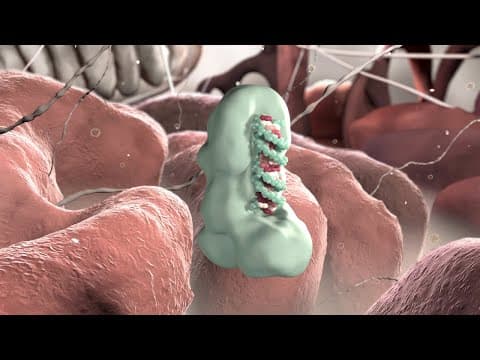
[0:06]This is a cell, the basic unit of all living organisms. Our body consists of different cell types like skin, muscle, or bone cells. They have different structures and functions, but contain similar components like the nucleus. The nucleus contains the DNA that encodes the instructions for cell development and function. This information is arranged into segments of DNA called genes. Almost every cell contains identical copies of DNA, but if there are the same instructions for all cells, why are there so many different types? The reason is gene silencing. Genetic information can be switched off. So, during development, a cell only reads instructions that are necessary for gaining the characteristic structures and functions. For gene silencing, a cell can use a micro RNA. This powerful molecule is able to turn off genes by inactivating messenger RNAs, which are necessary for translating the genetic information into proteins. In this way, genes can be turned off. Micro RNAs participate in the regulation of the cell from its development to its death. Their disregulation can have serious consequences for our body and can cause a range of diseases such as cancer and heart disease. Having such a big impact on our life, micro RNAs deserve a closer look. So, let's start at the beginning.
[1:45]Similar to proteins, the genes coding for micro RNAs are contained in the nucleus in the DNA. Each gene is transcribed by RNA polymerase 2, which produces either a regulatory or a messenger RNA. In this case, the transcript is a primary microRNA which forms a typical hair pin loop structure. It will become the final micro RNA with regulatory function after several steps of processing. First, the double stranded stem is recognized by the protein DGCR8. An enzyme called Drosha associates with DGCR8 to form a microprocessor complex, which is able to cut the RNA into a smaller precursor micro RNA. It can now be exported into the cytoplasm, where it will inactivate the messenger RNA of one or multiple genes. The precursor microRNA is carried out of the nucleus through a nuclear pore by the transporter molecule Exportin 5. In the cytoplasm, it is recognized by a large RNA's protein called Dicer. Dicer cleaves the stem loop and forms a short double stranded microRNA molecule. In the next step, an Argonaute protein Ago2 interacts with Dicer to bind the microRNA. The microRNA is unwound and one strand is released. The remaining strand calls the guide strand, interacts with Ago2 and some additional proteins to form the RISC, the RNA induced silencing complex. It can now be guided to its target and inactivates one or multiple genes. The messenger RNA of a target gene is complementary to the sequence of the microRNA, that enables base pairing. Once bound, there are two ways in which RISC can inactivate the MRNA. Proteins in the complex can simply cut the messenger RNA, which will be further destroyed by the cell.
[3:50]Inhibition of translation is another mechanism. In this case, the RISC complex prevents the ribosome subunit from binding. In both cases, the messenger RNA will not be translated into a protein and the gene is silenced.
[4:08]Since their discovery in the 90s, major parts of the microRNA's pathway still remain unclear. However, with their essential role in many biological processes, micro RNAs offer great potential for medicine and might lead to key treatments of various diseases in the future.


