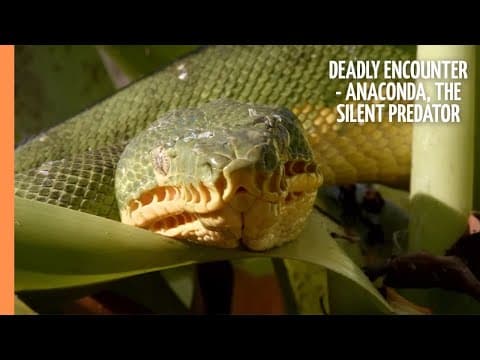
[0:03]The Anaconda, a huge, aggressive, voracious swamp monster. A cunning ambush killer, always ready to crush its next victim to death.
[0:16]It could be you. This is the scarf of nightmares.
[0:26]A silent killer with over six meters of sheer muscle power, as thick as a car tire. But is this the real Anaconda?
[0:54]South America. The Caribbean nation of Guyana on the northeast coast, boasts one of the largest unspoiled stretches of rainforest on the continent. Home to a huge, almost legendary reptile.
[1:16]The biggest and heaviest snake on earth, the Green Anaconda. Its enormous size and grizzly killer habits have given it a bad reputation. The floodplains, swamps and rivers, east of the Andes, are its home, and water its element. But its secretive ways mean this silent killer remains an enigma. Anacondas kill by literally squeezing the life out of their victims. This deadly embrace is the strongest known on Earth.
[2:03]It's like nine people standing on your chest. It may be a horrific way to die, but for this scaly predator, the technique is a success. Constriction is one of the oldest hunting methods among snakes. It's made the Anaconda a winner for at least 20 million years, including today. An enormous monster lives right among the people of Georgetown, and they have no idea it's there. It seems unlikely such large creatures could remain unnoticed, but Anacondas have found secret sanctuaries in the urban jungle. Water ditches are a convenient hangout.
[2:54]As night falls, a silent killer is on the loose.
[3:03]In fact, the city offers an easy life. There's plenty of food walking the streets.
[3:26]A dog is just the right size for a snack. You just have to know where to find it. Anacondas may have a trick to seek prey even in the dark. It's thought they can sense their body heat. Almost every organism has its own heat signature. Although a snake wouldn't see a picture like that of a thermal camera, it could enable it to target victims accurately. Under the cover of darkness, the Anaconda's deadly activities go widely unnoticed by its human neighbors. And the menu is by no means restricted to our canine friends. The good thing about living near people is their livestock.
[4:16]Snakes lost their legs in the course of evolution millions of years ago, but for these smooth assassins, it's no disadvantage.
[4:31]Being super flexible and extraordinarily strong means no obstacle is too big or too small.
[4:52]Testing the air with its fork tongue, the predator seeks out its prey.
[5:03]For the chicken, escape is futile.
[5:11]The struggle is brief as the Anaconda's body winds itself around the hapless bird. Its embrace becomes tighter and tighter until the chicken dies from asphyxiation.
[5:37]City life even offers a few comfortable, if risky, niches to warm up.
[5:44]In the cool of the night, a car engine must seem like a heavenly place for an Anaconda.
[5:54]Anacondas love the warmth. Around 28 to 35 degrees Celsius is ideal. They tolerate a little less at night, but still, a warm niche is like a magnet for them. And if you're this flexible and strong, nothing comes easier than getting into a cozy nest like this.
[6:31]As day breaks, the cityscape is transformed. Lotus flowers enchant. They were first brought to Guyana from India and have spread like wildfire in canals and ponds. The land here lies below sea level, so the ground drains badly, and there's plenty of standing water, perfect Anaconda habitat.
[7:00]The thick forest of lotus flowers and leaves is also home to small creatures that make ideal baby food for Anacondas. The leaves can reach 60 centimeters across, a perfect perch for a young hunter.
[7:18]This one is still less than a meter long and just a few months old, but already a killer.
[7:30]Many young Anacondas don't survive long. There are wildcats, stray dogs, or simply urban traffic to contend with, but here among the lotus, the baby is safe. It's these drainage canals that have allowed the giant snakes to thrive in the urban sprawl.
[7:54]Swamps and marshes used to cover this land.
[8:00]But over the last centuries, humans have turned swamp into solid ground, land that was traditionally the Anaconda's realm.
[8:14]Because it's low-lying, it's exposed to the relentless attack of the sea.
[8:21]An extensive protective wall had to be built to replace a natural buffer, coastal mangroves. Before humans moved in, a sturdy belt of mangroves lined the fragile coastline, shielding it from the seas merciless assault. Their tangled roots anchor the trees, trap soil, and break the power of the waves, so the coastline is safe and stable. Surviving where land and sea meet, they've had to find ingenious ways of reproducing. Red mangrove seeds begin to germinate while still attached to the tree. They're also buoyant and can be dispersed widely by the water. Eventually, the seed changes its density to float vertically, ready to root itself in the coastal mud and grow.
[9:21]There are usually only three or four different tree species here, but they support one of the most productive and complex ecosystems on Earth.
[9:37]Mangroves thrive in sweltering conditions, rooted in choking mud, and tolerate salt levels that would kill ordinary plants. They line coastlines and estuaries, where the salt content decreases. Even Anacondas can survive here. We tend to think of Anacondas lurking in inland swamps, yet here they are, right in the thick of the tangled mangrove roots, where the river meets the sea.
[10:09]Everyone here has to be exceptionally tolerant to an ever-changing environment. Twice a day, the tide floods the mangroves, then leaves them high and dry. It triggers a changing of the guards, a different set of animals now emerges. Crabs come out of hiding and patrol the roots. A young Spectacled Caiman squelches through the mud, looking for food, unaware he's being watched.
[10:46]The killer waits patiently for the perfect moment to strike.
[10:53]An Anaconda's hunting success depends on split-second timing and speed.
[11:20]Caught in the snake's deadly coils, the last breath is squeezed out of the Caiman's body.
[11:32]Where mangroves have given way to the unquenchable human thirst for terra firma, a new landscape emerges, sugar cane plantations. It's a different sort of forest with a different bunch of residents. But since the fields are left largely undisturbed for months at a time, it draws a sizable crowd of creatures. And yet again, where there's food, there are Anacondas. There's plenty of choice.
[12:07]Even a quick-legged Iguana is a target.
[12:15]Distracted by food, it lets its vigilance slide. A fatal error.
[12:34]Death comes quickly, but eating the prize is a slow affair. Even a small meal like this takes around 30 minutes to swallow.
[12:53]But life in the fields is a double-edged sword for the Anaconda. During harvest time, everything changes. The fields are set on fire to burn dry leaves and flush out unwanted critters.
[13:13]Miles of lush green go up in smoke. Animals desperately try to get away from the hellish inferno, but many succumb to the flames.
[13:32]The Anaconda's cumbersome bodies are sluggish and awkward on land, too slow to escape the fire.
[13:44]Were it not for the numerous drainage ditches. It seems that as an Anaconda gets bigger, its confidence also grows. It no longer needs to be aggressive to intimidate enemies. At this size, she has nothing to fear.
[14:04]Our preconception of Anacondas as terrifying swamp specialists is plain wrong. They're in fact extremely versatile and secretive. Even in the Anaconda's traditional home ranges on the savanna, the extremes of wet and dry seasons force them to be adaptable.
[32:36]Black Caiman's don't venture beyond the falls, but they're no barriers to the Anaconda.
[50:04]The Anaconda is different to most reptiles. Rather than laying her eggs in a nest, exposed to marauders and at the mercy of the elements, the mother carries her young with her.
[50:44]Incredibly, she now gives birth to live young.


