[0:00]Mahatma Gandhi pulled off something that had never been done before in human history. He turned non-violent resistance into a political weapon powerful enough to fight off a world empire without weapons or an army. And in 1947, he and India won. They made British rule morally indefensible and politically unworkable without a bloody revolution. Yet within a year, a million people, maybe a lot more, were dead in one of history's worst massacres. As India split along religious lines into India and the new country of Pakistan. I'll describe how violent that became because by modern standards, it's difficult to even comprehend. And then I'll get into not only what happened in India, but how patterns of revolutions and violence repeat throughout history. How idealistic movements collide with machinery of powers, even when they start off peaceful. I'm Ken Lacourt, and I dug into what happened during the India partition and why revolutions so often descend into terror. We'll look at how non-violence became slaughter. It's partially explained because destroying is the easy part, but we'll also take a look into other reasons why revolutions turn deadly. And finally, we'll take a broader look asking if blood is the rule or the exception with an interesting Indian comparison to the American Revolution. Okay, so how did non-violence become slaughter? Britain ruled India for nearly 200 years. They extracted its resources and built a system that funnelled wealth back to London. Cotton, tea, spices, India helped make Britain rich. The British East India company ran the place like a business until 1858 when the crown took control after a massive rebellion. By the early 1900s, India was generating enormous profits, while Indians themselves had foreigners running their country. The British Empire controlled a quarter of the world's population at that time. They had the most powerful military on earth, and Gandhi's revolution fought them not on a battlefield, but through shame and moral pressure. Mass protests, hunger strikes, boycotts of British goods. When the British arrested him, thousands more took his place. When they beat protesters with clubs, the protesters didn't fight back, and the images of disciplined Indians being brutalized by armed British soldiers turned world opinion against the Empire. How do you justify ruling people who refuse to hate you back? It made British rule morally unsustainable and turned occupation into an embarrassment. After the end of World War II, facing pressure both in India and at home, Britain finally gave up. But the speed of Britain's exit turned triumph into catastrophe and showed how even the most disciplined movements can lose control when power changes hands faster than a new structure can form. For a few years beforehand, it was starting to be obvious that the British were on their way out. The Indian National Congress, the Muslim League and others, they were fighting over the shape of the future of the country, and violence was already starting to occur. Then the new British Viceroy, Lord Mountbatten, accelerated the timeline from June 1948 to August 1947, giving the country essentially 10 weeks to end two centuries of colonial rule. The borders between India and Pakistan, they weren't even published until August 17th, two days after independence. People went to sleep in one country and woke up in another. Villages that had been mixed Hindu-Muslim for generations, suddenly had to choose side, and nobody planned for population transfers because the assumption was that people would stay put. The British-Indian army was being divided along religious lines, exactly when it was needed the most to maintain order. Muslim soldiers went to Pakistan and Hindus to India. The force that might have prevented the massacres instead split apart as the massacres began. Local governments collapsed and new city governments had zero authority. No track record, no ability to protect anyone. British troops stayed in their barracks under orders only to save British lives. The enormity of the situation makes numbers hard to pin down, but between 12 and 20 million people fled their homes in what became the largest force migration in human history. Muslims ran to Pakistan and Hindus and Sikhs went to India. And the violence was difficult to wrap your head around. Most wasn't random, but systematic and organized. Neighbors turned on neighbors they'd lived next to for generations. Gang set entire villages on fire. Pregnant women were mutilated and babies killed. Men were dismembered with their genitals cut off and corpses were displayed as warnings. They estimate that 100,000 women were raped or abducted. Some killed themselves or their children rather than face that, and others were murdered by their own male relatives to preserve the family's honor. Entire train loads arrived at stations with every passenger slaughtered and their bodies stacked in the aisles. When it comes to the numbers of people killed, there's wide estimates from 200,000 to 2 million, with some recent researchers putting it closer to 3 million dead. Many people, including me here, go with 1 million because it's round and it's a reasonable defensible number. But whatever that number was, it clearly wasn't what Gandhi and other leaders wanted. He had opposed partition until the end and spent his final months trying to stop the violence, fasting, walking through riot zones, begging for peace. Five months after independence, a Hindu nationalist shot him dead, blaming him for being too sympathetic to Muslims during partition. This clearly wasn't Gandhi's fault in a direct sense. He didn't draw the borders or rush the timeline. He spent his final months trying to stop the killing, but his success in forcing Britain's hand created the conditions. The moral pressure, the mass movements, the religious and nationalistic fervor he helped activate to throw off British rule, turned lethal the moment the Brits were gone. Victory came too fast for anyone to really figure out what to do next. So Gandhi achieved what he fought for, India's independence without a war, but the gap between tearing down an empire and building a new country was filled with a million dead bodies. But before we get to that, let's talk about something that we've all felt, because everything costs more now. Whatever you had saved in 2020 has lost about 22% of its value. Not because your savings shrank, but thanks to inflation. And here's what most people don't think about. Most retirement accounts are 100% tied to the stock market. So when it drops, your savings drop with it. So what do you do? A lot of people diversified part of their retirement into physical gold, something that doesn't care about what the Dow does or what the politicians do to the dollar. That's what today's sponsor, Augusta Precious Metals comes in. They've been around for over a decade and they're known for education, not sales pressure. They help you understand how gold IRAs work, how you can move part of your retirement into physical gold without the taxes or penalties. Especially for this field, I researched them and saw excellent feedback. They're A+ rated with the Better Business Bureau, and they'll walk you through everything in simple steps and handle most of the paperwork. If you want to learn more, Augusta offers a free guide that explains how this works and whether it makes sense for your situation. Not pushy sales calls, just clear information. You can get it by going to Kenforgold.com or by texting retire to 35052. This is more than just about gold. It's about understanding your options and protecting yourself from a system that's quietly eating away at what you've saved. So check out the free guide, it's educational, straightforward and helps you decide if this might be good for you. Go to Kenforgold.com or text retire to 35052 today. Okay, so back to India. But this really isn't a story about Gandhi being wrong or non-violence being a lie. It's about a pattern that repeats when idealism collides with the reality of power transitions. And when vacuums fill up with the ugliest parts of human nature. And it's also part of human nature and physics, because destroying is the easy part. Look, I'd have a hard time building my studio from scratch, but I could burn it to the ground in under an hour. Building anything takes time and effort. Destroying it, not so much. That applies to nations and governments as well. Destruction only requires agreement on what's wrong. Everyone can unite against a common enemy, a broken system or an oppressor. But building something that works requires consensus on a lot of complicated questions. India's independence movement had argued about that future for years. But when the common enemy left, those disagreements demanded immediate answers. Should it be one united India or separate Hindu and Muslim states? Who control the army? Where would the borders be? How would power be divided? The 10-week timeline essentially made finding practical answers impossible, and those lack of answers, they turned deadly. We saw similar chaos in Iraq in 2003. The US toppled Saddam Hussein in three weeks, but the Bush administration disbanded his 400,000 man army and dissolved the government with no solid plan to replace either one. Sunni and Shia militias started settling scores, and what followed was a decade of car bombings, ethnic cleansing and a civil war that killed over 200,000 people. The Russian Revolution promised peace, land and food in 1917. Instead, they got years of civil war between Reds and whites that killed millions. Plus peasant uprisings, foreign intervention, famine, and eventually Stalin's terror. Afghanistan, the US and its allies spent 20 years trying to impose a Western-style government in that country. Billions of dollars, thousands of lives and decades of work. But literally the moment American troops pulled out and the Afghan government's authority just evaporated, the Taliban walked in and erased all of it in a matter of weeks. The Arab Spring overall followed that pattern. In 2011, protesters knocked off dictators across the Middle East in weeks. A decade later, Egypt's back under a military rule. Libya is in a permanent civil war, and Syria is recovering from a war that killed a half a million people. It's a common theme, destruction is fast, building is slow because it requires positive agreement on everything. Revolutionary movements are built for the first part and not too often for the second part. Okay, so now let's look at some of the reasons into why revolutions turn deadly. Specifically, moral certainty, retribution cycles, and tribal reversion. India had all three. When people believe history's on their side and their cause is righteous, violence gets reframed as justice or self-defense and a necessary payback for past wrongs. India and Pakistan were both morally certain of their cause. Muslims believed they deserved a homeland free from Hindu domination after centuries as a minority. Hindus and Sikhs believe partition was a betrayal, a carving up of their sacred land to appease religious separatists. So when the violence started, nobody really thought they were committing murder, they were defending their people or avenging attacks on their community. They were protecting their faith from an outside threat. The massacres became self-reinforcing. A Muslim mob kills Hindus in one village, so Hindus retaliate somewhere else. Each side could point to genuine atrocities committed by the other side as proof they were the victim, proof their violence was defensive. Leaders on all sides of this lost control of their own movements because the fighters believed they were doing righteous work. Once the cycle started, it fed itself and every attack justified the next. And then there's a third force that makes it worse. When institutions collapse, humans revert to their oldest loyalties. Kinship, religion, ethnicity. Civic identity is fragile and it requires a functioning system to maintain it. Tribal identity, it's ancient and instinctive. India's Muslims and Hindus had lived together for generations. They intermarried, they shared neighborhoods. The moment British authority vanished and violence started, they again sorted out by religion because that's who could protect you when there's no government. The neighbors you'd known your whole life suddenly became threats based on which God they prayed to. Yugoslavia clearly showed this as well. Tito's "brotherhood and unity" held Serbs, Croats and the Bosnians together for decades. They lived in the same apartment buildings and worked together. Within a few years of Tito's death, nationalist politicians activated ethnic identity as a weapon. Within a few years, they were committing genocide against their former neighbors. Rwanda, same thing. Hutu and Tutsi identities had been somewhat fluid for centuries, but when order collapsed in 1994, about a million people were hacked to death in 100 days. Radio broadcast told Hutus they were under existential threat and the killing was framed as self-defense. So neighbors killed neighbors with machetes, sorting out by ethnic category for protection. Cambodia's Khmer Rouge. Pol Pot wanted to create an agrarian communist utopia, so he justified emptying cities and killing anyone who seemed too educated. Heck, wearing glasses could get you executed because it looked like you were literate. Nearly two million Cambodians were killed in four years, almost a quarter of the population. Retribution cycles feed themselves. Tribal identity fills the void when institutions collapse, and once you're convinced you're on the right side of history, the methods stop mattering as much as the mission. Hey, just a reminder again, if I mess up on something substantive here, let me know. I'll address it down below, both in the comments and the description box. So a quick look at history shows that India's partition wasn't an exception. And in general, blood is the rule. I could go through dozens of examples. The pattern generally holds, but it does break down when there's no sudden revolution at all. Brazil's military dictatorship, it gradually handed power to civilians over six years in the 80s. Spain's transition took seven years after Franco died. Poland's solidarity, they spent a decade building alternative structures before the handover. Slow, boring compromises. It can also be more peaceful when another power is involved, especially after a war. Like think of the rebuilding of countries like Germany and Japan after World War II. But revolutions, I mean, revolutions where power changes hands quickly, they usually produce violence. Even the ones we celebrate. Let's look at my favorite revolution, the American Revolution, which is justifiably seen as a success story. The founding fathers created a constitutional republic that's lasted over two centuries. They avoided the terrors, the purges, and a collapse. They had a careful design of checks and balances and a federalist system that had a gradual transition of power. And it worked. And it took 13 years from independence to the Constitution. Not the 10 weeks that India got. Here, the British didn't suddenly withdraw, they were kicked out militarily over eight years of warfare, and that gave Americans time to figure things out, to build state governments and to establish legitimacy before the final break. But even with all those advantages, the cost was still staggering. 25,000 Americans died in the Revolution. Now, compared to the numbers I've been talking about, that feels small. But we have to remember that the colonies only had a population of about two and a half million people. That means 1% of the entire American population died in that revolution. One out of 100 isn't a small number, however you look at it. By comparison, the Revolutionary War was three times deadlier than World War II for Americans, 10 times deadlier than World War I. The only conflict in history that was worse for it was the Civil War, which killed about 2% of the population. And the Civil War happened largely because the Revolution left slavery unresolved. Now, let's go back to India. A million dead is certainly horrific, but India's population in 1947 was about 390 million people. So on a per capita basis, the killing was a little over a quarter of 0.25% of its population. The "bloodless" revolution wasn't bloodless in the end, but proportionally, it killed a quarter as many people as America's Revolution. Gandhi's approach, for all of the failure and the horror of partition, was still less deadly per capita than the Revolutionary War we celebrate every Fourth of July. Now, it's not a defense of any violence. I mean, a million dead is a million dead, but it puts things in perspective, because even with a million dead in partition's aftermath, Gandhi's approach had its advantages. So these are all good lessons to remember when you see people talking about a glorious revolution. The violence is often more than a failure of just execution, but what happens when order collapses faster than a new order can form. The only real question is whether it's worth it? That's a question for another day. I mentioned that about 1% of Americans died in the Revolution. But there's another statistics that it's also troubling. America has about two million people locked up in prison. Compared to similar countries or Europe, the US incarcerates people at rates two, three, five times higher. But why? Most people have an idea, but many of those ideas, they're just dead wrong. I get into it in this video here and you may find it interesting. Hey, thanks for watching. I hope you learned something useful here and that it was worth your time. See you again.
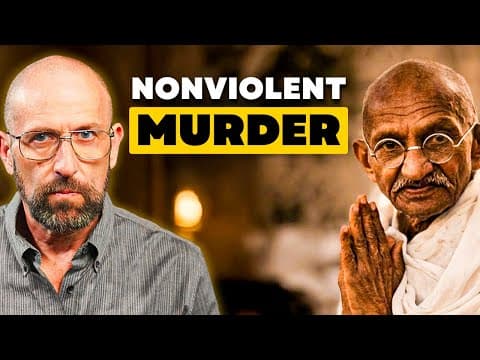
How Gandhi killed a million people
Elephants in Rooms - Ken LaCorte
17m 23s2,918 words~15 min read
Auto-Generated
Watch on YouTube
Share
MORE TRANSCRIPTS