[0:00]Hello and welcome to this video, the first in IOSH's Health and Safety Fundamentals series. I'm Duncan Spencer, Head of Advice and Practice at IOSH. In this mini-series, we're going to look at prediction and prevention from the perspective of reasonable judgement. This first video called What is Competency, explores the basic definition of competency. It is the foundation of occupational health and safety argument and reason. It is the basis for influencing and persuading others, which is a fundamental requirement for any occupational health and safety professional. It is widely accepted that a person's competency is a combination of their knowledge, experience, and skill. Knowledge can be gained through education, learning about the subject by attending a course, reading a book, or watching a YouTube video. It builds knowledge. Training is a form of education. It is a little more specific, for example, training to develop a skill like the use of a welder, or to follow a safe system of work. Both education and training builds knowledge. Skill. Skill is the evolving ability of a person to do a task. An apprentice practices their skill before they become proficient at it and able to act independently. For example, a trainee lorry driver will practice reversing a trailer in an open space with traffic cones until they have perfected the skill. Experience. Knowledge and skill is enhanced by continued practice. Through these three channels, a person develops their competency, their ability to do something successfully or efficiently. Note that competency is not a binary idea, that is to say, either you are competent or you're incompetent. Competency will develop over time as knowledge and skill improves. The more people work, the more frequently they do their tasks, then the more competent they will become. Arguably, asking whether someone is competent is the wrong question. It suggests that either you are or you're not. In practice, it is better to ask, is the person competent enough? By benchmarking with other similar people, it provides an indication that they had at least the minimum competency required, if not better. One of the more recognized ways of benchmarking minimum competency, is to pass an exam in a formally recognized and relevant qualification, or achieving a membership grade in a relevant professional body. So, competency isn't a static or binary concept. Consider a new employee joining a new organization. The application and interview stages are designed to ensure that they have at least the right level of technical competency and transferable skills. But what do they know of the culture of the organization they are joining, the strengths and weaknesses of their new colleagues, the processes they will have to follow and what can go wrong with them? Or the detail of the projects that they will be involved with? Not a great deal. So they build up this knowledge during their induction program. When they finish their induction program, when they can be trusted to deliver their role with less supervision, they continue to build their experience and therefore their competency in role. Why do we need to continue to improve our competency? The world is not a static place, it is in a continued state of change. New challenges present themselves. People develop new understandings and ways of doing things. We also can learn from when things go wrong. This links to the legal concept of date of knowledge. It is the legal test that ascertains when a fact became common knowledge and therefore, arguably, a person should have known about it. Such arguments underpin why it is important for the occupational safety and health practitioner, why they must engage in continued professional development. So, if you were required to prove your competency, how would you do it? If you had to prove your competency, you might deliver the following claims. Firstly, by claiming you are appropriately qualified, you have the minimum understanding of the subject. Secondly, that you have been recognized at an appropriate member grade of a professional body. This will benchmark you against your practicing peers. Thirdly, that you have completed further relevant courses, attended meetings and conferences, listened to podcasts and watched webinars and read around the subject throughout your career. Fourthly, that you will have spent sufficient time in industry, in similar roles or in your specific role. And lastly, any other claims that substantiate your claims of competency, for example, external recognition, membership of peer groups. What is the Achilles heel of competency? The Achilles myth was that this warrior's invulnerability in battle resulted from his mother dipping him in the river Styx when he was a baby. The river made him invulnerable, except for one weak spot, the heel she held him by. Achilles was then eventually killed by an arrow striking his heel and fatally wounding him in the Trojan War. The Achilles heel of competency is recognizing the limits of your competency. Competency improves with each piece of education received, when skills are practiced or through the gaining of daily experience. Nonetheless, sometimes we are faced with things where our knowledge, skill or experience are insufficient. At such times, we need to proceed with much greater caution or better still, bring in somebody with that expertise. So, in summary, competence is a blend of knowledge, skill and experience. Competency is not a binary concept; with work competency evolves and usually improves over time. Part of defining competency is identifying its current limits and how it can be augmented. In our next video, we will cover how we use competency as a basis for making reasonable judgments. To become a member of IOSH and for more information about occupational health and safety topics, please visit IOSH.com.
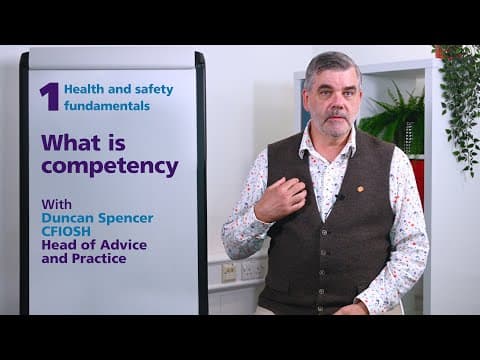
Episode 1: What is competency
IOSH
7m 5s953 words~5 min read
YouTube auto captions
Transcript source
YouTube auto captions
This transcript was extracted from YouTube's auto-generated caption track. The transcript below is server-rendered so it can be read, searched, cited, and shared without opening the original YouTube player.
Pull quotes
[0:00]Hello and welcome to this video, the first in IOSH's Health and Safety Fundamentals series.
[0:00]In this mini-series, we're going to look at prediction and prevention from the perspective of reasonable judgement.
[0:00]This first video called What is Competency, explores the basic definition of competency.
[0:00]It is the basis for influencing and persuading others, which is a fundamental requirement for any occupational health and safety professional.
Use this transcript
Related transcript hubs
Watch on YouTube
Share
MORE TRANSCRIPTS


