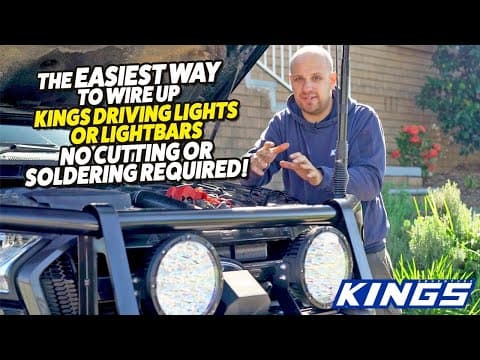
[0:00]Wiring up a set of spotlights or an LED light bar has traditionally been a nightmare and it's something that many people traditionally shy away from. But I'm going to show you just how easy it is to wire up your new LED driving lights or light bar using an Adventure Kings Plug and Play Smart Harness. In fact, it's so easy that there is no cutting and there is no soldering required. All you need is your new driving lights or your light bar, the Adventure Kings Plug and Play Smart Harness. You need a couple of spanners to undo your battery terminals, some cable ties to neat up the wiring at the end, and if you've got a bit of electrical tape and a wire coat hanger, well, I'll show you a great trick that you'll absolutely love. First we'll talk about the plug and play harness and what each component of it does. Then we'll start by mounting the harness in your engine bay. Next we'll connect the harness to your headlights. After that we'll run the cables down to your spotlights or your light bar. Then it's a case of running the switch into the dash. And finally, we'll do a light check and finishing off the install.
[1:09]First, let me go through what's in the box and what every component does. Now when you first open the box, it might look a bit daunting but bear with me, because once we delve into it, it's very easy to understand. In the box you'll have this main bundle of wiring that's cable tied together, this smaller bundle of wiring, these two nearly identical pieces here and one of these black boxes with a metal tab called relays with 24V marked on it. Undo the cable ties off the main harness and lay it out like this. You can see the very top of the harness has this relay and the relay holder. Now, the relay that's fitted to the harness when it comes out of the box has a 14VDC marking on it. That means it runs on 12V systems for most cars at four wheel drives, vans, that sort of thing. The only time you will need this other relay is if you're installing it into a 24V truck or machinery but for most of us we can put that aside, we won't need it. So next what we've got here is our positive and negative power cables so they go directly to your battery. If you follow the red cabling down, you see there's an inline fuse holder. Now of course, because we're working on electrical cabling we need to remove the fuse and set it aside somewhere safe until we're ready to install it again right at the end. And just as a bit of an aside, if you ever do need to replace that fuse, every car part store or most service stations have replacement ones. However, that's a 25 amp fuse and it must be replaced with an identical 25 amp fuse. Next, we got the wiring that goes down to the in-dash switch. Now, we've designed this harness to ensure that your driving lights or light bar remain completely legal when this is installed. And for that to happen a couple of things must happen. First of all, your light bar or your driving lights have to only be able to be turned on with your high beam stalk and canceled when you turn your high beams off. But as well, they need to be able to be separately switched so that even if you have your high beams on, you can still turn them off and just use your normal high beams. And for that, in a moment, we're going to run this switch wiring into the dash. So the next length of cabling is this one here with the white T-shaped plug. It connects to one of those two supplied headlight piggyback adapters that plug into the back of your headlight. And this final length of wiring that goes down to the gray plug with the orange seal on it, that goes to your spotlights or to your light bar. If you're just running a light bar, then it goes directly into that, but if you're running a set of spotlights, you use the included two-way splitter to plug into both lights. See, I told you there's nothing to it. Installing this wiring harness is no more difficult than putting an awning on your roof rack. Okay, let's get into it.
[3:39]So the first thing we're going to do is mount the relay into the engine bay. Couple of things you want to do here, first of all, is mount it as close to the battery as possible. That's because you need to run these cables to the positive and negative of the battery and they're only relatively short, so you need to mount it quite close to the battery. The second thing we're going to do is make sure that when we install it, there's plenty of room for this wiring to drop away underneath. What you don't want is this wiring to come out at an acute angle, because in a worst-case scenario you can actually pull the wiring out the back of the relay holder. So ideally what you want is somewhere that you can mount the relay that has about three or four inches of room underneath it for the wiring to fall away before it starts to curve. Okay, so now double-check that you have removed that fuse from the fuse holder and we can connect the positive and the negative to the battery. One of the big benefits of these forked terminals is that you don't actually have to remove the bolt the whole way, you just undo it, slip it in, tighten it back up. Now the next step is to connect that white T-shaped plug to one of the two supplied headlight adapters. In the box you get two of the most common headlight adapters to suit most common types of headlight bulbs. So, connect those two white T-plugs together and push them in place until they firmly click in. Then you're left with these two black plugs. Unplug one of your headlights and these are going to run in between. So you connect that into the plug you just removed and that goes into the back of the headlight globe.
[5:07]How you do this may vary depending on vehicle model, but you'll likely need to remove a dust cover like this. Gently but firmly wiggle the connector off the back of the headlight and connect the piggyback adapter to the back of the headlight and to the plug you just removed. Now, neatly feed this white T-plug down through your engine bay to the headlight so you can connect it to the corresponding white plug on the end of the piggyback adapter. Take your time to tuck it all away neatly so it doesn't hang loose. Push the two white connectors together until they click into place, but don't cable tie or tape it into position just yet. We'll neat up all the wiring together at the end.
[5:47]So the next step is we're going to take this gray plug with the orange seal and we're going to run it down to connect to the light bar or to the spotlights. Now do yourself a favor at this stage. Take a moment to make access down to the lights as easy as possible. Often that might mean removing the grill, but in this case, what I'm going to do is just pop out these plastic clips, remove this top access cover. So take a moment and have a look at the best way to run the wiring down through past the radiator support panel. You'll typically find there's usually some sort of access hole often where the air conditioning pipes run out through the front of the engine bay there. Just make sure that you keep the wiring away from any sort of engine fans. So if you're installing a light bar then this goes straight into the back of the light bar plug. But if you're installing spotlights then you use that included two way splitter. Push the connector into the light until it clicks firmly into place. Leave the grill or the access panel off for the moment.
[6:43]How easy is that? We are cruising through this installation. Now all that's left to do is put the switch into the dash. Now this is a tiny little bit fiddly, but as I mentioned before, I've got a trick that can help here. So what you need, just a little bit of tape and a wire coat hanger, let me show you how to do it. So we're going to take these three wires off the back of the switch, then what we're going to do is we're going to tape the wires to the end of that straightened out coat hanger. And that way, we've got a perfect tool to help run through the grommet on the firewall. So before you do that, here's a great little trick. Take a couple of photos on your phone of how each of these three wires sit in relation to each other, and also to which end of the switch the LED light is on. That way when it comes time to put them back on, super easy to figure out which wires go to which terminals. And a word of warning here, when you're wiggling these wires off the back of these terminals, don't pull them by the wire because you're going to risk pulling the wire out the back of the connector. Grab them around the metal connector, just give them a little wiggle and they'll pop straight off. Grab your wire coat hanger and untwist it. Then use your tape to firmly tape the ends of the three wires to the end of the coat hanger like this. Wrap the tape firmly up the coat hanger in the wiring about six inches, so the wiring can't come free. Now you've got the perfect tool to feed the wiring through your firewall. Locate a rubber grommet that factory wiring passes through and feed the end of the coat hanger through it alongside the other wires. Don't poke a new hole in the grommet as this risks letting water run inside your vehicle if the engine bay gets wet. It might take a bit of wiggling and a few attempts, but eventually you'll be able to find the end of the coat hanger up under the dash. So I spent a little bit of time and I've neatly run the wiring up into the center console here. Now, every vehicle's different, you need to decide where you want to mount your switch. Could be up on the dash here, down the center console, generally anywhere you can just easily access it while you're driving. So look out for one of these blanking plugs, you can usually just pop them straight out with a thin bladed screwdriver, and just replace them directly with that included switch. So I'm going to go ahead, use those photos that I took earlier to make sure that I connect the correct cables to the correct pins on the back of the switch here. Just one final note, once you've connected them, just make sure that these little rubber insulation sheaths are firmly in place. Now you can return to the engine bay and refit the fuse into the fuse holder. Make sure it's pushed in until it's completely snug. Your lights are now fully connected and it's time to give them a test. Start your car, turn your lights on and hit the high beams. The driving lights should turn on and off with the in-car switch and should also cancel when you dip back to low beams. So once you're all done in there, just push that switch firmly back in place and that's all the wiring done. The final step, just to go through all the wiring, a couple of cable ties just to neat it all up, make sure that it can't move anywhere. And how easy was that? I told you it was a piece of cake. An LED driving light or light bar installation can be that easy. If you use an Adventure Kings Plug and Play Smart Harness.


