[0:01]The word ecology comes from the Greek word, that is, Oikos mean a house or the home and the environment of the house or the environment of the home.
[0:13]And logos means study. It means the study of house or home environment.
[0:19]It means the life of house, the life in the house. In the house we have different compartments, we have different rooms.
[0:27]And each room is specific for specific activity, it is meant for specific activity.
[0:35]For example, the kitchen is the one where we cook, the washroom is the one where the cleaning or washing purposes or the washing activities are done.
[0:46]In the bedroom, there is a resting place. The living room, which is mostly the center of the house is the place where the whole family chat, and it is the full of life activities.
[0:59]The garden, it is the activity for your it is a place where you use your aesthetic sense to please yourself.
[1:10]So every compartment has a special place in your heart, in your mind and it has a special relationship and you have a special interaction with those specific compartment.
[1:23]Same is with the environment, every single factor in the environment is important and the human beings or the animals or the plants, the living organisms on this earth.
[1:36]They have a specific relationship and direction toward each non-living organisms or non-living environment.
[1:44]While scientifically, ecology is the scientific study of the interaction between the organisms and their environment.
[1:54]If you see in this slide, it very well demonstrate the interaction of the human beings, the interaction of the living organisms with their environment.
[2:04]And if you see the title, everything comes from the environment.
[2:08]It means, for everything we are dependent on the environment, whether it's a single human being, whether it's a single organism, whether it's a single plant, or there is a group of animals, group of plants, or group of people.
[2:23]Look at this if uh, we use water, we simply use water in the house from where this water comes in.
[2:29]The water source is far away from our house. We need a lot of infrastructure to catch this water into our house, and for drinking purpose, for washing purpose and for rest of the activity.
[2:46]And water is life, there is no life without water. The life originate in the water.
[2:50]So this pure water is basically the basic necessity of existence of life.
[2:56]And if there is single person in the house, it is dependent on the source of water. means the water has to be in the house.
[3:03]If we need the food, we are dependent on the environment again because the plants, these plants are used by various animals and we eat those animals.
[3:16]These are the source of protein for us. Again, this is out of the house. This is in the environment.
[3:24]So again, we are dependent on the environment. If we make a house, we need a constructor. From where these bricks, from where these almirahs, from where these furniture, from where these all things come from?
[3:38]These are all coming from the environment. If we need transportation, we need a car, from where this car comes?
[3:50]There is definitely a car factory manufacturers and they assemble different parts, again from where this different parts come, the rubber, the tires are made up of rubber.
[4:03]This rubber is come from plants because there is a rubber plant and this plant is used for making the rubber.
[4:09]The fossil fuels are used for running these automobiles. We cannot move these automobiles without the fossil fuels.
[4:17]There are different means of transportation, this car, this airplanes, the trains, and all these are dependent on the environment.
[4:24]Where these bricks comes from? Definitely these bricks are made up of clay from the soil and then they put into a hot chamber.
[4:36]Then it is assembled and it is used in the house for formation.
[4:39]What is the soil? It is the source, it is the environment, it is outside the house.
[4:44]It means for every single item, we are dependent upon the environment.
[4:50]And there must be the pure environment that is important because we are living because of this environment.
[4:58]Here, you can see the metal ores. We use the metals to make a roof and because of this metal, the roofs are waterproofs.
[5:08]We use the sand to fill up the places where we build the houses for the plants and animals.
[5:16]Sun is the light source, the ultimate source because of which the plants are grown up and these are used by various animals.
[5:25]Various animals in different way, either directly or either indirectly, we use it for eating or for as a food.
[5:34]But they are not only our food, they are the food of other animals as well. Is puri slide ke andar dekha ja sakta hai, koi aisi jarurat ki cheez insani nahi hai jo usne apni jo hai wo apne ird-gird ke mahol se istemal ya waha se jo hai wo hasil nahi ki hai.
[5:51]Ek chhoti si cheez ke liye wo apne jo hai wo mahol ke upar uska inhisaar uske upar hai.
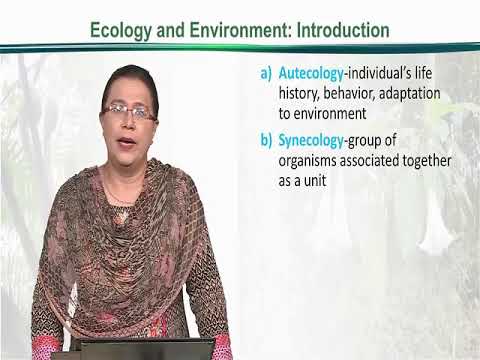
[5:58]While studying ecology, we can categorize the ecology as an individual ecology, as a group ecology.
[6:07]The individual's ecology is known as art ecology, because we learn about the individual's life cycle, their histories, their behaviors, their adaptation towards the environment.
[6:22]It means, we are uh, getting information from where this organism, from where this plants originated and how long they have passes all through years and now they are seen on the earth.
[6:40]It means, these plants have or these organisms have specific relationships, specific interaction with their environment.
[6:50]For example, the desert plants and the desert animals, they have a different sort of interaction with one another as compared to forest, individual plants or animals.
[7:03]Both are two different places and they have different types of plants and animals and each plant and animal has their own history, their own behavior, their own adaptation.
[7:16]The desert plants cannot survive in tropical or in moist areas, while the plants which needs moisture or more water or those animals which needs shelter or more water cannot live in the desert.
[7:34]Same is with the case of synecology. It means, it is the study of group of organisms which are associated together.
[7:44]Whether they are living as a community or whether they are of one type of organisms, they but they are interacting with the environment.
[7:54]When we study just single individual, it means we study its whole life, when we study the whole life, we can it is possible and it make us easier for us that we study the whole organism, the whole community and their association towards the environment.
[8:15]For example, if it's a desert environment, there are specific type of more than more than one type of plants.
[8:24]There are more than one type of different animals which are living in the desert environment.
[8:30]And there is just not one single organism which is capable of living in any moist environment.
[8:39]While all those organisms which are in living moist environment, they cannot live in the desert.
[8:46]Same is with the case of ocean and the fresh water environments, because these are two different environments.
[8:50]The most important limiting factor is the salinity is more, the ocean water is more salty as compared to fresh water.
[9:00]And they have different environments. The each single organism, whether it's a plant, whether it's a animal, it is living, it is interacting to their tolerance range with those environments.


