[0:00]Welcome back to Some Great Things, the YouTube channel where we talk about industrial design, etcetera. As you can tell from my outfit today, we are going green. There's a lot of systems, methods, and opinions on how to approach sustainability in product design, and it can be a pretty intimidating topic. That's why today I want to give you an overview on how to approach this topic, and give you what I think is a pretty good approach to it. To be honest, I was a little scared to make this video because it's kind of a big topic and I want to make sure I get it right. But in my usual fashion, I'm just going to dive into it and probably do it wrong. Join me today on Some Great Things as we do an overview of sustainable design and even try to design our own sustainable product. Today it will be a wireless charger. Okay, let's go. So, let's get into it. Quick refresher in case you're starting from zero, designing, manufacturing, selling, using, and disposing of products always creates some kind of damage, whether it's environmental or social. Some examples of this are damaging ecosystems when extracting raw materials, exploiting workers, increasing carbon emissions, and creating tons of trash. Sustainable design practices usually try to reduce this damage as much as possible, so that we're all not shitty people. So the question is, how do we do that? Well, there's a lot of strategies and systems out there, so you can take your pick. I really like this comprehensive design system that I found in this paper by Sehan O. It combines a lot of sustainability strategies into somewhat of a comprehensive approach. I actually use this as a backbone for this video, but I'll probably be simplifying a lot because you know, you probably have no attention span. Starting out with design and innovation. Before you even get into the nitty-gritty of designing the details of a product, it's good to think about some bigger ideas first. I think the most important question you need to ask is, does this product really need to exist? That answer is yes, which it's usually not. Then you can ask some more questions like how can we encourage low consumption behavior? How can we design it responsibly? And how can we reduce the long-term impact? For our wireless charger, what we want to do is lower the carbon footprint of the product and reduce the amount of waste we create from this as much as possible. Hey, how about this? Why do you need a wireless charger? Why don't you use a USB-C charger? Honestly, what I should have done, but I already did the wireless charger for this video. Oopsie. Not only looking at the environment, we also have to look at society or people. If you're making recycled paper bags with slave labor, it's probably not very sustainable. Some questions we want to ask here are, how can we design responsibly with responsible partners? Stimulate the community, consider inclusive design, and how can we make it intuitive? This is what really separates sustainable design from eco-design, meaning that eco-design usually only looks at the environmental impact of products, while sustainable design tries to look at the total impact. I like to rename this section as Don't be a D-Bag. So, now that we have a base for a product, it's time to look at raw materials. The goal here is to reduce the material usage as much as possible, minimize variety of materials, and use low carbon materials, which basically means materials that contribute the least amount of carbon in the atmosphere as possible. Some strategies to do this are to use recycled or recyclable materials, renewable materials, and or biodegradable materials. And of course, all this only matters if you do it in the right way. So, if you use a more sustainable material, but in the end you create more carbon impact or waste, then that was a bad choice. So, for a wireless charger, I think we're going to try to incorporate some sustainable materials into the design. There's a couple I'm really into right now. One of them is cork, which is a renewable material as long as you don't put a bunch of plastic in it, and the other one is good old-fashioned aluminum. So we've incorporated a cork top to our product, made this nice shiny aluminum base. Pretty sweet stuff already. I love a good sustainable material, don't you? Anyway, a dizel, looking at production. If you didn't know, production is where a lot of climate and societal impact comes from when creating new products. If you look at Apple's sustainability reports, they made a huge impact just by switching their suppliers to using green energy. Now if Apple could just treat factory workers like humans, we would be in a good place. There's also a lot of room in the actual product design itself to improve things. We can make things easy to manufacture, use processes that are low carbon impact, and also design our product in a way that it's very easy to process. So for a wireless charger, I think we will try to use some standard parts and also reduce the amount of parts as much as possible. So, here I'm using a standard wireless charging coil that you can get from pretty much any website. I'm trying to keep it to two main parts, the top and the bottom, and trying to design these parts in a way that's easy to process and manufacture. Super. Moving on to the underestimated shipping phase. Shipping is another area where you can create a lot of carbon problems. If you're shipping something by air across the world, the carbon impact of your product can be pretty high even if the materials or the production don't create a lot of impact. Generally, you want to reduce the amount of transportation and the distance you're shipping things as much as possible. You want to reduce the size and weight and the dimensions of the product, and use minimal impact packaging and even minimal packaging. I really like this chair here where they kind of designed it in mind with the packaging. One thing I never understood too is why do you have to have a product shipping box and then a box inside that box? So, for our sustainable charger, we're just going to make the box as the box you ship it in. That's what you get, and no plastic, all paper, you just throw it in the cardboard recycling. Easy-peasy. We got it. The next area, which is use. I think this is one that people don't think about as much as they should. The damage doesn't totally come from production and shipping. A lot of products, especially electronic products, can cause a lot of damage from the use. This could be electricity, but it can also be water, or it could also be environmental damage from the product. You want to try to eliminate all of it as much as possible. One thing I think really escapes the discussion in this area is extending the amount of time a product is used. This means not only making it more durable and repairable, but also thinking about the aesthetics so that it's something that someone will want to use for a long time. This is coming from the industrial design trans guide, by the way. Let's think about that for our wireless charger. We want to extend the amount of time this product is used. I think we have a good base and a kind of like somewhat timeless design. It's not too trendy. And what we can also do is make sure to use some standard components like USBC and make it easily repairable by putting easy access screws in the bottom. If something happens to break, you just open it up. Not like those Apple chargers that are hard to get into. Moving into end of life. At some point, a lot of products die or unusable, unrepairable, and we have to think of what to do with them. Here we need to make sure that one, we can easily separate the part into different products, and that the base materials can be easily reused or recycled or returned to the earth. Also here we want to make sure we use as few composite materials as possible or materials that are a combination of different materials. That way we can easily separate everything and dispose of it in the least impactful way. So for a wireless charger, we probably need a little bit more detail, but instead of using paint, since we have this nice aluminum piece, I think we can just laser in the information, pew pew pew pew, or engrave it in some way. And that way, at the end of life, we can easily take this thing apart and give it new life. So, yeah, that's that's the way to do it. There's probably still some room for improvement, but otherwise, I think it's a pretty good start for a YouTube video. Back to you in the studio, Grey. Hey, that was a pretty cool wireless charger we did. I probably should put in some disclaimers on this, but a lot of decisions on this, I'm not really sure about. Like, did I make it very sustainable? Did I really pick the most standard parts? At least we made a good attempt, and I think I will try to update the design maybe in the future video. If you caught some errors that I did wrong in the sustainable design journey, as there's a lot of experts out there, feel free to let me know. So, that's it for our intro on sustainable design today. I hope you learned a little something along the way. Have a good rest of your week, month, year, life, and I'll see you in the next one. Bye.
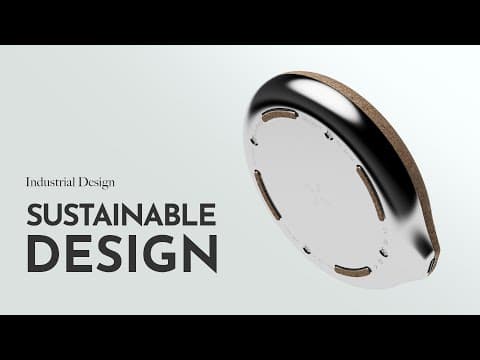
Sustainable Product Design
some gray things
8m 55s1,683 words~9 min read
YouTube auto captions
Transcript source
YouTube auto captions
This transcript was extracted from YouTube's auto-generated caption track. The transcript below is server-rendered so it can be read, searched, cited, and shared without opening the original YouTube player.
Pull quotes
[0:00]Welcome back to Some Great Things, the YouTube channel where we talk about industrial design, etcetera.
[0:00]There's a lot of systems, methods, and opinions on how to approach sustainability in product design, and it can be a pretty intimidating topic.
[0:00]That's why today I want to give you an overview on how to approach this topic, and give you what I think is a pretty good approach to it.
[0:00]To be honest, I was a little scared to make this video because it's kind of a big topic and I want to make sure I get it right.
Use this transcript
Related transcript hubs
Watch on YouTube
Share
MORE TRANSCRIPTS


