[0:07]I'm grateful that I can help support you through this. No, I I do appreciate. You guys are just fantastic in terms of the community and the support you provide. You know, it's one thing trading can be very isolating, right? And I've I've noticed that your perception about money and the way that you were raised and how you look at money and treat money, Before we get rolling here, just a reminder to please like and share our videos. Your support helps us to continue to bring you the wonderful content that we share with you each and every week. Is a very big part of what we do on a daily basis because of the risk we put into it and the challenges we put into it. I think a lot of times you see the glitz and glamour about what trading can do and it's, you know, the social media side of things can sometimes mess with your head in a way and get in in there in an in proper fashion. So being able to be on your webinars, talk about not only the strategy around trading, but the psychology of it too, right? Like, I want to be vulnerable in a way to tell people that, you know, life is not always roses and you might have challenges that you have to figure out that get in the way of how you view money and how you view success and how you view those challenges. And uh being able to voice those to you and come on and and talk about them is is really key because otherwise they can kind of fester. So I really do appreciate it. It's not always just about trading, it's about other parts of life, right? And they It does. And they do affect your trading also. I mean, from a time and a mental stress standpoint, I think it's important to talk about them. 100% and the the the the worry and the stress that you have in your life is translated in the the trading that you do. We always talk about being very clear voyant and meditating and being in the moment and not being stressed so that you can clearly see your plan and how that is affected by the market. And if you come in depressed or stressed or you've got, you know, your your you're carrying the baggage of a really bad day, that goes into the movements that you're making in the market, right? So you have to really make sure that you can either segment them or what I'm doing is trying to be better at being in the moment. Not taking life maybe as seriously or, you know, one thing I'm I've kind of gotten into is the neuroscience around um manifestation. You know, it's it sounds a little hokie, but at the same time, right, you are the perception of what your mind is thinking. The world is coming at you and it's how you relate to the events that are occurring. And if you're always negative or you're always a perfectionist, or you're always not trusting of people, then that can really play into how you see the world. So I'm I'm trying to be a better man, John, both personally and professionally. That's that's funny when you bring up, cuz it's like your brain will gravitate towards what you set. Yeah. A goal. And it's I found a goal sheet that I had from 2015. Mhm. And Sherry just found a card that she had from 2018 that she wrote down. And we've reached both of those goals. And That's amazing. We weren't even trying and it was pretty much on the time frame that was on the card. It was crazy. Yeah. Yeah. But you probably visualized it, right? You wrote it down. You Yeah.
[3:35]Maybe didn't consciously think about it all the time, but you you thought about it maybe subconsciously and you you you reached it, right? Well there was this like I mean you put it down and it's like I almost didn't believe it when I put it down. Oh, yes.
[3:48]But I put it down anyway and you know, I I spent a period of time with I just forgot about it. Yeah.
[3:55]Like I completely forgot about it. I just went ahead and did my work. It's like, oh, look at look at this sheet that we have, right? Yeah. This is this is what we were playing. It's pretty close and one of them was having a house in Florida, right? So here we are, right? That's amazing. That's amazing, right? So, Yeah, I think it is set, you know, everybody talks about setting goals and, you know, putting a monetary piece to it, but I would say focus more on the process and you know, as soon as you show a little bit more gratitude to yourself, and you figure out the other areas of your life, I think trading really kind of comes along with it, right? So it's all kind of part of the same same process in a way. Absolutely. And the thing is too, is not to be overly focused on it either. It's like, put it out there. Yes. You're going to get it. Just start working. Yes. And don't think it's your Yeah. Don't think it's your end all be all, right? I used to think, hey, I want to leave my corporate job and I want to become a trader and I want to do it in this amount of time and if I if I don't get there in time, then I'm a failure. That's not the case, right? As soon as you kind of understand that, the better. Yeah, sometimes these things take a little bit longer to work out. Yeah. You know, if you set a goal for a million dollars and you make 500,000, is that a bad thing, right? It's still a good thing, you know, it's just like I still made it. Totally it is. So, Yeah. Totally it is. Yeah, yeah. That's awesome. That's awesome. Yeah. So you can tell us about your trading.
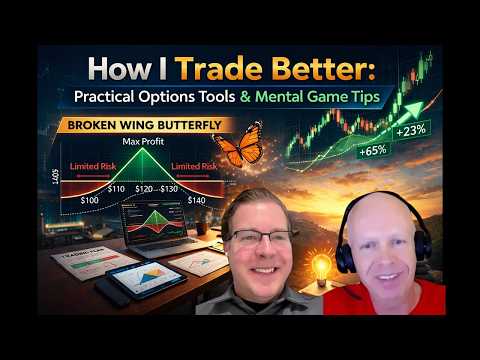
[5:22]Well, the process is here anyway with all the challenges, so Yeah, of course. So to maybe focus a little bit more on the trading side. Um, to me, the the pro meetings and just the way you and Stephen are kind of thinking about the markets and and being a little bit more directional, I think, has made a lot more sense to me. I'm I think it was mentioned on a meeting a few months back is taking the M3 for you, which doesn't take a ton of time and brain power to adjust on any given time frame. And starting to take the stages of improvement that are a little bit more subjective, right? So I might start, you know, I might lean it a little bit more on entering the trade then what the guidelines might say based on technical analysis. Or I might I might let the Delta ranges breathe a little bit more when we're coming into support or resistance and knowing that I could start to add a little bit of flair into it, right? And then that is sort of my bread and butter and then I will look at certain points in the market to where I can, you know, go with a bullish vertical or go with a bearish vertical and kind of have a little arsenal, right? We always talk about having various different tools in your tool chest. You don't want to just have a hammer to hammer nails, but you want to make sure that you can sprinkle in a few other of those different tools and all in all when you look at your progress, you're you're refining those tools and you've got a good variability there versus saying, I'm just going to be an M3 for you guy and my entire capital that I'm willing to trade is going to be in just one trade. If you start to sprinkle them around, I feel as though you're accelerating the understanding of the TA that you do on a weekly basis and and really starting to kind of feel and learn about the equities that you're trading, whether it's an index or an individual company. So for me, I'm still I'm still kind of sprinkling that in. I'm kind of living in that 30-day time frame right now. I'm bending and weaving the the broken wing butterfly to to what I see fit and then sprinkling a little dash of other trades in there to uh to keep things interesting if that makes sense. Yeah, that makes a lot of sense. I mean there I mean, there are times when it's highly probable the price is going to do something, right? Yeah. Right? I mean, do you agree with that? I mean, it's it's like who'll say I don't know where the price is going. Yeah, nobody really knows for sure where the price is going, right? So I would agree with that. But in the same context, certainly times when there's really high probabilities of certain if it going a certain direction or a certain magnitude, right? Yes. So I think it makes it it makes sense to maybe account for that somehow. Right? Whether it's maybe, like I said, even being a little bit more negative in your position, allowing a little bit extra risk here or there, um, you know, from a Delta standpoint, and then maybe adding a vertical in, right? Or whatever, you know, like you said. 100%. Yeah, and I you know, one of the questions you always ask is if you're new to trading, what are some advice that you would give to a new trader, right? And I I remember when I was very green, I would ask these questions to you and Steven, I would say, Well, how do you guys know the probability? You know, I'm very analytical. Is there a trigger that tells you that something's 80% probable versus 50%? And the answer is, right, there's a lot of information that you're absorbing to help you. It's a feeling sometimes, right? You're looking at what the technical show. You're looking at seasonality, whatever it is. And where you really start to hone in on that probability, just as an example, is experience, right? It's you looking at the market. It's you kind of understanding how the market behaves and you start to just feel the vibe of saying, okay, probabilities are fairly high here or probabilities are pretty low here. I'm not going to risk nearly as much and it's there's no manual that you can give someone and say, hey, read this up, follow these instructions and you're going to be incredibly successful at what you do because the markets are not a zero sum black and white game for for a lot of people. Right, right. No, I I agree with you, right? And if there was that book, I would give it to you. Right, right. Yeah. Yeah. Yes. 100%, exactly.
[9:39]Yeah, yeah. It's it's a lifelong journey. Let's just say.


