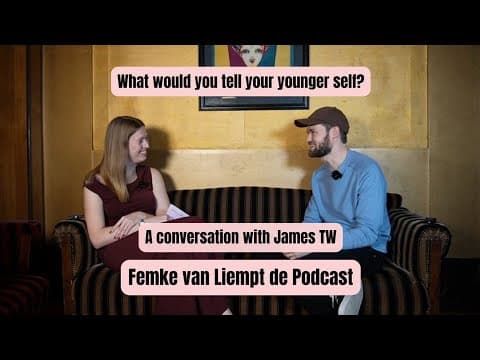
[0:00]Hi, and welcome to the Femke Vlieg podcast, where I raise awareness around mental health by sharing my own life experiences and those of my guest by having conversation with them about what would they tell their younger self with the knowledge of now. How did they grow up to where are they today and how do they reflect back on it? And today I'm joined by James W, who is music has touched hearts across the globe. He started with playing drums at 10 years, singing covers on YouTube at just 12, to performing on the Ellen show and touring with Shawn Mendes at 18, and to releasing songs like when you lost someone that have gathered hundreds of millions of streams. James C has built a career rooted in honesty and emotion, and what makes today even more special is that it all started with just a comment on TikTok. to sitting here right next to me. And I'm beyond grateful for this conversation and the opportunity and can't wait to explore the stories behind your music and your life and thank you for giving me the chance, so, uh, thank you. Thanks for having me. And the video that you made on TikTok I think was the real reason that I said yes, because you put a lot of effort into making that video and I really appreciated that so thank you. No problem. I was like, I'm not going to let this chance to buy. You were very, yeah, you were on it really quick. I was very impressed. Well, yeah, well done. Thank you. And well, you started doing music really young. Um, if you look back now, what kind of child were you? I was a very energetic child. I liked a lot of attention. I still do, I think, and I think I was very creative. I wasn't very good in school, um, academically. So I was, I played sports and I liked writing songs and coming up with ideas and plays and things like that. And when you think back to your younger self, um, what did you dream about most? I think music pretty early on was my dream. Basically from ten when you said I started playing drums in, in my dad's wedding band. From the first show that I played with my dad, I knew I wanted to be in music. I just loved performing with, with a band and making people come together and make them happy and be a part of that. That was infectious. So after that I just sort of said, I don't know what I'm going to do or how I'm going to do it, but I want to be doing this. And did you already practice music in school? I had started playing violin first and I was terrible, like really bad and my poor parents, that when my siblings, my younger siblings started playing violin, um, and I'd given up, I only then understood how painful it is to listen to someone who's really bad at violin. So my parents did that for two years, then I quit and I, and I didn't love music playing the violin. It was only when I found the drums that I did, that it changed my mind. And then you decided to follow your dreams and, uh, here you are. Did they believe in your dreams when you were at school? My parents were very supportive of me pursuing anything that I really loved. It didn't have to be, you know, um, go to school and go to university, get a safe job and then do something. They saw I loved music and they said go for it from the beginning, which was, I'm very lucky, I guess, that my parents were like that. And at school, when you practice music during lessons, were the teachers also supportive or? Less so. I think the school, the school obviously wants to look good to other schools when you compare them. So I think they cared more more about the grades and and how, um, and how they looked compared to other schools in the area or in the country. So they liked watching me perform if I was going to in a in a school concert, but when I sort of told teachers maybe 15 or so, I'm gonna try and do this full-time. A lot of them were were telling me, you need to get your grades sort of first and they were, they were being like the opposite of what my parents were being in a way. But still you went through with yeah, with your music. Yeah. And you've grown up in the public eye. Um, how was that, how does that shape your sense of self? That's a really good question. I don't think I've been in the public eye as much as people think. I think the songs that I've, um, sung and written and released, I think those songs have been way more in the public eye than I have and I think that's because of streaming. I think it's to do with the way people listen to music nowadays. I have so many bands and artists that I love, but I I don't actually know what any of them look like and and wrongly so. I should, I should sort of invest a bit more time looking, but we're so used to finding music on a playlist now and I think that's how my music started to to grow in the world was sort of, um, passively people would be in the kitchen making dinner. And then I would come on the playlist and they liked the song, so they'd add it to a playlist, but they wouldn't go, what does he look like? What is he like as a person? So I think it's actually been quite easy because, um, really it's the music that's been the popular thing, not me as a person if that makes sense. Are you grateful for that? that more like unknown, yeah, I think it's kind of the best, it's, it's like the best of both worlds in a way because I want people to care the most about the music. Um, but also I I think there's, there's another side of it where I think if you do know the personality of the person that you like listening to and you like their personality, there's a chance that you'll, you're more likely to to come and see a show because you feel like you know them better as a whole. So, I guess, if, if I'd been a bit more, uh, if my face had been around, whether you know, when people heard the songs, then maybe more people would have bought tickets. That's, that's the only other argument I can make on the other side, but I'm very grateful for the way it's been. And you toured with Shawn Mendes, so you've seen also the complete opposite of. Yeah, of course, Shawn is very famous, very, very young and I've seen that first hand that that can be a bit difficult sometimes if you're out in public and things like that. So it's also a very positive side that you're like can walk around. Yeah. Yeah. I'm going to go walk around Amsterdam after this and I'm not worried at all about how that's going to go. Yeah. Be the pendulum, I guess. Yeah.
[6:22]Did you have any insecurities growing up and how did you handle them? Um, I think the first one that comes to mind, I had really bad skin, uh, just like my, my dad did and then my auntie did, so I did and, um, yeah, when I, when I was maybe four, 13 onwards, it got quite bad and I wouldn't maybe not go to parties sometimes and things like that. Because of the insecurity? Yeah, because I felt like it it got sometimes it would be so irritated and like red and bad looking that I didn't want people to like see me like that, I guess. So that's probably one of the main ones that I remember growing up. And how did you change the mindset? Um, well, firstly my skin got better as I got a bit older, which was nice. Um, and I think I knew deep down anyway that people didn't really care, um, but I and I cared a lot more than they did. So I think just over time, um, maybe with the music, I got, I felt like more confident after performing and that made me think less about my skin. Um, but it could have gone the other way too, I guess. Also creating self-love, I guess. Yeah, that too. I mean, when you're young, that's a strange concept because when you're 16, you're not thinking about self-love or how to make yourself feel better. Um, but now looking back, I guess that's what was slowly happening, yes. So self-acceptance, self-love, creating that. And how do you take care of your mental health wellbeing on tour because you're traveling all through the world for quite a few years. Yeah. Um, sorry, sorry. I was just wondering how do you take care of your mental health then? I think just having good people are a phone call away or a text away and not isolating, um, myself so much. When I first started sort of going to LA a lot after leaving school, I didn't really reach out to a lot of my friends because I felt like they were getting on with their life and I was just removed from it. Um, and then when we would speak a lot a few years later and I say, oh, to be honest, I felt pretty like alone during and and they said, oh, we just thought you were busy doing your thing. So we were both misunderstanding each other and and I therefore I think I just learned from that. You just have to keep chatting to people, no matter where you are and that will make you feel more at home and less lonely. Keep communicating and Yeah. Reaching out. Yeah. Yeah, that's very nice. And, um, well, obviously, your wife is also sitting here. Yeah. How did you guys meet? We met at a table tennis lesson, uh, in London, and Laura was the coach of the lesson and I had bought the ticket to, like, the, you know, the pass to go to the lesson at 2 A.M. That more the same morning before going to bed, spontaneously, basically. And how did you know that you wanted to have a relationship with her? Uh, well, she's laughing because it took, it took me, it took me quite a while to be ready to the idea of a of a relationship because I'd basically been in a relationship for six years, um, and and I just, like, not quite recently come out of that. So I was kind of anti-commitment, anti-relationship, definitely had a lot of work to do on myself and and we met. So, um, it took me a while, but I think I think it got to the point where I just realized there was, I didn't want to, I didn't want to have a life that didn't include Laura in it. So, when that became obvious, then of course, that, you know, committing and and being in a relationship felt like the natural thing. And she kept waiting for you. She was very patient. Yeah. I owe her one for that, yeah. And what did you learn the most in the two years of marriage you have now? Um, I just think we communicate really well. I think if, if either of us are feeling a certain way about anything, um, we're quite open with each other immediately about it. We don't hold anything back and sort of self-process it. So I think that that's helped us, um, if I'm traveling or if we're in a stressful period, we we just sort of moved and moving is a is a stressful thing. So all those kind of things, we just communicate how we feel the whole time. That's, that's like a trick of making a marriage happen, just communicate. I mean, well, it's been two years. I I mean, we're at the right at the beginning, but I'd say of the of the things that I've learned so far, that's been the important one, yeah. And you just turned 28 three days ago. And if you compare your 18-year-old self to who's just started to be many who you are now, like 28, um, how do you reflect back on it? Like, what did you learn the most of life? Ooh, I think the, the idea of my head of the 18-year-old James is actually just a different person. I even with the my older songs, I feel like I didn't write them because it's been so long since I've written them and I've written so many songs since and I've become a different person since and grown that I, I almost feel like I can't take credit for any of the old music because it's it's like another life and. I feel the same way about, um, who I was at 18, really. I think life was very, very exciting at that time because, um, music was really starting to happen for me and that had been my dream for a for a quite a long time. So, I was definitely not really making the most of what was happening as well. I was just so focused on the next thing and and I have an example of that here because when I first, um, supported Sean, I played he he played in Paradiso here and then it was a few years later I got to play in Paradiso as well. And a member of my team who books my shows and stuff, they came over and they, they saw me in the meet and greet and said, uh, you know, congrats, this is such a great achievement. And I, and I completely sort of ignored what he said and said, where are we going to play next time in when we're in Amsterdam? Because I just wanted to keep growing, of course. And now looking back, I think I wish I'd just sort of been a bit more present in those moments and, uh, I'd say that's the main thing that it makes me think of. But how was the period of time when you like the music took off? Um, it was just, I don't know. I think, I wasn't too overwhelmed. I was just excited and I was just looking at again, I was looking at the next thing. I wanted to grow, I wanted to reach more people and and play bigger shows and like every artist wants to do. But it in in thinking that way, I was completely neglecting in a way what was happening at the time. Um, and I shouldn't have done that. You know, I should have, um, yeah, focused on that a bit more. And how did you learn to be more present? Because I really heard the power of now from Eckhart Tolle a bit through your through your sound, yeah, story. Cool. Um, I think, uh, well, my wife has been Laura has been great with that because when we, when I started releasing music when we were together, she would always make sure that we did something to celebrate a song coming out. And I think when you're an artist in the beginning, there's this novelty about releasing music and then eventually you're releasing your like 50th song and obviously it doesn't feel quite as special as it did from the first. So, but she would always like bake a cake or we'd go out for dinner or we do something fun. And I think even though we we don't have to do those things, you should just do it. And I say that to any of my friends who are artistic or creative and, you know, even, even you putting this episode out, you should celebrate it because, you know, you put a lot of effort into it and, um, and so I'm getting better thanks to my wife and and what she's teaching me, I guess. So celebrate the little moments in life. Yeah, I think so. Yeah. And being present in the now and then just calming your nerves down and, uh, Exactly. That's great. And what's one thing you like to accomplish when you look into the future? Hmm. I don't know exactly how to answer that because I'm I'm trying to figure that out myself right now. I think, I think now that I'm an independent artist, I'm not sort of attached to a big company. Um, the, the environment is different, even though I'm still releasing music and but I'm taking a lot more weight on myself in doing that. That's what all the independent artists have to do. So, therefore, my goals are also changing because, uh, of the amount of sort of workload compared to what it was before and different workload. That's a strange answer. I guess what am I looking forward to? I'm I'm still looking forward to making music that I love and that I believe in and I, I think it's me in, in in music. But, um, but in terms of sort of setting a goal per se, I, I'm not sure what I, what I want. And you told an an in another interview that you were thinking of quitting sometimes. Yeah, yeah, definitely. I think, you know, I think in any creative or even when you're just self-employed and you're sort of you're in that mindset, it it can be a lot sometimes and you can be fed up of it. And sometimes the idea of doing something where, you know, um, someone else is sort of the boss and you just do your part. That sounds like a lot more chill, but I'll probably be less happy and fulfilled doing that. So, yeah, sometimes I do think about stopping and then I'll go home and I'll tell Laura and and I'll say, oh, I think I'm done. Like I think I'm done and and she she's great because instead of going, oh, no, don't quit, like don't. She'll just go, oh, okay. And then, and then the next day she knows that I'm going to be like, I've got this song idea and I love it and then I'll just go back to being myself again. So it's like a bit of waves. Yeah, it's always waves. I'm just a dramatic person. Yeah. Of course, because you're already from school if I heard from the story. Yeah. Exactly. And if you look like back on your life, what are your few highlights that you already accomplished? Um, I think when I supported Shawn in London, I got to play at the O2 Arena and to me, you know, that's my zigga dome, right? So the idea of playing at an arena in London in my home country was very cool. Um, I guess hearing one of my songs on the radio, that's cool and just driving in the car. I remember the first time was in in San Diego that that happened and it was funny for the first 30 seconds. I was like, I know this song, but I don't know who it is. And then it clicked and I pulled over and I, you know, filmed it and, uh, so those are, those are two that come to mind. It's surreal when you hear your own song on the radio. Yeah, it's cool. It's strange, uh, but it's, it's fun, yeah. And if you look back to the music you made ten years ago till now, what is the biggest difference? Hmm. I guess I just have different things to say. I think when you get older, you realize a bit more about life and and your values and what it is, um, how you want to live. And I'm trying now to incorporate a bit more of that into into my music. Whereas before, I was just like a teenager writing about crushes and what what love was then and you know what I mean? But they were, they were really vulnerable. Yeah, I I think that's been a consistent thing in my music is just if I'm honest, then I know, it's kind of like if I'm honest, I know that someone else will connect to my honesty, but if I'm pretending to be or feeling a certain way because it's cool or it's sad or whatever, then it doesn't usually connect as much. So if I'm vulnerable and honest, then I, I almost like know people will connect. But if I look around, like the men I know, they find it really difficult to be very vulnerable or honest. Yeah. I I've written about that too, about my dad and not being so open and I guess I'm just I'm an open book. I'm very emotional and vulnerable and open about it. So it's easier for me. Yeah. So you hope to be an example to support people to be more vulnerable. Definitely. Anyone, yeah. And are there a few like downsides also on your life? To being vulnerable or in general? Or in general? Um, I guess what I said about, um, sometimes when you are a creative or being a creative and trying to exist in a very sort of like business corporate world, because at the end of the day, it's called the music business and, um, and that's that's that's tricky.
[18:43]You know, to try and balance art with actually making having a living and all that sort of stuff. Um, and and as I said, it can be lonely sometimes too. Those are probably the two. Yeah. And how do you like, um, make the difference between James and James DW? Hmm. Um, yeah, I, I talk about like, if I'm talking to my friends or and I say, oh, well, normally like a James W concert is like this and obviously that's kind of me talking about myself in the third person, which sounds terrible. Um, but that's the way I separate it to me, like I'm just James and then James C W is my work and that's my project. And of course, I'm still, um, communicating how I feel as James in my James C songs. But I just, I don't really think of the two as the same thing and I'm fine with that. So you can separate it while like from a nine to five job kind of yeah. Exactly. Like, I guess when I talk about James C, I'm like clocking into the office, right? And and then when I'm just hanging out at home, I'm that's just me. James. And if you, you're now in Amsterdam, do you have like a few, uh, good memories from Amsterdam because you've been quite a few times? Yeah, I it's one of my favorite places to visit because it's from the beginning. It was one of the most supportive cities and and countries, uh, for my music. When you love someone really did well on the radio over here and that that was the first time that had ever happened to me where one of my songs had done well on the radio anywhere. So I remember coming here and and, you know, more people showed up to my concerts here and and even showed up to radio shows to say hi and and so I have so many great memories of being here. That's also so funny because everyone I told that I was going to interview you, they were like, who and then I was like saying song and then she like, they were like, oh, yeah. I know the song. And that is exactly what I was saying earlier about people know the song. And I don't know the meme, that's fine. That's awesome, because you're having the candle light concert this evening. Yes. Yeah. How is it to be on tour with the candle light, uh, It's actually been kind of scary because usually I play with a sort of band, like with drums and and keys. And I've just been performing on my own to make it really acoustic and intimate and just like a conversation almost between me and and everyone else. But it's I haven't performed like that since like being on the Shawn tour, maybe. And and I've been quite scared, like up on stage. Um, more scared than I felt in a long time. How come? I don't know. I think it's because I feel more vulnerable, like on stage on my own. There's no like loud backing music. So if I'm if I'm mess up my chord or if I sing a a bad note, everyone is going to know. It's not hidden behind and that's okay. You're right. That is okay. Uh, but I'm also like I want to hold myself to a high standard on stage. You're professional. I guess, yeah, in in certain ways. So, so that's why I think I've been a bit more, uh, but, but it's been a fun challenge as well. Yeah. And what are the highlights so far in also there weren't were a few things, the things that went wrong.
[21:43]Uh, with the tour. With the tour, yeah. Yeah, there were shows that had to get canceled and, um, all of the cancellations were out of my control. I was very much looking forward to the shows and I hope I can go back, but yeah, just some had some fell through, basically. And how do you handle that mentally? Um, well, yeah, that's, that's been a bit tough because I've seen it's let people down and, you know, certainly people who were traveling from out of whatever city had already booked their stuff and that did, um, yeah, upset me for for a while. Um, but I guess if I can, if I can go and and put on a show and hopefully they can be there and that would be great. And then you'll just get a lot more energy from it that day and then Yeah. And if you look back on your life with everything that happened, are there a few things that, um, you really want to say before you give the advice to your younger self? Like just things that I remember or, uh, Yeah, like tips to people, for young people, who are also following their dream to become an artist, for example. Oh, I think, yeah, I think if you want to be an artist, I think you have to, you sort of have to believe in yourself more than anyone else does to begin with. Um, and it's important to still have people around you, like your parents or friends or anyone that, that believe in you, but you really, you, you really have to believe in yourself, otherwise, it's going to be hard for someone else to convince you. And, uh, I guess the other thing I'd say is in today's world, it's really important to, uh, put yourself out there on sort of social media at the moment. And I, I think I think any new artist would really struggle in this environment right now to, to make a living if they did not do that. And I think a lot of artists want to keep their stuff sort of secret and they don't want to post and and they just want to be sort of unknown and and mysterious, but I think it's quite hard to do that now, so I would just encourage people to share. Don't hold your music back for too long. Just start sharing it and you'll grow as you go. So be authentic also. Definitely be authentic. That I mean that's you're better answering these questions than me. No, I just listening to your. Yeah, yeah, that's what you get. Yeah. Yeah, authentic is very important too, of course. Yeah. And, um, if you look back, is the last question, um, if you look back to your whole life, what are a few things or one advice that you want to give to your younger self with the knowledge you have now?
[24:12]Um, it would be to enjoy every part of the, the journey, I guess. Every release, every concert, even this evening, I'm reminding myself that this is very cool that this is happening. And I'm I'm doing a classic me and thinking already, well, when's the next Amsterdam show going to be? And I haven't even done this one and all the people that are coming tonight, I'm so grateful they're going to be there. I feel very lucky. So yeah, my advice would be to focus more on on the present and now and and celebrate it, I guess. I really want to thank you for this conversation and the opportunity. You too. Yeah, thank you so much for having me.


