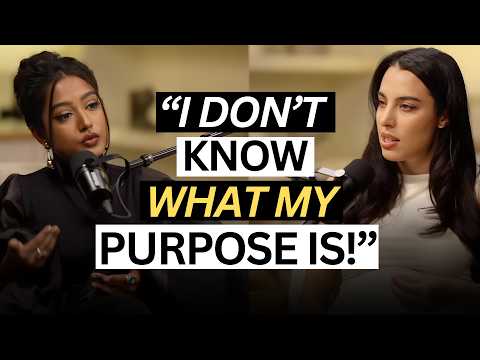
[0:00]biggest misconception is that we're all meant to have just one. So if we as individuals have so many roles in life that we have to do, how can your purpose just be one thing? How can we just be one thing? Today's guest is joining me for a third time on the podcast. She's an entrepreneur, author, founder, and a beautiful friend. Today's guest is Ria Jacobs. Why do we feel so lost when it feels like we've done everything right? We've got the checklist, we've got the goals, we've got the job. But something still feels empty. In life, we're all given a blueprint. 0 to 18 school, 18 to 24 Uni, and then after that you work until you're 60 and then hopefully have like a nice house and a dog and kids to go back to. But I think that model is now obsolete in a way. For someone listening right now, who is anchored in that moment of feeling really unfulfilled, they feel a bit lost. Where do they start to realign or re-anchor themselves? The number one thing is How do you think people can distinguish between the fear that's useful versus fear that's keeping us small? Anything that's stagnant rots, water, food, anything. It's very important to have momentum. These are things that you might think is not even related to your purpose, but it's the core of who you are. It's literally your foundation. The first step towards identifying or or to get closer to your purpose is to identify.
[1:34]All right, Balancers, today's guest is no stranger. Actually, fun fact, after me, you've been on the podcast the most. This is your third appearance on the podcast. It's one of my very dear friends here in Dubai, Rhea Jacobs. Rhea, welcome back to the show. Thank you so much for having me. I'm so honored to be here. I it feels like I'm in your house, like we're just chatting. But yeah, I I can't wait. It's going to be a great episode. Me too. Now, this one is a special one, because you've been working on something really amazing. I've been watching you pour in the time, the dedication, hearing you speak about it from ideation through to now it being alive thing in the world that we can all enjoy and embrace. And what Ria has done has is she's created a a product or a journal around the idea of purpose. Now, purpose is such a buzzword. I feel it creates a pain point for a lot of people, creates motivation in others, but there's so many aspects of it. And so today what I want to do is really talk about the practical aspects of purpose, right? Like, what does it mean? How do we actually achieve it in our life? What are some of the myths that sit around it? And you're the perfect person to run us through that. So, firstly, congratulations for what you've created. Thank you. And secondly, I'm really excited to have this chat. Me too. So, to kick things off, I think this is going to be a starting point that a lot of people resonate with. Yeah. Why do we feel so lost when it feels like we've done everything right? We've got the checklist, we've got the goals, we've got the job, but something still feels empty. You know, um, if you're in that phase in your life where you're lost, you feel like you're doing everything right according to the book. Well, I have great news for you. You're on a verge of a breakthrough, because and you might say, Rhea, but why? Like, I feel lost. I don't feel happy. I don't feel fulfilled. Well, in life, what happens is, there's always a two parts. The first path is, you have that feeling, and you don't have the emotional intelligence to to process that feeling. So, you just go on with life, and you think, oh, maybe I'll feel happy after I get that job. It's the happy when. It's it's the happy when, exactly. Maybe I'll get, um, I'll feel more at ease when I get when I make A amount or or B amount. Or you become that person who has the emotional intelligence to tell yourself, I'm not happy. And then you make yourself realize that all this why you don't feel happy, you feel lost, because you're trying to chase external validation, instead of trying to fulfill who you are inside. And I think that's why your purpose comes in, because your purpose comes in and in inside a path of alignment. I think in life, we're all given a blueprint, right? Like 0 to 18 school, 18 to 24 Uni, and then after that you work until you're 60 and then hopefully have like a nice house and a dog and kids to go back to. But I think that model is now obsolete in a way because because of the access, because of the information, because of the conversations like this, people are creating their own timeline. You're not comparing your life to another person anymore. Someone's achieved their life goals at 18, but there are some people who are 80, and maybe then they feel like, oh, you know what, I didn't do this, and now it's time to do that. So, I guess realizing that you don't have to to seek for external validation and look for alignment is way more essential and and will help you to feel less lost. This is really interesting and there's like so many details I want to go into. The first one that's sticking out to me. Uh, you know, you said some people achieve their goals at 18, right? You you hear about multimillionaires that are in their 20s, things like that. But it's interesting when you talk to people, when you I I've met a few people in Dubai, you know, they've achieved extreme wealth at very young ages, they still feel unfulfilled in some aspects. And so, my question to you is, purpose, this one thing that we need to find, or are people really holding themselves back by limiting it to being this one thing they need to define? It's such a beautiful question, and it's something that I struggled with for a long time as well. I think the concept of what your purpose is itself needs to be redefined, because I think a purpose was marketed and like showcased as this big magnanimous thing. Like maybe at least for me, I thought it would be on on like a track to the Himalayas or maybe I would go to a nice place and someone would like a really intelligent purpose would say, I mean, really intelligent, and man would say, oh, Rhea, this is your purpose.
[6:16]From the from the heavens, drawing to you. From the heavens, like, Rhea, this is your purpose, I'd be like, oh my God, I've been waiting for you my whole life. But such is the nature of how it was shown to us. But the beauty of purpose is, it can be found, yes, in the magnanimous ways. So many people have found their purpose doing all these things, but it can be also found in the most simple moments in life, in the most pure moments in life. And I think the biggest misconception is that we're all meant to have just one, because you and I, okay, you, Erica, you're not only the wife, you're the mother now, you're the friend, you're the sister. So if we as individuals have so many roles in life that we have to do, how can your purpose just be one thing? How can we just be one thing? And the beauty of purpose is, you might start with one goal, but then as time goes by, that same goal because of your growth, because of the things that you've learned, will slowly start to evolve. And I think there's magic in that, you know? It's actually quite similar to the way I talk about balance, right? It's this it's this concept that you need to really anchor in, okay, what does this look like for me in X, Y, Z areas of my life? And so I really like a piecemeal approach to purpose, because it takes that pressure off, I have to find this one purpose. Like for me, I'm always like, you know, when I was thinking about personal branding, I'm like, what is my mission statement? Like, what's the sentence that defines who I am? And I've really struggled with that because I feel I have all these different aspects of my personality and I've created a life where they all coexist. And so for me, it's not this big one bold statement. It's actually just me living the life that feels most aligned for me. But that also in and of itself is very daunting. So, for someone listening right now, who is anchored in that moment of feeling really unfulfilled, they feel a bit lost. And again, this might be, maybe it's in one area of their life, not all of them, right? But across the board, they're just feeling lost. Where do they start to realign or re-anchor themselves? The number one thing is awareness of yourself. There's a reason it's the first thing that you see as soon as you open the book, because in order to build the life you want, you need to know the tools that you already have and the tools that you need in life to create the life that you want. A lot of times it's easier to look outside and say, oh, but like I said before, we need to achieve this goal, we need to achieve that goal. But a lot of times you need to see where you where you lack or where your strengths are, your internal self-awareness, meaning your self-awareness with who you are without the noise of the world, and your external self-awareness, meaning that's also essential in a way. Like we say, there's no need to look externally. There is, because you're not always right. There's ego that comes in and so I think a balance of the two, identifying who you are within the book in itself. Like, we go internal self-awareness, healing, we go inner child. These are things that you might think is not even related to your purpose, but it's the core of who you are. It's literally your foundation. If your foundation and its core it's weak, how do you expect to build a life or to build your purpose based on that? And on that point, if you do pursue some sort of purpose or life based on a shaky foundation, it's a misaligned path, right? And I've been there before. You know, you spoke before about the 18 years old, you're at school, then you go to Uni, then you get a job, and I was on that path, and I felt all the feelings of this feels misaligned for me. And it's because I hadn't done that base work to be like, well, who am I and what do I want? Is there, like, obviously, you've put together a whole book, so this is not something we can deconstruct and work on today in in a single episode. But is there an exercise or something from that initial piece, a question someone can ask themselves, just something practical that the listeners can take right now to just have a think about their purpose? You know, whether you're someone listening who feels very aligned, this could be just like a check-in for them, or whether you're someone who is looking and and wanting to recalibrate. Like, is there anything like that you can share with us? I think I think it's not something that can be answered with just the a question like you said. I think you have to go way in deeper, but I think the first step towards identifying or or to get closer to your purpose is to identify, who am I now? What am I good at? What is the world need? Because you think your purpose is just you. There's a beautiful quote that, uh, I mentioned in the book. It's by Picasso. He said, the meaning of life is to find your purpose, and the purpose of life is to give it away. And I think that is so beautiful, you know? So, who you are right now, so who you are is like your awareness and all all the things I spoke about before. And then you ask, what are your skills? What is your contribution to the world? What is your legacy? What is your what is something that you can bring that can help the world? Which goes into my third thing is how how can that help the world around you?


