[0:00]Hey guys, and welcome back to badminton insight. Now we're always getting questions over which grip you should use for certain shots.
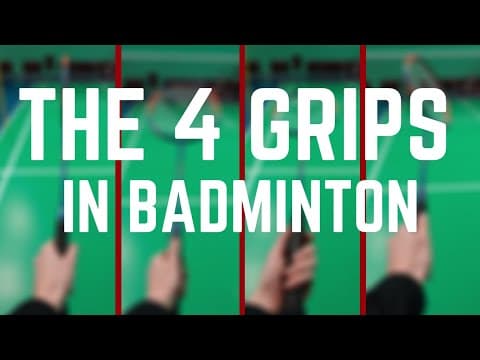
[0:07]So in today's video, we're going to teach the four grips you need to know in badminton and what shots you'd play with each of these grips. Hopefully we'll clear up a few doubts and it'll be a video that you can constantly refer back to to help you improve your game.
[0:22]So first, we have the forehand grip, and the easiest way to learn this is by pretending to shake someone's hand. Although, you may have forgotten what that's like with COVID. So you slot the grip in there, leaving this V here with your fingers loosely around the grip like this. Leaving a little space between these fingers. So we're showing it without a grip here to make it look very clear. But here's what it would look like with a grip on. And this grip is used for the forehand clear, the forehand smash, the forehand drop or slice, forehand lifts, and forehand net shots. So moving on to the backhand grip, our favorite way to teach this is using the frying pan, which you'll all have in your kitchen. So for this, you want your thumb on top with your fingers nice and relaxed around the sides. And it's the same when you transfer to a racket. This is what it looks like with the grip off, and this is what it looks like with the grip on. Again with your thumb on this wider section of the grip and your strings facing upwards. We would recommend using the backhand grip for the backhand serve, backhand drive, and doubles defense. But don't use it in your backhand rear court. Now there are some scenarios where you might choose to use a bevel grip, as the difference between these two grips is very small. It's essentially a halfway house between your forehand grip where your strings are facing this way, your backhand grip where your strings are facing this way, and the bevel grip, the strings are halfway. Now to learn this, we'd recommend starting in a backhand grip like this, and then bringing your racket head clockwise, so that your thumb is now on this bevel here or ridge. So to show you, and this is what it would look like with the grip on. You would adjust to this grip for shots such as some forehand or backhand net shots, depending on your position. Sometimes your forehand or backhand defense if you are stretched out wide, and you will always use it in your backhand recourt corner. This is apart from when you're really late, which is when you'd use a pan handle grip. And this is the last grip you need to learn, and it's one that comes most naturally to beginners because it's easy to hit. But contrary to what most players use it for, it should actually only be used for the late backhand.
[2:51]This grip is where you have the thumb on the side of the racket, almost pinching the sides with your thumb and fingers in this position. Now we're going to summarize the grips and watch where the strings are facing. So this is the backhand grip. This is the bevel grip. This is the forehand grip. And this is the panhandle grip. So this is the backhand grip, this is the bevel grip, this is the forehand grip, and this is the panhandle grip. As we've said throughout this video, there are lots of shots that require different grips, and whilst this may be overwhelming at first, we promise that with some practice you'll get to a stage where changing grips quickly between shots becomes really natural. The best players are so used to changing their grips and choosing the right grips, they don't even know they're doing it. It's trained into the unconscious mind and that's what we want to happen with any technique we learn. That's it for this video. If you've found it useful, please give it a like and the next step in the process is to learn some of the shots you can play using these grips, such as the late backhand, which you can watch here. And if you haven't already, make sure you smash the subscribe button so you don't miss future videos from us. See you next Sunday.


