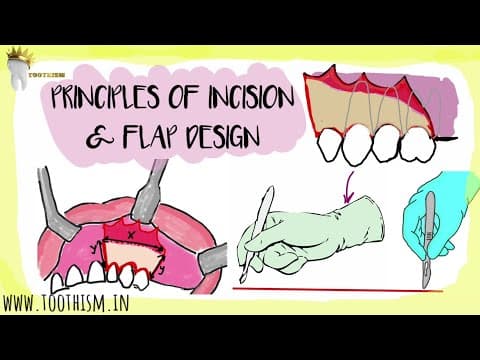
[0:00]Hey guys, this is Dr. Ketki and welcome back to my channel. Today we are going to understand basic principles of incision making and flap design in oral surgery. When you apply the basic principles of incision making every time during surgery, it helps the wound to heal faster and without complications.
[0:27]The first principle of incision making is that we should always use a sharp blade for carrying out the incision. If the blade is sharp, we will not need to make repeated strokes, which brings us to the next principle. The incision should be made with a firm and continuous stroke. If we make short interrupted strokes, it increases the amount of damaged tissue and this results in impaired wound healing. So one long and continuous stroke is always better than short interrupted strokes. To make it, the scalpel motion is like this. Notice how we are moving the hand at the wrist and not moving the entire forearm. The third principle is that the flap design and the incision should be made in such a way that we don't injure any major anatomical structure. So let's see which structures we might encounter in the oral cavity. The mental neurovascular bundle, palatal vessels coming from the greater palatine foramen and incisive foramen. Nerves like infraorbital nerve, lingual nerve, submandibular duct, parotid duct, buccal artery. The buccal artery is of concern when we are making the incision to drain an abscess of the tergo mandibular space. Then there is facial nerve and facial artery and vein, which can get damaged when we have made an extra oral incision for the drainage of an abscess. So one should take care of these vital structures. But the next question is how should we avoid damaging these structures? The answer is, when we are making an incision where an important structure might be present, we should incise only deeply enough to define the next major layer.
[2:10]So in any layer, if we see a major structure, it can be managed, like for example, an important nerve can be freed from the tissues and retracted away from the area to be incised. This care has to be taken when we are in an area where the important structure might be present. So knowledge of the anatomy of the area is very important as you can see. The fourth principle is that when incising, the blade should be held perpendicular to the tissue surface. This results in squared wound edges, as you can see, they are easy to reorient and close. If we make an oblique cut, what will happen? It will be difficult to close the incision properly. It can also compromise the blood supply to the wound edges, which can result in the necrosis of the wound edges. The fifth principle is regarding the proper placement of the incisions in the oral cavity. Incisions should be made through attached gingiva. These are more desirable than incisions made through unattached gingiva. Also, they should be made over healthy bone. When you place an incision properly over healthy bone, it provides support for the healing wound. Likewise, we should avoid making incisions over prominences like the canine eminence. Because you see, when we close the incision, the prominence will create pressure on the wound, and this might delay healing. Sometimes we have to place a vertical releasing incision for better access, and when we place such an incision, it should begin approximately at the buckle vestibule and end at the interdental papilla of the gingiva, without dividing the papilla.
[3:51]This point is very important. The papilla must be preserved. If we don't preserve it, it can expose the underlying tissues. And even for aesthetic reasons, the papilla is very important. Now let's understand principles of flap designing. Proper flap design is basically important to prevent the complications of flap surgery like flap necrosis, flap dehiscence and flap tearing. Now let's see which principles we should follow to prevent flap necrosis. Number one, height of the flap should never be greater than the base. So as you can see here, this X represents the base of the flap, and Y is the height. So X should never be less than Y. Ideally it should be like this, which means the length of the base should be twice the height of the flap. The reason is that when you have a wide base, it provides good blood supply to the flap. So less chances of flap necrosis. The sides of the flap should be parallel to each other or converge from the base to apex like this. If it's like this, you can see how this kind of releasing incision will cut off the blood supply to this part of the flap, and it will result in flap necrosis. This what you see here is called as buttonhole deformity. When for some reason such kind of trauma to the flap occurs, maybe because of improper flap handling, blood supply to the part of the flap tissue away from the base is compromised.
[5:34]During the surgical procedure, excessive pulling and crushing or folding of the flap must be avoided. Because the blood supply can get compromised, and it will delay the healing. Now let's see how to prevent flap dehiscence. Flap dehiscence basically means opening of the surgical wound edges that exposes the wound. It can expose the underlying bone and tissues, which can result in a lot of pain, bone loss, and increased scar tissue. Now what can cause a wound to open up like this? Perhaps it could happen that the wound was closed under tension, or maybe the edges of the flap were traumatized. Another reason could be that the edges of the flap were not resting over healthy bone. So we should try to eliminate these mistakes in order to prevent flap dehiscence. Flap tissue should always be handled gently, and the edges of the flap should be on healthy bone. Third complication of poor flap design is flap tearing. Suppose we are performing surgery over here, but the flap is giving us insufficient access. So we try to retract it too much, and this can cause flap tearing. We might think that creating a long incision to reflect a wide flap will require more healing time. But actually, a long incision heals just as quickly as a short one. So it's important that we make the incision in such a way that it will give us enough access for surgery. So that we don't tear the flap and we don't have to lengthen it later on. So suppose we have made an incision like this around the necks of the teeth to expose the alveolar bone. This kind of flap is called as envelope flap. But if we need access to more apical region of the alveolus, we will need a releasing incision here. So this is the vertical releasing incision. It should be generally placed one full tooth anterior to the area of any anticipated bone removal. So as you can see, this gives us better access. So the chances of flap tearing are minimized. So guys, I hope you enjoyed this short lecture. If you are interested in oral surgery lectures, this is the playlist here. You can find most of the important oral surgery topics here. And please subscribe using this link here, so that I'll be motivated to produce more good content for you guys. And I'll see you very soon. Bye.