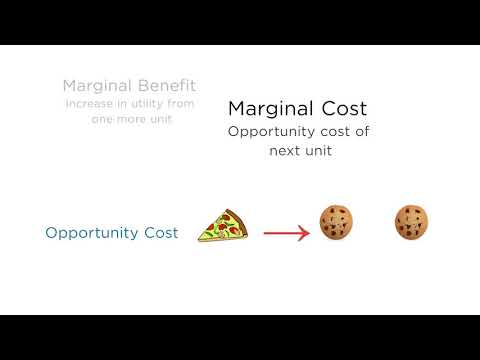
[0:00]To use this strategy of marginal analysis to maximize utility, it's helpful to think about the marginal benefit and the marginal cost of consuming the next unit of each good. The marginal benefit is the increase in utility from eating one more slice of pizza. The marginal cost is the opportunity cost of that next slice of pizza. If the marginal benefit of that next slice is greater than the marginal cost, you should eat more pizza. That is, you should climb higher on the utility hill. If the marginal benefit is less than the marginal cost, you should eat less pizza and going back down the utility hill. If the marginal benefit is equal to the marginal cost, you should stop right there. You're on top of the utility hill. So how do we measure the marginal cost of the next slice of pizza? Remember that your budget is fixed, so to eat more pizza, you must consume fewer cookies. Therefore, the opportunity cost of a slice of pizza is the cookies you could have had instead. This may be confusing. Why isn't the opportunity cost of a slice of pizza just the price of that slice of pizza? Because money itself doesn't matter, just what you can do with it. So what matters is not the dollars that you lay out. It's what else you could have done with those dollars. So we could think about the marginal cost of an extra slice of pizza in terms of how many cookies we would have to give up for that slice. What determines that? The ratio of their prices. The more expensive is pizza relative to cookies, the more cookies you have to give up to get more pizza. Therefore, the opportunity cost or the marginal cost of a slice of pizza can be expressed as the ratio of the price of a slice of pizza to the price of a cookie. Does that sound familiar? It should. It's the price ratio we talked about in the previous lectures. As in the last lecture, let's say that a slice of pizza cost $2 and a cookie cost $1. So the price ratio of pizza to cookies is 2 divided by one or two. This is the marginal cost of pizza. Similarly, the marginal benefit of another slice of pizza can be expressed as the ratio of the marginal utility of pizza to the marginal utility of cookies. That is, the benefit of having another slice of pizza is how happy that slice of pizza makes you, relative to the cookies you could have had instead. Why isn't the benefit just the marginal utility of a slice of pizza? Because of opportunity cost. If you're going to have that slice of pizza, you have to have fewer cookies. So to just think about how about how happy the pizza makes you, would ignore the alternative. You have to consider how happy it makes you relative to the cookies you're now skipping. So let's say you've already had a few pizza slices and cookies, and you're debating what to buy and eat next with your remaining money. At this point, let's say that another slice of pizza would increase your utility by six points. And another cookie would increase your utility by two points. These are the marginal utilities for pizza and cookies. The actual values of six and two aren't all that important for this exercise. What's important is the ratio of these values. 6 divided by two is three. So three is the marginal benefit of pizza, expresses the ratio of the marginal utility of pizza to the marginal utility of cookies. With cookies as the alternative, the marginal cost of pizza is two, and the marginal benefit is three. Because the marginal benefit is greater than the marginal cost, you'd be better off ordering another slice of pizza rather than settling for a cookie. Even though the pizza slice is twice as expensive as the cookie, it's the better choice, since it gives you more than twice the additional benefit to your utility. You can keep playing this game, considering different amounts of pizza and cookies you can consume until you get to the top of the hill, where the marginal benefit of the last pizza slice you eat equals its marginal cost. Suppose that the last pizza slice you bought cost you $2 and gave you utility of four units. And the last cookie you bought cost you $1 and gave you utility of two units. In this case, the marginal cost of that last pizza is the price ratio 2 divided by one or two. And the marginal benefit of that pizza is the ratio of marginal utilities, 4 divided by 2, which is also two. Marginal benefit is equal to the marginal cost. You've maximized your utility and have chosen your meal wisely.
1.7 Utility Maximization Part II
AP Microeconomics with MIT Professor Jon Gruber
4m 32s818 words~5 min read
YouTube auto captions
Transcript source
YouTube auto captions
This transcript was extracted from YouTube's auto-generated caption track. The transcript below is server-rendered so it can be read, searched, cited, and shared without opening the original YouTube player.
Pull quotes
[0:00]To use this strategy of marginal analysis to maximize utility, it's helpful to think about the marginal benefit and the marginal cost of consuming the next unit of each good.
[0:00]The marginal benefit is the increase in utility from eating one more slice of pizza.
[0:00]If the marginal benefit of that next slice is greater than the marginal cost, you should eat more pizza.
[0:00]If the marginal benefit is less than the marginal cost, you should eat less pizza and going back down the utility hill.
Use this transcript
Related transcript hubs
Watch on YouTube
Share
MORE TRANSCRIPTS


