[0:11]The style.
[0:16]A Dutch Avantgarde art movement takes its name from a publication that ran from 1917 to 1931. Its main purpose when relating to architecture was to create a language where universality is placed before artistic individualism. The reduction of elements to the essential basis of form and color is sought, and dynamic conceptions of spatial relationships are offered. These principles are synthesized and materialized in a fundamental work, not only for this artistic trend, but for 20th century architecture.
[1:05]At the beginning of 1924, Mrs. True Schröder went to the architect Thomas Jared Ritfeld to commission the project for her house, which she wanted to locate in the outskirts of Utrecht, in the Netherlands.
[1:19]The chosen side abuts a series of brick houses rigidly aligned along the street, and at the time with potential country views.
[1:31]Due to its proximity to the countryside, the site was aesthetically desirable, however, the small size of the lot and the surrounding buildings were significant limitations on the composition of the project. The role played by Mrs. Schröder in the creation of her home is important, not only because of the choice of location, but also because of the design of the building.
[2:16]Closeness to the field, freedom, openness and flexibility were established elements in Mrs. Schröder's program. She's actively involved in the project, suggesting architectural possibilities that were incorporated and collaborates with the architect in the organization of the interior.
[2:36]The project solution for Rietveld back then was a fixed wall composition. The idea of creating a large free space on the upper level, capable of being divided by sliding panels, came from Mrs. Schröder.
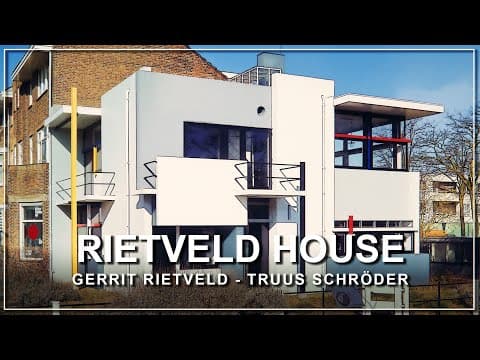
[2:51]The house is conceived in terms of straight lines, and rectangular planes materialized in the form of roofs, supports and beams.
[3:03]The volume is defined from linked flat elements, all the parts are asymmetrical shaped following a coordinated system, so that the lines and surfaces can be parallel or perpendicular to each other.
[3:17]Despite the rigid geometry, there is no module that regulates the proportions or the interrelation of the architectural elements. Everything was designed loosely supported by visual impressions.
[3:32]In the design of the house, each element maintains its visual identity, while interacting with the others to create the whole. The uniqueness of the architectural parts is emphasized by the superposition of the different planes and lines.
[3:49]The vertical load-bearing elements extend beyond the horizontal planes, thereby eliminating the static effect. By increasing their position, not only the structural efficiency of the system increases, but also the dynamic quality of the design.
[4:07]The independence of the architectural elements is also given by their own separation. Planes, lines and edges are decoupled from each other, allowing the intervals between them to remain empty or to be expressed by glass.
[4:24]Components are labeled by different colors, white, black, three shades of gray, red, blue, and yellow, thereby accentuating its uniqueness. And through the tendency of colors to retract or advance, the space is modulated, and the essence of the building is lightened. From a flexible assembly of the parts, two important aesthetic conditions result. The exterior space merges with the interior, and the mass of the building is minimized. As a result of the rhythmic interaction of the finite volumes and the infinite space, interior and exterior come together in the areas of material discontinuity, and a spatial continuity is achieved. Solids that are physically bonded are visually dissociated.
[5:19]The visual continuity in a structure is absent, and as a consequence the independent defining elements of volume, surface and line are interconnected discontinuously. Because each visual unit maintained its integrity, the observer sees the continuous surfaces of the roofs, as planes, and not as limits of the masses.
[5:41]Rietveld underlined the spatial configuration of House Schröder, and minimized its corporeality. Rietveld believed that the space of a building, is more important than the material that defines it, arguing that the material of architecture is space.
[6:11]The user enters the house through a relatively spacious entrance. The ground floor is divided into small rooms, attached to each other.
[6:24]The architectural program on this level is distributed around the staircase.
[6:36]Kitchen, dining room and the living room are divided into a single space.
[6:48]The study, a work and reading area, as well as a bedroom for domestic staff, complement the spaces on the ground floor.
[7:07]Daily activities, rest and food are organized on the upper level in a diaphanous space that contrasts sharply with the relatively restricted spaces on the ground floor. The large volume of the upper floor can be divided into other smaller ones. Through mobile partitions, the client raises the possibility of creating an open space during the day, so that their children have a greater extension to play and later, at night, to become private places again.
[7:43]Although the upper deck is relatively open, it is not simply a large undifferentiated space.
[7:53]Even with all the panels running, the space will show its maximum amplitude. The observer is subject to a rich variety of spatial experiences. Open closed, finite infinity, vertical horizontal. Both wardrobes and built-in furniture subtly alter the single space, dividing it into smaller segments without altering its continuity. Ceilings and floors are related through color, thereby achieving an association of such surfaces.
[8:27]The walls, when associated in the same way by color, manage to visually separate from the floor and the ceiling.
[8:41]Initially, Rietveld planned to build the house in concrete. Being too expensive for a small building, it will only be used on foundations and balconies.
[8:53]The walls are forged from brick, a traditional building material in the Netherlands, and covered with plaster. The walls are supported by steel beams.
[9:06]The Schröder house is a near perfect state of visual balance. The state of weightlessness, postulated by painters, marks an important shift in the vocabulary of our architectural vision, since we traditionally see an uninterrupted surface as the limit of a mass. Through the superposition of planes, the separation of the parts and color, Rietveld manages to dissipate not only the massiveness of the building, but also the conception of the material itself.
[9:40]The volume in the Schröder house is accentuated by the continuum of utter space, without sharp definitions, without massive materials, but simply suggested by the light elements of line and surface.
[9:56]The house puts into practice the latest ideas formulated by the artists of the Distille Group. The intangible aesthetic qualities of this work, lightness and spatial continuity, are basic ingredients of 20th century architecture. These qualities were achieved with surprising clarity of means and confidence of expression. The Rippled Schröder House becomes an outstanding expression of the human creative genius, with all the purity of ideas and concepts developed by the Distage Movement. With his radical approach to design and the use of space, he occupies a fundamental position in the development of modern architecture.
[10:52]If you liked the video, please do hit that thumbs up and share it. Don't forget to subscribe and press the bell button. Thank you for watching and I'll see you next time.


