[0:01]The planet doesn't argue, it doesn't negotiate, it sends signals. And today, those signals are no longer warnings. They are consequences unfolding in real time. For decades, humanity treated climate change like a distant chapter in the future, something that would affect tomorrow, not today. Something that could be delayed, negotiated, or solved later when technology improves. But in 2026, that illusion has collapsed. Because the Earth is no longer quiet. Across continents, something is happening at once, rising seas are swallowing entire coastlines, heatwaves are breaking historical limits year after year, wildfires are burning longer, faster, and more uncontrollably than ever before, and glaciers that stood for thousands of years are disappearing within a single human lifetime. This is not random. This is not coincidence. This is a system under pressure. And it is sending one unified message, The balance is breaking.
[1:09]We are now standing at the edge of one of the most critical thresholds in Earth's modern history. The 1.5 degrees Celsius warming limit.
[1:20]A number once treated as a warning line, has now become a repeated reality. But what most people do not understand is that climate systems do not respond gently. They respond in chains. A small increase in temperature does not create a small problem. It triggers cascading instability across every system that supports life. Rainfall patterns collapse. Agricultural cycles fail. Heat becomes deadly rather than just seasonal. Oceans absorb more energy, making storms stronger. Ice melts faster, raising sea levels in unpredictable ways. And ecosystems, nature's invisible support system, begin to break down quietly, long before human systems even feel the impact. So, this is no longer climate change as a concept. This is climate change as a system redesign of the planet itself.
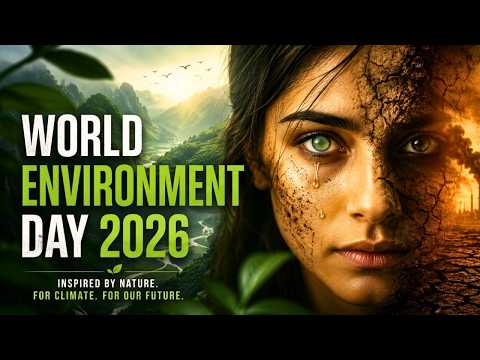
[2:16]World Environment Day, established by the United Nations back in 1972, was created as a platform for awareness. But in 2026, it has become something far more serious. It is now a global moment of confrontation. Hosted in Azerbaijan, in the city of Baku. This year's World Environment Day arrives at a time when environmental stability is no longer guaranteed. And the theme says everything, Inspired by Nature. For Climate. For Our Future. This is not just a slogan, It is a survival framework. It carries three truths that cannot be ignored anymore. One, nature is not separate from us, it is the system that sustains us. Two, climate action is not optional, it is now survival-critical. And Three, the future is not guaranteed, it is being decided in this generation.
[3:18]If history is honest, humanity did not fail because it lacked knowledge. It failed because it delayed action. And that delay was built on three forces: delay, distraction, and denial. We delayed because we believed there was always more time. We distracted ourselves with economic growth and short-term progress. And at times, we denied the scale of what was unfolding, because accepting it demanded uncomfortable change. But nature does not operate on belief, it operates on physics, and physics does not negotiate. We said 1.5 degrees Celsius was the limit. Now we are crossing it. And every fraction of a degree does not add a small problem, it accelerates every existing one. The crisis is no longer ahead of us. It is inside our present reality.
[4:13]But this is not the end of the story, because even in crisis, Earth sends another signal. A quieter signal, but a powerful one. A signal of transformation. Across the world, a silent revolution is already underway. Solar energy is expanding faster than any energy source in history. Wind power is reshaping national electricity grids. Electric mobility is replacing fossil fuel dependence. Cities are being redesigned to reduce heat, pollution, and waste. And forests —once destroyed —are being restored. Rivers are being cleaned. Ecosystems are slowly recovering. This is not symbolic change. This is structural change. We are entering a phase where sustainable systems are becoming more efficient than destructive ones. And when that happens, change does not slow down. It accelerates. At the center of every solution lies a truth humanity forgot. Nature is not weak. Nature is not secondary. Nature is the original survival system of this planet. For billions of years, it has maintained balance without human intervention. Forests do not just grow —they store carbon at scale. Oceans do not just exist —they regulate planetary temperature. Biodiversity is not decoration —it is stability itself. But when these systems collapse, everything built on them becomes unstable. That is why the world is now turning toward nature-based solutions. Reforestation. Ecosystem restoration. Sustainable agriculture. Biodiversity protection. These are not environmental policies. They are survival strategies written by nature itself. As the host of World Environment Day 2026, Azerbaijan represents a wider global transition. A shift toward responsibility. Toward accountability. Toward action. Its commitments reflect this change: reducing emissions significantly by 2035. Expanding renewable energy capacity by 2030. Building zero-emission zones. Transforming urban sustainability in Baku. But this is not about one country. This is about a global realization. Because climate does not recognize borders. Carbon does not respect politics. And temperature does not wait for agreements. Which means the response must be collective, or it will fail individually. Even in a global crisis of this scale, one truth remains powerful: Systems change when behavior changes. And behavior changes when millions of individuals act together. Every time someone reduces waste, saves energy, chooses sustainable products, or raises awareness, they are contributing to a global shift that no single institution can create alone. On its own, one action feels small. But multiplied across billions of people, it becomes the foundation of global transformation. At this point, the question is no longer whether change will happen. Change is already happening. The real question is something far more important: how fast will it happen. And whether we will guide it with intelligence, coordination, and urgency, or be forced into it through crisis, damage, and loss. Because the planet will respond either way. The only thing that remains unknown is the cost of delay. World Environment Day 2026 is not a celebration. It is a turning point in human history. A moment where awareness is no longer enough. Where information must become action. Where warnings must become decisions. The Earth is not asking for permission anymore. It is demanding balance. And yet, it is still offering solutions. That is what makes this moment critical. We are not too late to act. But we are no longer early. The theme Inspired by Nature. For Climate. For Our Future. is not symbolic language. It is a direction for survival. If we align with nature, learn from its intelligence, and act with urgency, a stable future is still possible. But if we delay, the consequences will no longer be reversible. The planet has already spoken. Now the response is no longer optional. It is ours.


