[0:00]I always say to people that out of I think it's about 300 songs that John and I wrote together, we never had a dry session. We'd always come in and we never went away from the session going, "Couldn't get it today." We always finished a song, which is pretty remarkable.
[0:23]I lost my little girl. It's the first song I wrote. That was very simple, three chords. Four chords and um, yeah, it was real early, little kind of rock and roll thing. I got a guitar when I was um early teens and I learned a couple of chords, I learned a G and a G7, C and an F. And using those chords, I made up this little song called I lost my little girl. People asked me whether it was about losing my mother at that early age. Which I don't know, psychiatrist might have a field day with that. But um I certainly didn't think it was at the time, but it could have been.
[1:17]woke up and I had the melody of the song, "Yesterday" in my brain. And I didn't have any words, so I called it "Scrambled Eggs." "Scrambled eggs, oh my baby, how I love you." I think the difference between me and a lot of people is they, they often dream about music, but they don't remember it. I, but for some reason, this melody just kept going around and around my brain, so I was near a piano, so I I kind of remembered it and blocked out some chords. A couple of months later, I put some words to it, "Yesterday."
[1:55]When John and I, John Lennon and I were getting together, we were kind of showing each other what we'd written. And this was one I I said to him, "Well, I got this idea." And I started off with it and uh we finished it together. So it was a very early Lennon McCartney song. Having collaborated one thing's great if you get stuck with the with something, you can just say, "What do you think of this?" You know, and you can kick it around together. My song started um she was just 17, she'd never been a beauty queen. And we kind of looked at each other's like, I said, "I don't really like that line." So we changed it to, "She's just 17, you know what I mean." Which makes more sense, even though you probably don't know what I mean. So we changed it to that and that uh started our songwriting partnership. Most of it was start from scratch, but sometimes one of us would just have an idea, like the first couple of lines, and then we'd just sit down and work it. But a lot of it we just came in and just started talking about what we might want to write about and then we'd just sit down. They were pretty quick sessions, it's normally like about three hours and we'd finish something. Um, you know, from beginning to end with the chords and the melody and the words. You wrote 300 songs, do you ever forget a lot of the songs that you've written? Yeah, I mean 300 was just the ones I wrote with John. Since then I've written lots more. And you do forget them. Yeah, and that is my excuse. "And I Love Her." I brought it I'd written it and I brought it into the studio and I was showing the guys. George Martin, our producer, said, "It'd be nice to have an intro on it." You know, let's have a little something leading the song in. So we were sitting around thinking and George Harrison just went, "What about this?" And I think, you know, that song wouldn't be anything without that, he just came up with it. So, uh that was the kind of pace we worked at. Because nobody ever knew what song we were about to record.
[4:25]Then it would be me and John would know because we were written it the previous week, but George and Ringo and the producer wouldn't know what we, so we'd say, "Oh, it goes like this," you know, and we'd show them. And in the space of about 20 minutes, they'd go, "Okay." And then we'd just record it. So it was a very fast process and uh that was very cool cool move, you know, he just made up that riff. I'll say if you think about the song without that riff, wouldn't be half as good.
[4:55]Eleanor Rigby was um, when I was when I was really little, um I lived on what we call a housing estate, uh which is like the project. There were a lot of old ladies. And I enjoyed sitting around with these older ladies because they they had these great stories in in this case about World War II, you know. And one in particular, who I used to kind of just visit and I'd kind of go shopping for her, you know, she couldn't get out. So anyway, so I remember her, so I had that figure in my mind of a sort of lonely old lady and over the years I'd met a couple of others. And I don't know, maybe their loneliness made me sort of empathize with them, but I I I thought it was a great character. So I I started this song about lonely old lady who picks up the rice in the church, who never really uh gets the dreams in her life. And uh then I added in the the priest, the vicar, Father McKenzie. And so there was just the two characters, you know, so it's nice, it was like writing a short story. And but it was based basically on these old ladies that I had known as as a kid. Father McKenzie in the song, I originally had Father McCartney. But when I came to finish it up with John, I brought it to John and we were playing it around. And I said uh I don't want I don't want to call this Father McCartney because it's like my dad, it's just a bit confusing. And he said, "No, it's fine." It's fine. I said, "No, I don't like it." So said, "Okay, let's change it." So we got the phone book and we just went right down to sort of McCartney, McCartney, McCartney and looked for something, Mc something. And the next one was like McKenzie. I said, "That's better." So it became Father McKenzie. Sometimes I do that, you know, just to block it out so you so you don't spend forever trying to figure out the exact lyric. You just go, "Ba da da da." So it could be "Barbara Hawkins, Miss Daisy." And you you just leave it for like that and then you go, "I don't really like that." So I was looking around for another name. This is a kind of strange story about that because I I wanted I like the name Eleanor. We'd been working with an actress called Eleanor Bron in the Beatles film, "Help." So I liked the name Eleanor, but I was looking for this Eleanor "ba da da" to make the the rhythm. So I looking for this nice surname and uh I happened to be in Bristol and I saw a shop that said Rigby. So I thought, "Oh, great, Eleanor Rigby." So now I had the the name of my main character. But then years later, somebody else is researching this and they said, "Do you know in that village where you you used to where John used to live, um there's a graveyard in the church and there is a gravestone there to an Eleanor Rigby." So I thought, "Did I subconsciously know that name?" Why would I go around searching for it? I don't know, I think it's maybe a coincidence, but there is a gravestone in Liverpool and in uh place called Woolton, where me and John met. That just say Eleanor Rigby.
[8:27]A Day In The Life was um a song that John had started and uh he kind of had the first verse. And this often happened, one of us would have a little bit of an idea, and instead of sitting down and sweating it, we just bring it to the other one. And kind of finish it together cuz you could ping pong. You know, you get an idea, then he get an idea, then, "Oh, that's good." You know. And uh, so he had the first verse. I read the news today, oh boy. And we sat in my music room in London and just started playing around with it, got a second verse. And then we got to the what was going to lead into the middle, and we kind of looked at each other and kind of knew we were being a little bit kind of edgy. When we sort of said, "I'd love to turn you on." So we kind of knew like this would have an effect. It worked and then we put another section I had, "Woke up, fell out of bed, dragged a comb across my head." So I had that section, so we put that in. Then finish the song up and then did a big sort of epic recording of it with a big full orchestra and everything. You know, and then did that crescendo thing in the middle of it with the orchestra, which was an idea I'd had because I've been I've been talking to people and reading about sort of avant-garde music, kind of atonal stuff, crazy ideas. And I came up with this idea, I said to the orchestra, "You should start all of you," now which they're all looking at me, puzzled. We've got a real symphony orchestra in London, who are used to playing, you know, Beethoven and here's me, this crazy guy out of a group. And I'm saying, "What you got to do is you everyone start on the lowest note your instrument can play and work your way up to the highest at your own pace. Just if you want to go, "Brrrap" that's fine or "Do, do, do, do, do" you know that was too puzzling for them and they're all looking at me. And orchestras don't like that kind of thing. They like it written down and they like to know exactly what they're supposed to do. So George Martin the producer realized that. You kept the random aspect. But he said to the people, "You should be about this note at this point in the song and then you should have got to this note and this note." And he left the random thing. So that's why it sounds like a chaotic sort of swirl, you know. Yeah, I know, that that was a that was an idea based on the sort of avant-garde stuff that I was into at the time.
[11:17]John and his wife Cynthia had divorced and I felt a bit sorry for their son, who was now a little bit, you know, a child of a divorce. I was driving out to see the son and Cynthia one day and I was I was thinking about the boy whose name is Julian, Julian Lennon. And I started this idea, "Hey, Jules, don't make it bad, it's gonna be okay." You know, it's like a reassurance song. So that was the idea that I got driving out to see them, I saw them and then I came back and uh worked on the song some more. But I liked the name Jude. I didn't realize it meant Jewish, which it does. I actually I nearly got into trouble because we we put it up on on a window of our shop, we we had a little shop because we were into fashion, would you believe, for a while? On the shop window, we put, "Hey, Jude." So that people going by on the buses would see, "What's that?" You know, intriguing, ah, and then it was our record. Well, I got this furious phone call from this guy, Mr. Leon, who was Jewish. He said, "What are you doing? How dare you do this?" And it's all "Hey Jude" because in Hitler's day, in the Nazi thing, "Juden Raus" meant "Jews out." So, and I didn't connect, is I actually heard the name first in a in one of the musicals, but I liked the name. Anyway, he rings me up and he's furious. "What are you doing this, you know, making fun of the Jews? We've got enough!" I said, "No, no, no, wait a minute." I swear to you, it's nothing like that. He said, "I'm going to send my son around to beat you up!" I said, "Hey, baby, it's cool it down, nothing to do with that." I said, "You'll hear when you hear the record, it's just a name in a song and it's all cool." But, of course, I, you know, I suddenly was alerted to the fact that it would have caused him a lot of problems because his family will have experienced that, you know, um firsthand, probably. Anyway, I calmed him down, he was cool and his son didn't come around to beat me up. Whenever I do a new tour, I think, well, I'll just switch up all the songs, but then I go, "I've got to do 'Hey Jude' because it is such fun." Um and it's great handing that over to the audience, you know. And you know what the greatest thing is? You feel this sense of community. And in these times when it's a little dark and it's people are sort of separated by politics and stuff, it's so fantastic to just see them all come together singing the end of "Hey Jude." So I'm very happy about that, so I keep it in the show.
[14:11]Helter Skelter. Yeah, I heard it on the car radio the other day. I did think, "Wow," you know, it is, I could see why people would think it was the precursor of heavy metal. How it came about was I had read in a a music paper that The Who had had done a really heavy track. And um Pete Townshend of The Who was quoted saying, "It this is the we've just made the dirtiest, loudest, filthiest song ever." So I was kind of jealous. I didn't hear their song. I still don't know what song he was referring to, but I went in the studio, said, "Guys, we've got to do a song that's dirtier and filthier and louder than The Who." If you think about the Beatles' stuff, was that um when I look back on the our what we produced, there's no two songs that are alike. Whereas, you know, a lot of record artists will find a great formula and they the next three singles are kind of the same song, you know. Um but we just we we always changed whatever we were about to do and did something different.
[15:33]So I had this Helter Skelter thing and we did that and uh yeah, it is pretty raw, you know, it's pretty screamy. But it was good to do. We did a lot of takes on it, so it was hard on Ringo. You know, on one of the on one of the takes you can hear him right at the end, he says, "I've got blisters on my fingers!" He's been drumming so hard and so loud, you know, that uh yeah, I I wonder whether, you know, heavy metal bands heard that and thought, "That's the way to go." I like, you know, loud rock and roll, basically.
[16:13]And I know the ACDC guys and they're loud. If you've seen them live. Oh, baby, that's that's one of the joys being in a band is you get to plug in an electric guitar and turn it up just as loud as you want. And it's such a sort of cool feeling that uh I can see why you'd form a group based around that idea.
[16:39]Blackbird, I was sitting around with my acoustic guitar and I'd heard about the Civil Rights troubles that were happening in in the 60s in Alabama, Mississippi, Little Rock in particular. So that was in my mind and I just thought, it'd be really good if I could write something that if it ever reached any of the people going through those problems, it might kind of give them a little bit of hope. So, uh, I wrote "Blackbird." And in England, a bird is a girl. So I was thinking of "Black girl" going through this, you know, you now's your time to arise. You know, set yourself free and uh take these broken wings. One of the nice things about music is that you know that a lot of people listening to you are going to take seriously what you're saying in the song. So I I'm very proud of the fact that the Beatles' output um is always really pretty positive. You know, there's hardly anything in there that's sort of says, "Go and screw your parents or whatever." You know, it's always pretty, "Let it be, Hey Jude, Blackbird." So it's hopefully a good message. I particularly like that and you you sometimes when I'm writing songs, um I will think there's people out there who are going through some problems and hopefully um people out there will listen to it and think, oh yeah, it's not just me alone going through this, you know, this is something and also something I can fix.
[18:23]That was a another dream song, actually. I'd been overdoing it, you know, it was the 60s and we were just getting crazed and stuff a lot of the time. And so I went to bed and um wasn't feeling too great inside my in my myself. And in the dream, my mother came to me in the dream and she died, um maybe 10 years previously. And so when someone who you've lost comes back to you in a dream, it's a miraculous moment, you know, cuz you're you're with them. And you your mind doesn't say, "Wait a minute, you shouldn't be here." You're just with them.
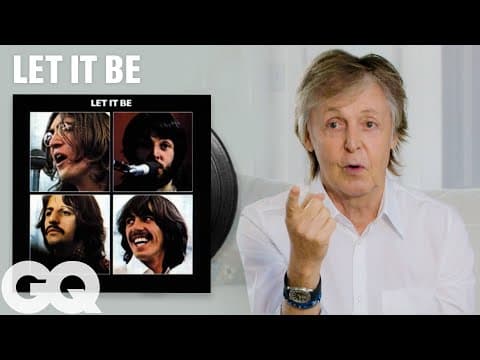
[19:07]And so it was really nice, you know, because it's my mom, oh, mom, you know, very emotional. And she seemed to realize, this is all going on in my mind, of course, but, you know, forget that. She seemed to realize that I was going through struggles. And she said, "It's going to be okay, it's all really going to be okay." And she said, "Just just let it be." I went, "Ah," and felt great. Then woke up, and thought, "What was that? What?" And I remembered the dream, thought, "What did she say?" "Let It Be." And then I sat down at the piano and wrote the song. Had a lot of emotion because of who'd said it and my situation. So that kind of translated to the record and I think that's why a lot of people like it. They they feel somehow that kind of magic comes through. Why why the piano, why not a guitar? Um I don't know. You know, just sometimes you just sit down at a piano and sometimes there isn't a piano, so you play the guitar. It's not like a formula, it's just what you fancy at the time and that particular song, there was a piano in my room. So I just sort of wrote it on the piano. Um and it it still is a piano song when I do it live, it's a piano song.
[20:25]Those times after the 60s were pretty high and you know, a lot of people were getting high. So to me this is like a fantasy song, sort of say, "Hey, girl, come on, let's get high and now I must admit it can get a little bit embarrassing because I got grandkids and there's me going, "Yeah, everybody get high." So when we do it live, I kind of go, "Let's get high on life." A little bit of a disclaimer there, you know. But um at the time it was just about the times and uh multi-colored band and it's a it's very much a period piece. But it it goes down well and one of my guys sort of rang me up, he said, "Hey, you know, this we've got a problem." "What?" Oh, the BBC had just banned "Hi, Hi, Hi." They won't play it. "Why not?" "Oh, it's drug related." And uh they're pretty straight-laced, you know, one of my two banned records. I I, you know, I can see why.
[21:33]After John died, there'd been a lot of talk about who did what, and who liked who and did the Beatles argue and. I was almost buying into this idea that um me and John were sort of fighting all the time. But I I just remembered it wasn't true. So I wrote the song about, you know, if you were here, you might say this or that. But I know better. I remember well some of the things we did. Yeah, it was really it was really for me thinking about John and just thinking, you know what, we we had a great relationship.
[22:17]And like any family, there's always arguments, there's always disputes, but in the end, you know, we loved each other. And um I wanted to do a I wanted to make a song where I actually said, "I love you" to John. And so that was that song. Again, it's quite emotional, you know, because it came from a real feeling about him and wanting to correct the record, kind of in my mind, as much as in anyone else's mind. And there are some photos from that period which are really beautiful. And there's just him and me working and you can see we loved each other. So but you know, once once all these rumors go about, you almost buy into them yourself. Anyway, so I that song kind of helped me set the record straight.
[23:08]I was in a songwriting mood and I was up in Scotland, I just thought, "Okay, I'll just got to go somewhere and try and write a song." And we happened to have a little pony that was called Jet on the farm, I was on a farm in Scotland and uh I actually took my guitar and hiked up this great big hill. I just kind of find myself a place which is in the middle of nature and um just sat there and just started making up a song, you know. It's not one of those songs that I even when I sing it now, I don't kind of know what where all the words came from. I know where Jet came from and I I like the name. The words are are kind probably about me and my father-in-law, you know, early days of getting married and when your father-in-law is kind of a nuisance and you kind of, "Hey," So he's probably the major in it, but uh, you know, it's only a song. So you kind of work you work your things out. That one was written halfway up a mountain in Scotland. Then record recorded in Nigeria. Yeah, I was wondering where to record and I fancied getting out of England. So I asked my record label, which is EMI, to supply me with a list of all the studios they had around the world. I knew they had a lot. And one was in China, one was in Rio de Janeiro, and one was in Lagos, Nigeria. So I went, "Yeah, Lagos, come on." Cuz I I like African music a lot, I love the rhythms of African music. And um so I chose that, not realizing that it would be really basic little studio. And we kind of built half the studio. They didn't have a vocal booth. You know, you go in a booth to isolate your voice. They didn't have one. So we had to explain to them, "You take some wood and you do this and you get some glass and you put it in like that." So we we built the uh vocal booth. But it was kind of nice, I liked the primitive aspect of it and being in Africa was pretty interesting experience, if you've got three hours I'll tell you about it.
[25:27]"I Don't Know" is um the one that opens the album and it's much more uh angst ridden. But again, you know, you you sit down to write a song and you think, oh, I'm not going to write anything that's like too sad or desperate. People are going to think I'm desperate. But but you go, "No, people like that. I like that." So I'm going to write something. You can often take a moment you remember where you had like a, let's say, an argument. And you think you think of that situation and you work it out in the song. So just by saying the opening lines, "I got crows at my window, dogs at my door, I don't think I can take anymore." That makes you feel better. And you suddenly, "Oh, it's a song." And you're you're crafting it into a vehicle that kind of puts all those thoughts in there, all your kind of troubles and woes. So you kind of work you work your things out. And songs are one of the great things about writing songs, it's almost like a therapy. You can go in kind of angry or sad and you put all of that in the song. It kind of makes the song better because it's real feelings in it. And when you finish the song, you feel a lot better.