[0:13]Augurs of Spring marks a radical shift from the introduction to Part One. Dramatically, we shift from the pastoral to the military mode, from the natural world (with no dancers on stage) to the human world (populated first by male, and then by male and female dancers). From night to day. Musically, we shift from tempo rubato to tempo giusto, from solo winds to massed strings played percussively, and eventually the whole band. And from a dark haze to bright clarity. The scene is in three large sections. In the first section, the old woman teaches divination to the young men. The harmonic orientation is toward Eb-Bb, but with strongly dissonant countervailing pressure from E-B, and with intermittent presence of C-G. I will call this section Dances of the Young Men, with the Old Woman. Amid the regular, march-like meter, punctuated with irregular accents, the expressive mode is military. In the second section, to which the scene's subtitle, Dances of the Young Women, properly applies, the pounding chords cease, and the young women enter with their own distinctive tunes and ostinato figures. Although the prevailing expressive mode is still military, the entrance of the young women brings elements of the feminized pastoral from the introduction to Part One. The harmonic orientation is balanced between Eb-Bb and C-G. The dissonant E-B has fallen away. In the final section, which I will call Dances of the Young People, the music accumulates layers even as it thins harmonically to an exclusive focus on Eb-Bb, and moves to a cacophonous climax, leading directly to the riotous ritual of abduction scene that follows. This first section of the scene features the steady pulsation, punctuated by irregular accents of a loud, dissonant percussive eight-note chord, known as the Augurs Chord. Metrically, this section is in a steady 2/4, often grouped into four-measure phrases, in the tempo of a fast march. The expressive mode is military, and the section is dominated by the young men as they learn divination from the old woman. As Stravinsky described the scene, "Some adolescent boys appear with a very old woman, whose age and even whose century is unknown, who knows the secrets of nature, and teaches her sons Prediction.
[3:00]She runs, bent over the earth, half-woman, half-beast. The boys at her side are Augurs of Spring, who mark in their steps the rhythm of spring, the pulse-beat of spring."
[3:17]The beginning of this scene plunges us right into the military mode. A strict metronomic succession of eighth notes, punctuated by irregularly spaced accents, in the manner of a march, and in strict march tempo. A percussive tamber with the massed strings playing repeated down bows punctuated by massed brass. A low register with the notes closely spaced. We hear a harmony layer only.
[3:57]The repeated chords are grouped in measures of 2/4 arranged as an eight-measure phrase-perfectly duple at every level.
[4:21]The eight notes of this Augurs chord are clearly divided into two distinct components: an E-major triad below and an Eb-dominant seventh chord above.
[4:42]The low register of the chord and its close-packed arrangement add to the dissonant noysiness of the combination. At this point, the two triads seem equally strong, but it will turn out that the locus of musical activity throughout the scene takes place within the Eb-Bb frame, often mixed with C-oriented harmonies.
[5:10]The E-major triad is a secondary distractor, and eventually fades out of the picture. The E-major triad was a prominent harmony in the introduction to Part One. There, it was used to harmonize the old woman's melody as well as the various nature melodies. In Augurs, when the old woman is on the stage, we hear the E-major triad as the lower component of the Augurs chord. When she leaves the stage, the E-major triad leaves also. The E-major triad functions as both a harmonic link to the previous scene and as a harmonic emblem of the old woman. But Eb-major is the principal harmony of Augurs. In that light, we can understand the Augurs chord as a consonant triad, Eb-major, with a dissonant distractor, E-natural positioned in the base.
[6:09]This creates a familiar 6+5=11 registral arrangement.
[6:20]The pounding chords of Block 1, lasting for eight measures, are answered by the more delicate arpeggiations of Block 2, lasting for four measures.
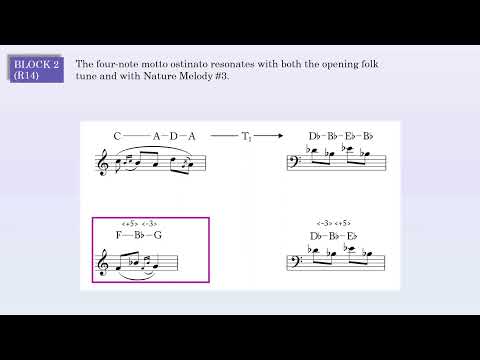
[6:37]At the top of the texture is a four-note figure that will run as an ostinato through virtually the entire scene. It arpeggiates the upper three notes of the Eb-major chord from Block 1, Bb-Db-Eb. It begins with a descending minor third, Db-Bb, and is framed by that same interval from its first note to its last.
[7:05]It describes the trichord type 035, which we have learned to think of as an incomplete Dorian tetrachord.
[7:15]This motto ostinato has strong resonance with two tunes from the introduction to Part One, including the ballet's opening melody. The motivic transformations both create a musical link to the earlier scene and measure the significant expressive distance the music has traversed from a focus on the natural world in pastoral mode to a focus on the young men of the tribe in military mode. Compared to the opening folk tune, the motto ostinato is a semitone higher.
[8:00]Compared to Nature Melody Number 3, the motto ostinato is both transposed and has the same intervals in reverse order.
[8:25]Beneath the four-note ostinato, three different triads are arpeggiated. In the cellos, moving in eighth notes, E-major alternates with C-major.
[8:37]The E-major is also the lower component of the eight-note chord in Block 1. In the bassoon, moving twice as quickly in sixteenth notes, C-major alternates with E-minor.
[8:50]Eb-major and E-major, the components of the Augurs chord, have no notes in common. The arpeggiated C-major and E-minor triads share tones with each other, and with the components of the Augurs chord, binding these four triads together.
[9:42]In Block 3, in the harmony layer with its Augurs chord and its four-note ostinato, we hear the first melody of the scene. In the score and in his letters, Stravinsky identifies this melody with an old woman, a seer and a diviner, half-woman, half-beast. "I see her running in front of the group, stopping them sometimes, and interrupting the rhythmic flow." The melody is in two parts: an ascending three-note head motive and a much longer descending chromatic continuation.
[10:50]This move recalls the introduction in two ways. First, the introduction also ended with its opening music transposed down a semitone. Second, this transposition returns us to the level of the opening of the introduction, where the initial tune featured a descending minor third C-A with D as upper neighbor to C.
[11:22]This transposition of the old woman's tune lies within a shared descending 3-cycle that the previous transpositions also inhabit, going back to early in the introduction to Part One.
[11:49]Just as the old woman is different from the crowd of young men she dances with—she's an old, female supernatural figure—the prevailing meter shifts from duple to triple at her entrance. There is no general association of triple hypermeter with particular characters or expressive modes, but in this instance, the musical differentiation of the young men and the old woman is underscored by their contrasting hypermeter: the young men are duple, the old woman is triple.
[12:49]In Block 4, a 12-measure block, the textural strands start to proliferate with three distinct ostinatos in the harmony layer.
[13:13]Of the three ostinatos, two are oriented toward Eb-Bb and one toward C-G.
[13:36]The upper two ostinatos are comfortably duple, but the lowest ostinato is inherently triple: it lasts for three (not two) quarter notes, and coincides with the notated downbeats every three measures. The hypermeter is also triple, and divides the 12-measure phrase into four groups of three. If triple hypermeter, like a melody based on 036, is characteristic of the old woman, we can say that she is still in charge of the scene.
[16:29]Block 5 marks a return to duple hypermeter after the disruptions caused by the old woman's triple hypermeter.
[17:27]In Block 6, the eight-note chords continue to pound away in steady eighth notes, in regular 2/4 meter with irregular accents.
[17:58]In the same low register, we hear a new tune, based like so many others on the Dorian tetrachord and featuring a descending minor third. The Dorian tetrachord tells us we are dealing with human characters, and the low register, marcato articulation, and rhythmic regularity tell us we are dealing with young men in a military expressive mode. It is the young men's melody at a different transposition level.
[18:50]The melody trots up and down within its four-note frame, mostly articulating regular four-measure groups.
[19:19]This melody associated with young men is linked to the old woman's tune in three ways. First, its descending minor third lies within the descending 3-cycle previously traversed by both the four-note motto ostinato and the old woman's tune.
[20:06]Second, the young men's tune lies at the same pitch location as the head-motive of the old woman's tune.
[20:26]Finally, the two tunes are linked through their minor thirds: one shared and the other a semitone apart. In all of these ways, subtle affinities bind these tunes despite their obvious musical and dramatic differences. The dramatic situation here involves interplay between the old women and the young men. She teaches them divination. They respond to her teaching. Hodson, in her reconstruction of Nijinsky's choreography, refers to this dramatic moment as the "conversation" and arranges it as "a series of gestural exchanges between the old woman of 300 years and the men whom she teaches how to jump and how to divine with twigs."
[21:38]Block 7 is basically a repeat of Block 6, but with the melody in strict canon at the double octave, and at a distance of two measures. After the third measure, the canon produces only consonant intervals between the parts: octaves, thirds, and sixths.
[22:10]The two voices have different hypermetric schemes, and these contradict each other. In addition, the leading voice has been altered from its previous appearance in Block 5, and its internal hypermeter is now also full of conflicts.
[22:39]Block 8 is a brief interjection, a momentary suspension of the steady, relentless pulsation of the previous blocks. Formally, it closes off the first section of the scene, and the cessation of motion gives the measures a cadential or at least interruptive feel.