[0:00]Hey everyone, and thanks for jumping back into the Cryptoverse. Today, we're going to be discussing asymmetrical tail curvature in Bitcoin price quantiles. If you guys like the content, make sure you subscribe to the channel, give the video a thumbs up, and also check out the sale on Into the Cryptoverse premium at into the cryptoverse.com. The sales ending in a few days. Let's go ahead and jump in. So, there's been a lot of model development in Bitcoin over the last decade. And we're going to provide a brief review of that, and then we're going to talk a little bit about this model. What it does better, what it doesn't do better, and and also give credit where credit is due, frankly. So, let's talk about how we got here to this model that I'll probably start using some on the channel. The first thing I will say is this, is that all models are wrong and some are useful and every model eventually starts to wane from the original, you know, from the original fit, right? It doesn't always hold up over a long period of time. But while all models are wrong, some are useful, and some are a lot more useful than others. Now, it all started arguably with a Bitcoin talk post, uh, I think his name was Trolo Lo, something like that. And he posted this rainbow chart. Now, this was posted a long time ago. Um, and it was one of I think it was the first, if I'm not mistaken. I could be wrong, but I think this was one of the first ones posted, and it's essentially a rainbow chart. And one of the things that you'll notice is that the price of Bitcoin at the peaks tends to fall down. Like you see how every cycle it doesn't go up as high into the regression bands, like every single cycle it doesn't go up quite as high. And that was one of the things that, you know, I've talked about before with the regression rainbow that that we have on, uh, on trading view. But it was something that wasn't really fully captured, okay? So, there's this model, and then I think I I and again, I could be wrong, but I I did the best I could and and looking up the different models. Giovanni, I think a lot of people are pretty familiar with the power law. Um, and I'm going to link, you know, I'll link the stuff in the description of the video. So if you want to go check out any of these models, you can do that. Giovanni has a YouTube channel, and I will also link that as well. And he has a video called The Bitcoin Power Law Theory. I would encourage you to go watch it, um, because he'll, you know, he really starts to talk about where this stuff comes from, okay? And I think this one was next in about 2018 if I'm not mistaken. I think he maybe talked about it before 2018, but the earliest like threads I could find on Reddit were 2018, but that doesn't mean that there weren't some threads before then. And so then there's the power law theory, the power law model, which structurally at the lower tail does a pretty good job. Does a pretty good job at the lower tail. And then that was in 2018 and ongoing, you know, ongoing work since then. I put together this model. And basically what this model was was the idea of it was essentially fitting the different quantiles essentially. This was back in I think this indicator was published back in 2020. I believe, I believe it was 2020. And the idea was if we fit the data to the lower quantile versus the upper one, like basically fitting it to data in that like that 1% quantile versus the 99%. What do you get? And we got this chart. But I didn't actually fill in all the ones in between, but you can see how the curvature is different, right? You can see how the curvature is different between the two curves. And I was essentially trying to capture the fact that the rainbow chart was using the same curve, right? It was using the same curve to predict both the lower tail and the upper tail. But you can clearly see that they have different curvature. The lower tail, the structural support is a much, does a much better job of actually finding the lows, and even that sometimes breaks down, right? Like originally, you know, you can see that it was held holding up in the blue one, and then as the cycles went on, then it went down into the purple one, and even went below the purple one last cycle. So, even that one is a little optimistic, and you can see how every cycle it kind of drips, the highs aren't as high into the regression band, and the lows are are starting to go a little bit lower into the regression band.
[5:37]But again, when these were fitted all those years ago, I mean, it did a pretty good job. Right? Because I think this was fitted well before the 2017 peak. So, this model was not a failure. In fact, it's one of the, you know, the the the best models that we've had on Bitcoin for a long time, and a lot of work was inspired by this one. It's just that when you fit the data, and you only have like one cycle of data to fit, it's not going to be able to predict what happens 20 years later because markets change and you just don't have enough data. So, Giovanni came along, right, with the power law, and I think that does a better job than the rainbow chart, right? I think it it does a better job. Structurally, it does a pretty good job of of finding the lows, but the last couple of cycles, it has like the price of Bitcoin hasn't really gone to the highs. Now, I don't think the power law, it doesn't state that it has to go to the highs, right? It doesn't say that it has to go there. It just says that these would be the bounds at a point in time if it were to go there. But it again, I don't think it it hasn't hit those higher higher bands, uh, for at least two cycles, I believe. And so, after that, I put out this model to try to capture some of the curvature. And I I don't know if you guys remember, maybe the only the people that will remember are the are the OGs. But back then, I referred to the lower quantile as quote unquote non-bubble data. So, when I selected it, it was not a mathematically rigorous way to do it, right? It was more dubious speculation, it was not mathematically rigorous, but the idea was there, okay? And then after that, I put out the regression rainbow, right? And the idea was to kind of show how every cycle we kind of drop a few regression bands, right? Now, that gets you through 2020. Now, there's other models developed as well, right? Like stock to flow was put out, I believe in 2019, but that's been pretty optimistic of a of a model, and and we haven't really hit those extremes, um, of of the stock to flow model. And then not too long ago, there was a person named The Real Plan C, and he's, he's on Twitter. I don't know if he's on YouTube, but I I think he I know he's on Twitter.
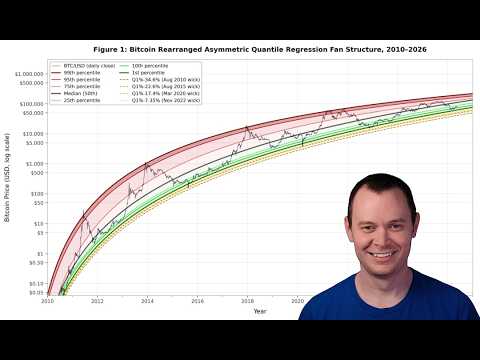
[8:21]And so, I would recommend following both him and Giovanni, because, you know, there's a lot of, there's a lot of hype in this space. And I I feel like there's a lot of stuff that's not really based on data or rigorous mathematical proofs or anything like that. And so, you know, it's easy to put out a model that is just going to call for Bitcoin to go to like $10 million, and, you know, you can go to a Bitcoin conference and hear everyone giving these like $30 million price predictions as their bearish target. And I mean, like that's great and all, but do we want that or do we want something that's like realistic? And I I think that the power law has been struck it it has worked for a while in terms of the lower tail, like showing you kind of where those lows form. It's not, I mean, I'm not saying it it it it always perfectly gets everything right, but I mean, I think it is a a fairly mathematically sound model to to kind of understand what Bitcoin is doing. And so, the real Plan C, he put out a a quantile model, which basically was it it just kind of showed all the different quantiles of, you know, of the price. Um, sort of like a like a like a rainbow chart. But he then also introduced, I think, this like exponential decay function in the upper tail, uh, as well. And again, you can go to his Twitter page and you can read all about that, and I will link that all in the description below. So, a lot of the work, you know, sort of like builds off each other. You have, you have the the the regression rainbow, you have the power law, you have sort of the regression fits to the the lower quantile and the higher quantile. You have the full quantile framework, um, and I think they all do a pretty good job of of trying to kind of explain what's going on. And what I wanted to do was basically come back to this idea of asymmetric tail curvature. And I wanted to do it in a mathematically rigorous way, okay? I wanted to do it in a mathematically rigorous way. So, what I did was I, let me just pull the model up. So, this is what it looks like, okay? This is what the model looks like right now.
[11:13]This at the lows, at the lows is no better than the original power law model, no better, okay? Um, in fact, the power law model works just fine at the lower structural support, and it has for a while, okay? So, no better there. Where I think this model provides a little bit of intrigue is the upper tail. Because the upper tail, the peaks are diminishing. The the euphoria excess is getting a little bit less each time.
[13:08]So, what's happening is they're converging to each other, right?
[13:46]You see this like, once upon a time, they were pretty wide apart, but as time goes on, they're converging towards each other. So, you're not, you're not getting the same type of explosive moves. You still get them, but they're not like what they used to be. But the support level continues to rise. So, I think it's an interesting thing, um, and it it again, it sort of builds off this model of the regression bands, right? Like it's not if you look at it compared to the regression bands, this one was published like six or seven years ago, it's not that different in terms of the idea. The fit is different, but we have more data, like the fit is different, we just have more data. But you can see that it's not that different in terms of the idea, okay? So, um, from here, if we go into each one. Right now, you can see that we are at the 9.4 percentile, meaning throughout all of history, Bitcoin has only spent about 9% of its time below the current quantile. Only about 9% of the time.
[15:08]I'm just trying to make sure I get I I'm just trying to make sure I get all these things exactly right because there's a lot. I mean, if you guys want to read the paper that I wrote for it, this is what it looks like, okay? And it it's a long paper. I, you know, if you if you want to go take a look, you can, uh, it's on the website, Benjamin Cowen.com. And you can go to the reports and look at asymmetric tail curvature in Bitcoin price quantiles, and it goes through all the mathematical rigor. We talk about some of the other models, some of the ways in which those models are better, some of the ways in which this one is might be might be useful. Um, so I would say go check it out if you want a little bit of light reading before bedtime. Um, so the bands of this model can bend, right? They can bend, they can converge towards each other. And this basically uses a post estimation rearrangement, um, and it's an unconstrained fit. So, there there's no, you know, the fit itself is not constrained in any, you know, in any way in that sense. So, what I want to do now is talk a little bit about where we are. So, if you zoom in here, the lower quantile, the 1% quantile, is at around 62k. And I will double click this, and I will add in price levels so you can see what I'm talking about. So, the current quantile Q1 is at 62k. That doesn't mean Bitcoin can't go below it. What it means is that historically, Bitcoin has only spent 1% of its time below that quantile, 1% of its time. It doesn't mean it can't go below it, it just means it doesn't go below it when it does go below it, it hasn't historically gone below it for that long. So, you have to be careful about how we like define things, right? If you say that Q1 is always support, well, look at what happened in 2022, right? It went slightly below it. In 2020, you can see it like went slightly below it. And again, there's there's different models you can use to sort of look at this stuff, um, but what I wanted to do was capture some of the dislocation events that had happened. And those dislocation events, in this case, I'm just referring to any time Bitcoin has gone below Q1, the first the the 1% tile. And there's four main times in history, really there's like maybe you could argue more in some of these wicks, but four main times in history, okay? And if you go into the fit, you can see the different dislocations that occurred, and we're going to add those back on. So, the most recent dislocation was in 2022 where the price went a little below that first quantile. In terms of a price or in terms of like a a distance below it, you know, we have it exactly in the paper, but you can sorry that was not that's not from the one that's from like the five or whatever to 10. About, you know, five or 6% below it. So, what we wanted to set, what we wanted to show is if Bitcoin were to go to the quantile it went to in late 2022, what would the price be? Today, what would it be today? If Bitcoin were to go to the same quantile that it was in in late 2022, it would put the price at around 57 to $58,000 today, okay? So, if Bitcoin were to drop to 58k, then that would essentially correspond to where it dropped in terms of its quantiles back in 2022. Now, there's other models you can use, right? This is not like a a perfect model that that supersedes all prior ones. This is just a different model. It's just different. It it doesn't it's not necessarily better at the lower bounds. In fact, at the lower bounds again, the simple power law does just fine. But I'm just run we're just running with this model right now for the lower bounds. I want to talk about the upper bounds. That's the 2022 one. If you go back to the pandemic, it went lower, right? It went lower, and you if you zoom in, you can see it went all the way down to this quantile down here in March of 2020. And now, that quantile, today, let's just say what would where would the price of Bitcoin be if it went to the quantile it went to during the pandemic? What would that be?
[20:05]It'd be about 51k, 51 to 52k, right? Okay, Now keep going back because there's another one. This is the most egregious one. This was the one we got in 2015 where in 2015 on some exchanges, Bitcoin actually went below where it was in January 2015. So, you had the bear market year, you went sideways and you basically had a double bottom. That double bottom, what quantile, where did it go? Where did it go? It went right here, it was about 35% below the below Q1. It was a pretty big drop. And you know what 2015 had? It was a recession scare. A lot of people probably don't remember, we didn't get a recession, but there was a pretty big scare we were going to have one. What price would that correspond to today? Today, that would correspond roughly to around 48k, 48 to 49k, right? And actually, that one's only that one's not 35, it's 22% below. The only other one, and this one, I'm not convinced we should use. But if you go all the way back to August of 2010, I'm not even I'm not even going to dare include this one because this is like 50% down. But August 2010, there was a pretty big wick down.
[21:40]It was probably an illiquid wick that doesn't really mean anything, if we're being honest, right? But I wasn't trading Bitcoin back then. I don't know for sure exactly what that was. So, just for completeness, we've added it. And you can see that that one would currently correspond to about 40k. So, you have the regression bands, that there the quantiles, but it's an asymmetric quantile fit. The upper tail is fit differently than the lower tail, which is kind of what we did six years ago with this model. But the main difference between six years ago and now is that this one was not mathematically rigorous or mathematically sound. It was more so me just eyeballing it and fitting it. This one is more rigorous and sound, the one we have now. Now, again, that doesn't mean it can't break, right? I mean, yeah, if we were to go into some massive global recession, then this model could easily break. I mean, it's not like Bitcoin's ever experienced a prolonged major crash in the stock market. So, again, there's no guarantee that this model will stand the test of time. In fact, it probably won't, right? In fact, it probably won't, given a a long enough period of time. Now, let's talk about the upper quantile. And this is where I think there are some advantages over some of the other models. Because in this case, you can see the euphoric parts. Now, you might say, well, hold on a second, it wasn't euphoric in the last bull market. But we know that it wasn't. We know that Bitcoin topped on apathy, and we know the only time in history it topped on apathy was 2019, two months before quantitative tightening ended. So, if you were to overlay interest rates onto the chart, you'll see how in 2019 when QT ended and and interest rates started to drop, that is where Bitcoin topped out at. See right here where interest rates started to drop, didn't drop the first time, but now what we're going to do is we're going to overlay QT, the balance sheet of the Fed. We're not going to overlay Q, we're just going to overlay the balance sheet of the Fed, what you'll see is that Bitcoin topped out two months before the Fed's balance sheet started going back up, just like it did in 2025. So, in 2019, Bitcoin topped in June, quantitative tightening ended in August, and there was no rotation from Bitcoin to all coins. 2025, the same thing, Bitcoin topped in October, QT ended in December, two months later, no rotation from Bitcoin to all coins. Okay? And guess what? They both topped out. They both topped out at the 75% quantile, give or take. A little above both times, but you can see neither time did they go to the 95th to 99th percentile. So, if you have sat around wondering why there was no rotation into all coins, why there was no quote unquote alt season, the reason was because of monetary policy, in my opinion. And and how and also because a lot of them are a lot of all coins are just simply scams and and people are tired of losing their money in the space, frankly. But from a non-judgment perspective, just from like a mathematical macro perspective, the reason why it didn't happen was because of monetary policy. And the reason without including monetary policy that there was no alt season was because Bitcoin never became euphoric because it topped out before getting to the 95th percentile, which did not happen in this past cycle, or in the mid-cycle peak of the cycle before that. So, that doesn't mean that Bitcoin can't go back up there. There is an argument to be had that this top here corresponds to this top right there in 2019, right? So, if that's true, then where we are right now, where we are right now is in this phase. And you can see that once that phase ended, we did go back up to the higher quantile, right? We did. But not before resetting, right? Not before resetting. Now, I'm not here to suggest that we have to go all the way back down in terms of the quantiles, exactly to where we were in the pandemic. But what I am saying is that midterm years are normally when the markets reset, and every cycle, every cycle so far, at some point, Bitcoin did go below the first percentile. In the 2018 cycle, it didn't happen until 2020, when we went below it. Last cycle, it happened in the midterm year where we went below it. Cycle before that, it happened in the pre-having year. So, you can see that it's happened every cycle, it's just hard to know when in every cycle, it's going to happen. So, I I want people to sort of keep this model in mind, not as, you know, a a perfect way to capture the Bitcoin price. I think there's a lot of models that do a good job. I think the power law model does a good good job. Um, you know, I think Plan C, what he's working on, The Real Plan C on Twitter, I think what he's working on with his quantile work does a pretty good job. This is just another mathematical framework that tries to capture in a mathematically rigorous way without any bias or anything like that, the fact that the upper tail is different than the lower tail. And that you don't have to eyeball it. You can just run the calculations, and it'll spit this out for you, okay? So, I I guess what I would maybe refer to this area down here, this golden band, I'd probably say that's like the golden pocket of Bitcoin. Whenever it goes there, it's been a incredible time to buy whenever it goes there, but it doesn't go there very frequently. Right? It doesn't go there very frequently. If you look at the time between when it's gone there, between say 2015 and the next one, it was about 238 weeks, and then the next one after that was about 139. We're currently at around 185. So, you know, we're kind of in between the last two in terms of how long it took to get back down there. So, I just want to put this on your radar. I want you to imagine a future for the rest of the midterm year, where we know Bitcoin could stay weak through the midterm year like it normally does. If later this year, you're looking at Bitcoin and it's below say Q1 and it's late midterm year, just consider that maybe this time's not different. Maybe Bitcoin's just bottoming at the end of the midterm year like it normally does, and perhaps that'll be a good accumulation target, accumulation window as we go hopefully into the next Bitcoin bull market. So, in this indicator, I also wanted to just quickly show, these are the having lines, right? So, you can see kind of like where the havings are. And then also, um, I know people are going to ask this. So, I'll I'll go ahead and add it. We have a sort of this end of year price table. And and and this basically just shows every price for every quantile at the end of each year. That's all it shows, okay? Going to 2050. And so, for Q1, when does Q1 the first percentile reach a million?
[30:31]2041.
[30:35]But maybe we hit it sooner because that's just the first percentile. You can see that the 50th percentile says 2036. The point is, is, you know, whenever it happens, it's probably going to take longer than people think. It's probably not going to happen next cycle. Probably won't happen the cycle after that either, because next cycle gets you to 2029. Cycle after that gets you to 2033. And in order for it to hit a million by 2033, you'd basically be looking at which percentile here. Yeah, there's no none of the percentiles show it by 2033. The earliest one, the 99th percentile, the earliest would be 2035, okay? So, this was just an idea, you know, I I during this recent rally that Bitcoin has had over the last few months, um, one of the ways that I spent my time, um, other than, you know, being with a newborn in the wee hours of the night, trying to work on on on this and just, you know, saying, look, I'm not claiming this model is better than other models. I'm not at the lower tail. It's not, it it it doesn't do a better job than just the base power law model. But at the upper tail, I think it might be somewhat helpful in terms of identifying the highs, right? In a euphoric rally, in a non-euphoric rally, like what we just got and in what we got in 2019, you can see that when that happens, you then end up topping out at around that 75th percentile, maybe a little bit higher in both cases, not 95 or 99. So, again, if you want to read about this, I'll link it in the description below. You can go read about it. I will also link, um, you know, the other models as well, the the the rainbow chart, the work by Giovanni, the work by Plan C, all do a great job, and all are are not hype. Just presenting the work as the math leads them to present, which that's the way we should do it. And in a world of hype and overpromising, we can all use a little bit more of that. If you guys like the content, make sure you subscribe to the channel, give the video a thumbs up, and I'll see you guys next time. Bye.


