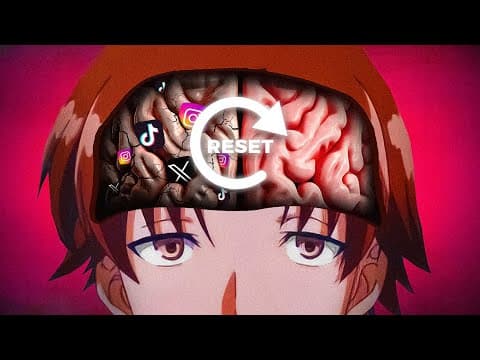
[0:00]Ayanakoji Kiyotaka is the embodiment of precision and control, a character who doesn't leave success to chance. However, contrary to popular belief, the source of his abilities is actually not the brutal regimen he endured in the white room. It is something much more fundamental, his ability to rewire his brain for success. Now, while he is quite obviously a fictional character, the techniques behind Ayanakoji's seemingly superhuman mind are grounded in neuroscience. And in this video, we will show you how to apply them in your own life. For that, we're going to take a deep dive into how to harness the hidden power of your brain to lock in the behaviors that lead to success. You'll learn how to leverage specific times of the day to make habits stick, tap into your brain's natural reward systems, and even break free from the destructive behaviors that are holding you back. Also, a big thanks to Brilliant for sponsoring today's video. Now, let's get started. To truly rewire your brain for success, you first need to understand how your memory systems work. Specifically, let's focus on the difference between episodic and procedural memory. Episodic memory is about recalling specific events or experiences, like remembering your first day at school. Procedural memory, on the other hand, is all about retaining the step-by-step sequences necessary to achieve a desired outcome, like learning to ride a bike or bake a cake. This matters because procedural memory plays a critical role in how we form habits, and it's a cornerstone of rewiring your brain. Think of it as following a recipe. When you bake a cake for the first time, you rely on the recipe to guide you through each step. But with practice, you internalize the process, and it becomes second nature. This same principle applies to building successful habits, and it's a cornerstone of rewiring your brain. So, how can you harness procedural memory to your advantage? It starts with a simple, yet powerful visualization exercise. The next time you want to make a change, imagine yourself performing the specific sequence of actions required to achieve it. For instance, if you want to start journaling, you could picture yourself setting aside time in the evening, perhaps after dinner or before bed, to sit down at your journaling spot. Imagine the surrounding environment, and then visualize yourself opening your journal and grabbing your pen. Feel the texture of the paper under your fingertips and the smooth flow of ink as you begin to write. Picture yourself reflecting on your day and recalling significant events. Lastly, see yourself closing your book and finish visualizing. But there's more to it than just imagining the steps. You can amplify this exercise by positively anticipating the moments leading up to and following the habit. This taps into a mechanism called "reward prediction error," where dopamine motivates behavior by creating a sense of anticipation and satisfaction. By expanding the time frame, you enhance the overall reward prediction associated with the habit, making it more enjoyable and reinforcing its repetition. This is one of the ways you can prime your brain to adopt new habits seamlessly. However, if you're serious about rewiring your brain for success, you need to go beyond visualization and understand the concept of task bracketing. A strategy that fundamentally shifts how your brain perceives and executes habits.
[3:01]Task bracketing is a powerful technique for training your brain to associate specific actions with certain times of the day. This method leverages your body's natural rhythms, as each phase of the day is linked to unique chemicals and neural circuits that can make tasks feel easier and more automatic. To apply this approach effectively, the day is divided into three distinct phases. The first phase spans the zero to eight hours after waking. During this time, you should tackle tasks or behaviors that you find most challenging. After all, here you benefit from naturally heightened levels of neurotransmitters like dopamine and norepinephrine, which enhance focus and motivation. Engaging in these high-friction activities early also creates a task bracket, which allows your nervous system to anticipate and prepare for this effort. Phase two, from approximately 9 to 15 hours after waking, is ideal for less demanding activities. During this interval, dopamine, norepinephrine, and cortisol levels decrease while serotonin rises, making it harder to overcome significant resistance. This makes it a great window for tasks that don't require as much effort. Also, associating these lower friction activities with this phase further strengthens the task bracketing process by aligning behaviors with your neurochemical state. The third and final phase, from 16 to 24 hours after waking, is when your nervous system locks in the benefits of earlier efforts. This happens through neuroplasticity and is driven by mechanisms like NMDA receptors, which strengthen neural pathways during sleep and deep rest. Optimizing your sleep is crucial for this process, as it solidifies the behaviors practiced earlier in the day. For tips on enhancing your sleep, I've uploaded a video dedicated to this topic. Lastly, you might wonder, if a particular behavior becomes effortless after consistent practice in phase 1, and is no longer challenging, should you maintain it in the same phase? Well, once a behavior feels reflexive, it's actually best to occasionally change its timing. This ensures the behavior becomes context independent, migrating from the hippocampus, where memories are initially formed, to the neocortex, where they are stored long-term. Only then has the behavior truly taken root and is an intrinsic part of your routine. But you and I both know that there is something even more important than implementing new productive habits. We also have to eliminate all the destructive behaviors that are holding you back at this moment. Breaking free from destructive behaviors is the next crucial step in rewiring your brain for success. These behaviors often persist due to deeply ingrained neural pathways, reinforced over time by repetition and immediate gratification. To dismantle them, you must engage your brain's neuroplasticity, the ability to reorganize itself by forming new neural connections. How? Well, one highly effective approach is employing the strategy of habit substitution. Instead of attempting to suppress a destructive behavior outright, which often leads to resistance and relapse, focus on replacing it with a positive alternative that fulfills a similar need. For instance, if you habitually check your phone as a stress response, identify an alternative activity, such as deep breathing or physical movement, that offers comparable relief. The critical component here is to consciously recognize the trigger for the behavior and redirect your response. Practically, to further solidify this shift, you can leverage implementation intentions. This involves creating a clear if-then plan that preemptively addresses situations where you're likely to revert to old habits. For instance, "If I feel stressed after work or school, then I will take a 10-minute walk instead of scrolling through my phone." These plans also tap into your procedural memory, which helps to automate the new response. Another advanced technique is leveraging deliberate friction. This involves introducing small obstacles that make the destructive behavior less convenient. For example, if procrastination leads you to binge-watch videos, sign out of streaming platforms on your devices and remove saved passwords. This additional effort creates a moment of pause, which allows your prefrontal cortex, the area responsible for decision-making, to reassert control. Moreover, understanding the role of dopamine in this context is essential. Destructive behaviors often hijack your brain's reward system by providing quick dopamine spikes that reinforce their repetition. This is why you should engage in activities that offer delayed but more sustainable dopamine rewards, such as exercise or creative work, to recalibrate your brain's reward system over time. But while activities like the ones mentioned are a great starting point, you sometimes need structured challenges to push yourself further. And today's sponsor, Brilliant, is the perfect resource to fill that gap. What makes this educational platform so special is that it transforms learning into an interactive and engaging experience. Brilliant offers thousands of lessons in subjects like math, data analysis, programming, and AI, all designed to help you build your skills from the ground up. Instead of passively watching lectures, you'll dive straight into hands-on problem-solving and real-world applications. This approach is perfect for sharpening your mind and training yourself to think strategically, just like Ayanakoji Kiyotaka. For example, if you want to use your freed up time to learn a valuable skill like programming, Brilliant's courses are the perfect place to start. Their intuitive platform guides you through creating programs from day one, featuring a built-in drag-and-drop editor that makes the learning process both seamless and hands-on. To try everything Brilliant has to offer for free for a full 30 days, visit brilliant.org/MethodicalMind or click the link in the description. Plus, you'll get 20% off an annual premium subscription. So take the opportunity to challenge yourself and start rewiring your brain today. By combining all the techniques talked about today, you can systematically weaken the neural pathways associated with destructive behaviors while simultaneously forging new pathways aligned with your goals. However, knowledge alone isn't enough. The most important part, the real game changer is what comes next. It's time to take action. No matter how powerful these strategies are, their true potential lies and execution. Start small, but stay consistent. Every action you take, no matter how minor, contributes to rewiring your brain for success. Remember, this isn't about perfection, it's about progress. So don't overthink it and take that first step today. You got this, bro.


