[0:00]Welcome to the Deep Dive! We have a monumental task today. We're not just summarizing a few sources, we are compressing an entire year, a whole strategic 12 month mentorship curriculum. Right. And we're distilling it into the essential high impact takeaways you need right now to fundamentally change your competitive profile. That's right. Our source material is this comprehensive chronological schedule of 58 strategic conversations. They span from January to December 2025, and they were developed by the Musinguzi's ScholarshipT program and the African Center for Career Mentorship. And it seems the core idea is that this program isn't for passive applicants who are just, you know, hoping to get lucky. No, not at all. It's built for professionals who are committed to a pretty fundamental shift. It's about moving from merely applying for opportunities to becoming a proactive, strategic, and uh highly competitive candidate. So our mission today is to chronologically dissect this entire calendar year of advice. We're going to be extracting every critical technique from the secrets of crafting a knockout CV, mastering those impossible interview questions, all the way through to advanced academic writing and high-level resilience training. If securing a fully funded scholarship or fellowship is your goal, this Deep Dive is basically engineered to shortcut your path to the very top tier of applicants. The consistent thread running through all 58 sessions is this absolute necessity of preparation. Right. And a highly structured strategy and a kind of profound self discovery that informs every single decision you make. Okay, let's unpack this journey. It's dense, it's systematic, and it starts right at the beginning, with Q1, January through April, which seems to have laid the bedrock for success by focusing on building that foundational narrative. Exactly, the foundation comes first. January kicked off immediately with a brilliant, almost subversive concept. In conversation one, it was titled: "How to Design Outstanding CVs Using the Movie Trailer Technique." Yeah, I love this one. Me too. I think most of us, myself included, have been taught that a CV is a historical archive. The idea that we should treat it like a captivating movie trailer, it seems counterintuitive at first. It is counterintuitive, but it's essential in an environment where, you know, selection committees might spend less than 30 seconds scanning an initial application. 30 seconds? A historical archive is boring. A movie trailer's job is to create immediate urgency and desire. So your CV must only contain the high impact moments that compel the reader to investigate further. So no comprehensive log of every duty you've ever performed? Absolutely not. And the core strategic detail behind this technique involves harmonizing what they term the three gears: You1, JoD, and You2. Hmm. So what are these gears and why do they have to be perfectly aligned? This is the intellectual engine room of the whole Movie Trailer technique. So You1 represents your inherent personal narrative. This is your past history, your soft skills, your core values, your driving purpose. Okay, that's you. Then there's JoD, which stands for the job or degree requirements. So the specific needs, the prerequisites, the research gaps, the funding priorities of the institution or scholarship. What they want. What they want. Yeah. And finally, You2 is the future vision, the successful version of you and the positive impact you will deliver after the scholarship. I see. So a selection committee isn't just funding your past, your You1. Right. They're funding the perfect alignment of your past with their current needs, the JoD, to ensure a successful outcome that benefits them, the You2. Precisely. If your past experience doesn't clearly map onto the program's needs and lead to a powerful future contribution, your CV will just feel incoherent or generic. I've just misdirected it, completely. The Movie Trailer technique is the vehicle for showcasing that alignment instantly. That structural insight clarifies so much. But let's talk about the hard stops. They provided a highly actionable list of clichés that must be eliminated. I found this quite aggressive. It is aggressive, but for a good reason. I mean, why should applicants scrap terms like work experience and skills competencies? You raise a perfect challenge. Yes, the terms must go because they are placeholder jargon that just wastes space. Okay. They get replaced by action oriented quantifiable achievement statements. Instead of section labeled work experience, you should have Key Accomplishments or Impact Delivered. I see. And instead of listing duties and responsibilities, you replace them with results. You don't say manage team of five, you say manage team of five, leading to a 20% increase in regional efficiency. You show the results and impact. The old terms are passively descriptive. This new approach is aggressively persuasive. That sets a very high strategic bar. Moving on, conversation two shifted from general strategy to a specific case study. MSc in Public Health at the Institute of Tropic Medicine, Antwerp, Belgium. And this is a perfect example of using detail to teach a universal strategy. How so? Well, while the conversation focused on the specifics, the application requirements, the program's core components, specific scholarship opportunities, the true value lies in pattern recognition, right. Learning how one institution's committee weighs criteria and structures, its process is a transferable skill. It teaches you how to read between the lines of any advert anywhere in the world. So it transforms passive reading into active strategic analysis. That idea of strategic wins continued with conversation three. "How to Win a Fellowship: A Case of the African Fellowship for Young Energy Leaders." Mhm. Securing any fellowship, even if it is short term or on a niche topic, is presented here as a massive competitive advantage. It is something applicants often overlook. Why is it such a big deal? These fellowships provide crucial validation. They give you protected time for research, high level networking. So when you later apply for a competitive, fully funded master's or PhD, that fellowship acts as an immediate profile booster. It signals that someone else has already vetted you. Exactly. It tells the committee that other high level bodies already trust and value your potential. And wrapping up January and recurring throughout the entire year was conversation four. "Presenting Your Research Proposal or Idea with Impact in 5 Minutes." This is the mandatory high stakes practice known as the 5MPS program. And the ability to articulate a complex research idea in 5 minutes is, well, it is mandatory for nearly all postgraduate research admission and many fellowship interviews. And it is intimidating. It is very intimidating! Applicants often freeze when asked to condense months of complex thinking into a rapid pitch. So this recurring session forces participants to practice, get constructive feedback and build that confidence. The repetition signals that this skill is absolutely non-negotiable. That constant repetition is the training ground. Now let us jump into February, where the focus shifted to personal branding and global mobility. Conversation 5 introduced the second major strategic technique of the year. "How to Introduce Yourself Using the Value-Impact-Curiosity Technique." This one directly tackles the problem that plagues networking, interviews, supervisor meetings. You know, the outdated standard introduction. You mean; my name is A, I work with B, and hold CDE degrees? That is the one. That passive listing of credentials just doesn't generate any engagement. So how does the VIC solution transform that passive list into an active engagement generator? Okay, so the VIC technique structures your introduction in three strategic parts, all delivered in under 60 seconds. You lead with value. What unique capabilities or expertise do you bring? Okay. You immediately back that with impact. A quantifiable result or achievement that demonstrates that value. Right. Proof. And the entire goal is to generate curiosity in the listener, compelling them to ask a follow up question. For example, instead of saying I am a Project Manager in Agriculture, you might say, you are. You are. I specialize in reducing post harvest losses. [VALUE]. Which last year resulted in saving 15% of our regional grain supply. [IMPACT]. This success is now being scaled nationally. [CURIOSITY] You have completely changed the conversation. That is brilliant for interviews. It generates immediate interest. February continued its global scope with Conversation 6 providing a full guide to studying in the USA. Right. And as one of the world's most sought after destinations, the USA presents unique challenges. You've got standardized testing, navigating a vast university landscape, funding options. It's a lot. It is. This session provided invaluable, practical, targeted insights necessary for developing a coherent USA specific strategy. It really emphasized the need for geographical specialization in your planning. And complementing that was Conversation 7: "Unlocking Opportunities in Global Education." This one addressed a really common struggle. Opportunities exist, but many professionals lack the systems to find and secure them. They just wait passively for a scholarship ad to appear. Right. So drawing from personal experiences like securing an EU funded PhD, the conversation gave actionable strategies for mastering the art of proactive opportunity identification. The message is clear. success is less about luck and more about mastering an efficient search process. And February closed with a crucial reinforcement session, Conversation 8, continuing the practice of presenting your research proposal with impact in 5 minutes. Yeah. And as we enter March, the Deep Dive shifts heavily into the technical components of the application package. It starts with conversation 9. "How to Build a Strong Foundation for Your Recommendation Letters." This is where so many applicants unknowingly sabotage their efforts. They do. I remember the powerful analogy here. "The applicant builds the foundation and the referees are merely the painters of the house." Exactly. If the foundation, your documented achievements, your impact, your profile alignment, if that's weak or disorganized, the painting, no matter how eloquently done by your referee, is just going to collapse! So the actionable insight is that the applicant has to proactively build that solid foundation. You have to. This means providing your referees with a strategic package: an organized CV, clear explanations of the program's requirements. You have to guide the referee to write a strategic letter that supports your three gears, not just a generic testimonial. You are coordinating the narrative. This leads directly into managing the complexity of PhD applications covered in conversation 10. Dissecting PhD scholarships adverts (DIPSA). DIPSA is basically the antidote to the chaos of analyzing PhD adverts. These adverts often contain complex technical or just vague language. Right? This session specifically taught attendees how to dissect those adverts with surgical precision, looking past the surface level keywords to identify the core research needs, unspoken institutional priorities, and the precise funding mechanisms. And the outcome of this surgical dissection is the creation of the Scholarship Application Launchpad (SAL). How is this different from just a simple checklist? A SAL is a project management tool. It's the strategic map for the entire application based on that surgical dissection of the advert. The SAL ensures that every single document you submit, your CV trailer, your research proposal, your Personal Statement directly and strategically responds to the precise requirements you identified. So, it prevents a chaotic last minute submission. It transforms into a highly organized targeted effort. March continued the vital practice with Conversation 11, the fourth iteration of presenting your research proposal with Impact in 5 Minutes. And finally for March, Conversation 12 focused on regional wins: "How I Won the East Africa Community Scholarship." Learning directly from a recent recipient of a prestigious regional scholarship like this, it allowed attendees to discover the specific essential strategies that lead to success within that particular context. It really reinforces the idea that success leaves clues. Conversation 13 detailed the DigesT4Me Scholarship and Careers App. This session was all about leveraging technology to maintain a competitive edge. The App, with its user base of over 2000 active professionals, serves as a crucial tool for seeking reliable, up-to-date information on scholarships and international jobs. So it's about efficiency in that preparation phase. In the 97% preparation phase, efficiency in sourcing vetted opportunities is paramount. Technology like this provides a significant time advantage. Now we hit the necessary resilience training. Conversation 14 covered how to apply the MAEVA technique to tackle destructive criticism. Yeah, competition breeds scrutiny and sometimes that scrutiny turns destructive. The MAEVA technique is designed to cultivate the professional skill of handling harsh or unwarranted feedback with grace and strategy. So you don't get derailed. Exactly. It ensures that applicants can navigate the often harsh reality of academic competition and just maintain their focus. That's essential for the long haul. But the real game changer for interviews was conversation 15, which targeted one of the trickiest interview traps, "How to Use the RAPEC Technique to Handle the Interview Question about Your Major Weaknesses." This is such a classic stumbling block. Candidates who give cliche answers like I work too hard or I'm a perfectionist instantly signal a lack of self awareness, which is fatal in a high stakes interview. It is. RAPEC provides the necessary structure to turn this question into a display of professional maturity. Okay, we absolutely need to unpack RAPEC fully. What does it stand for and how does it restructure the answer? RAPEC provides a highly disciplined five step response. You start with recognition of a genuine area for development, making it clear this is a developmental area, not a core flaw. Okay. Then you detail the actions you have taken to mitigate it. This is followed by documenting the progress you've achieved so far. So you're showing initiative. Right... The evaluation step explains how you track or measure this progress, demonstrating a systematic approach. And finally, the conclusion links your improvement back to the required skills for the job or degree. Can you give us a quick example? Certainly. Instead of saying I sometimes struggle with delegating, a RAPEC response might be; Recognition: I recognize I used to over rely on individual performance rather than delegation, particularly on tight deadlines. Okay, believable. Action: I took a project management course focused on task allocation and began using a tracking tool for shared team responsibilities. Progress: In the last six months I've successfully delegated 30% more tasks, freeing up critical hours for strategic planning. And the E and C? Evaluation: I track my team utilization rates monthly to ensure balanced workloads. and Conclusion: This systematic effort has strengthened my leadership skills, which I know are essential for collaborating effectively on this PhD project. That is fantastic! It transforms a defensive moment into a strategic asset. And April wrapped up with conversation 16, the fifth practice session of presenting your research proposal with impact in 5 minutes. So, Q1 in summary established the non-negotiables: structured self-presentation with the movie trailer CV and VIC and highly structured application analysis with DIPSA and SALs. Now, Q2 shifts the focus entirely towards strategic preparation, tooling and adopting the winning mindset you need for the long game. Right, as we transition into Q2, the emphasis shifts from designing documents to mastering the preparation cycle. May started with a critical modern topic in Conversation one. "How to Leverage AI to Discover Fully Funded Scholarships..." AI is definitely transforming the scholarship search landscape, but the key insight here is that superior search results rely on superior prompting. Many applicants are still relying on generic simple searches. This session was designed to help attendees master advanced AI tools and complex prompting techniques for discovering hidden or niche funded opportunities across all academic levels. So it's an immediate advantage in that 97% prep phase. A profound advantage. Then they introduced their proprietary structures. Conversation 2 was "How to Use ACCM Scholarship Matrix for Scholarship Application Preparations." Right, the matrix. This is where the strategy moves from general principles to tactical implementation. Referencing Nelson Mandela's analogy about spending 99% of the time sharpening the axe. I love that. The ACCM Matrix serves as a diagnostic tool. It forces you to understand and benchmark what selection committees are truly seeking. Not just the minimum requirements, but preferred attributes, project alignment, impact potential. So you gauge your readiness before you even start writing. You gauge your readiness against the ideal candidate. This philosophy was immediately backed up by real world examples. Conversation 3 moved into high profile case studies how to secure the Mastercard and DAAD scholarships, two of the biggest ones out there, they are. The session provided crucial valuable insider insights and strategies necessary to win them. It really reinforces that rigorous applications informed by personal success stories are the key. It demystifies the process for scholarships that often feel, you know, unattainable. And further refining that Benchmarking Strategy Conversation 4 focused on the ACCM Scholarship Appraisal Index. The Appraisal Index is all about leveraging collective intelligence. It capitalizes on the knowledge that prestigious scholarships like Chevening often keep their core essay requirements or thematic questions remarkably consistent year to year. That consistency is gold. It is, the index allows professionals to benchmark their readiness against successful past applicants and prepare strategically, sometimes years in advance. You don't guess what the question will be. You use the Appraisal Index to refine your profile for the inevitable question. May concluded with the continuation of that crucial practice session: Conversation 5: presenting your research proposal with impact in five minutes. Mhm. And moving into June, the timeline for preparation expanded significantly, truly cementing that long-term focus. Conversation 6 detailed a comprehensive journey, "Scholarship Success: My Personal Journey to Winning Scholarships for Bachelor's and Masters". This is inspirational because it shows strategic thinking isn't just a late career fix. Exactly. The speakers shared their secrets, drawing from success stories starting way back in primary school and continuing all the way through the Master's level. It proves that strategic profile building and the pursuit of funding are not just about late stage career development. They're lifelong skills. They're lifelong skills that have to be cultivated early. The major strategic framework of Q2 arrived in conversation 7, the 97% Vs 3% model preparing to win scholarships. I have to challenge this. It seems extreme. If I'm looking at an October deadline, shouldn't I dedicate most of my energy to the final writing and editing? The model exists precisely to counter that common and flawed belief. The advice to just apply or seeking mentorship only in September or October virtually guarantees failure in competitive funding. The 97% model dictates that the win is secured in the preparation phase. The 3% is just the actual application window and submission. So what specific tasks belong in that massive 97% phase? Everything non-submission related. It includes proactive profile building, publishing short articles or blogs to boost visibility, strategic networking, identifying referees and preparing them, drafting core essays years in advance, completing diagnostic tests... and using the ACCM matrix. And crucially using the ACCM matrix to benchmark your readiness. If you've done the 97%, the 3%, the final writing and submission becomes a smooth confident process. That reframes the entire timeline. It turns the application process from a sprint into a disciplined year long marathon. Following that, Conversation 8 introduced the M5-S Scholarship Success Coaching and Mentoring program. Right. This session framed scholarship, coaching and mentoring as a crucial necessary field. It provided valuable insights into the specific M5-S program, a structured framework developed from the host's own experience securing a competitive PhD scholarship. So it's a roadmap for that 97% phase. Exactly. June wrapped up with Conversation 9. Another critical practice round of presenting your research proposal with Impact in 5 minutes. And July brought us back to the power of the VIC technique, but this time applying it in an advanced written format in conversation 10, "Applying the VIC Technique to Write Winning Cover Letters." This really demonstrates the true versatility of the Value Impact Curiosity structure. How does it shift the dynamic in a written document compared to a spoken intro? Well, in a cover letter, the standard opening often just recounts how you found the advert. A VIC opening immediately leads with why you are uniquely qualified. It forces the reader to engage. And the results. The session highlighted phenomenal real world results: hearing back from potential PhD supervisors in just 18 hours, and using VIC specifically to land a World Health Organization consultant job. Woow! It confirms that leading with quantifiable value and proven impact is the fastest way to break through that initial document screening. That's a phenomenal success rate. But the reality is not everyone wins on the first try, which leads us to conversation 11 how to recover from scholarship application rejections. This addressed the huge emotional and practical challenge of recovery. Rejection is inevitable, in say, a 2% acceptance environment. Of course. The power of this session was the case study. An applicant who faced four rejections in one cycle but then secured five successes in the next, ultimately winning a Mastercard Foundation Master's at the University of Pretoria. So rejection is feedback, not failure. It reinforces that completely. Persistence coupled with systematic strategy refinement is the only way forward. Persistence requires a strong sense of self direction. Conversation 12 addressed deep internal struggles with the 4W framework for personal discovery. This framework targets professionals struggling with internal misalignment, those who are busy but feel empty, or who can't visualize their future. That makes it hard to write convincing application essays. What are the 4Ws? It clarifies: what you are currently doing, why you are doing it, where you are heading, and who you are becoming. Right. Achieving clarity on these four elements is fundamental because selection committees are masters at detecting inconsistency or lack of purpose in your documents. A clear 4W Framework translates directly into a compelling statement of purpose and internal. And internal clarity needs external presence. Conversation 13 was how to elevate your career with social media. Exactly. Scholarship requirements increasingly emphasize career achievements and visibility. This session focused on using social media strategically, not for personal updates but for professional elevation. So demonstrating thought leadership. Demonstrating thought leadership, sharing accomplishments and networking purposefully, which signals to committees that you are an active, recognized leader in your field. July concluded with conversation 14 presenting your research proposal with impact in 5 minutes, ensuring continuous skill sharpening. And moving into August, the focus sharpened on the biggest picture; WHY they should fund you? Conversation 15 asked; how to create impact for scholarship applications? They fundamentally reject the idea that scholarships are awarded randomly. That's right. Selection committees are institutional investors. They demand a clear, compelling justification for their funding. It has to demonstrate how the investment will yield societal or academic benefits beyond your personal gain. This was followed by conversation 16, a practical reality check. "The Dos and Don'ts of Applying for Scholarships: My Personal Experience." Straightforward session. It offered lessons learned from one applicant's journey, distinguishing between high leverage actions and common avoidable mistakes. And finally, unnecessary provocation in August, Conversation 17, "Beyond Chevening: Why You Should Apply for Other Scholarships." A great one! It directly challenged the common strategic mistake of focusing exclusively on one or two highly popular competitive scholarships. They used hard data to make the point. They did. The Chevening 2024-25 intake had an acceptance rate of just 2%. So if 98% of applicants didn't succeed there, they must have a diversified strategy. You must apply broadly and strategically, leveraging that 97% prep model across multiple opportunities to dramatically increase your probability of success. And Q2 concluded with the final August practice session, Conversation 18 of presenting your research proposal with impact in 5 minutes. So, Q2 has driven home the strategic systems, the 97% model, using AI and proprietary tools, integrating VIC everywhere, building resilience and diversifying opportunities. Now we enter the final third of the year focused on highly specialized strategy and profile polishing. We begin the final push in September with a focus on academic depth and legacy. Conversation 1 detailed "Book Progress Documenting Scholarship Stories that Ignite Inspiration." This was a project update, but it confirms the value of preserving and celebrating these success stories. It speaks to the broader mentorship mandate, not just securing your own win, but using that experience to light the path for others, which is a key component of that impact narrative: The You2. It is. And that feeds perfectly into the next topic. Conversation 2 how research writing skills increase scholarship opportunities. This vital connection can't be overstated. No, it can't. Strong research writing is the ultimate proxy for critical thinking, clarity and originality. Selection committees, especially for research heavy programs, know that poorly written proposals often conceal flawed logic. So what was the advice? The session provided practical strategies for professionals to improve their writing and crucially, align it perfectly with the academic rigor expected by high level scholarship requirements, making their entire application significantly more competitive. Conversation 3 detailed securing specialized opportunities; "How I Won a Visiting Fellowship to University of Warwick, UK." Securing a 12 month UK fellowship is strategic because it provided critical protected time for PhD concentration away from professional duties. And it enhances collaborations. Right, which bolsters your future research profile. The key detail shared was the specific role played by these UG Scholarship Groups in facilitating the win, emphasizing the necessity of leveraging niche high trust mentorship networks. September ended with conversation 4, the recurring presenting your research proposal with impact in 5 minutes. And moving into October, the strategy turned global with a specific focus on high profile UK and European applications and how to select targets intelligently. Conversation 5 offered highly tactical advice on "How I Aced Chevening Scholarship into the UK." Yeah, with the Chevening deadline hour looming, this session provided specific actionable insights. Not just how to write the essays, but how to stand out in the interview and profile components. So more proof of the 97% model. It confirmed that the 97% model is absolutely non-negotiable for success with high volume, high competition awards like Chevening. Following that, conversation 6 focused on another major award, "How to Win the Queen Elizabeth Commonwealth Scholarship." This one required a unique strategic focus. Applicants needed practical tips for crafting a compelling application, showcasing tangible leadership potential, and most critically, demonstrating precise alignment between their career goals and and the scholarship's core values. So aligning with Commonwealth collaboration and development. Exactly. Conversation 7 then shared a motivating personal path: "My Journey to Winning a PhD Scholarship to Belgium." I like this one. It was an inspirational case study. It detailed how early predoctoral exposure led to a determined return for doctoral studies. It focused specifically on the systematic multi-step strategy taken to achieve the PhD scholarship, demystifying that long term process. And perhaps one of the most tactical sessions of the entire year was conversation 8, "How to Use Global Ranking Systems to Find Top Universities, Study Programs and Scholarships." Many applicants just apply to the institutions they've heard of. That's the exact mistake this session sought to correct. With thousands of universities globally, applying blindly is just wasteful. This session taught attendees how to leverage global ranking systems. They mentioned URAP, ShanghaiRanking, Times Higher Education, QS, all of them using them as objective decision making tools. The strategy is to filter for universities that not only offer prestige but also correlate with superior funding opportunities and research alignment. It turns university selection into a strategic data driven process. October finished with Conversation 9, another round of presenting your research proposal with impact in 5 minutes. In November, we moved firmly toward writing mastery in elite access. Conversation 10 provided specific guidance. journey to becoming an SI scholar: Lessons and application tips. A very focused session. It was entirely about navigating the application process for the SI scholarship to study in Sweden, providing highly specific tips tailored to the unique criteria and values of the Swedish Institute. Then we get the final essential technical writing framework in conversation 11 how to write impactful application documents using the Ink Funnel for Mastering Academic Writing. The Ink Funnel directly addresses the major gap in academic writing. Applicants often skip essential stages when drafting documents like personal statements or research proposals, and that results in superficial submissions. It does. The funnel provides a structured multi stage process from initial conceptualization and deep research alignment to drafting, peer review, and final surgical editing. Mastering this technique ensures the resulting document is not just well written, but strategically impactful and persuasive. And speaking of elite access, Conversation 12 tackled the ultimate challenge, winning AFox Scholarship to University of Oxford. This session was powerful because it directly addressed the intimidation factor associated with applying to Oxford, which is very real. Which is very real. Very real. The speaker provided an insider's perspective, walking attendees through the specific path to entry. Demonstrating that successful entry often relies on leveraging specific targeted funding pathways. So not just a general application. Not at all. the future of work and scholarships. We've combed through all the material and it really paints a picture of these huge interconnected shifts, things impacting how you work and how you even fund the education to get that work. So let's just jump right in and unpack this. Yeah. And I think the most urgent message, really, the thing for you to hear right now is that the pace of this change. It's not just fast. The material says it's already catching many people off guard. And that's the key phrase. Off guard. Why? Because it's not just one thing. It's not just, you know, AI. It's that the old career paths and the old ways of funding your education, they're kind of eroding at the same time. That sets the stage perfectly. So we know things are moving fast. But what's actually causing this? I mean, technology and education sounds a bit abstract. What are the core drivers the source is really honed in on? Right, and what's so fascinating is how connected they are. The first driver is of course the sheer speed of technology. AI, automation, it's fundamentally reshaping especially those middle-tier knowledge worker jobs. Okay, so the tech is one piece. It is. But the other force, the one that makes it a real challenge, is that the education system just, it can't keep up. It's creating this massive skills gap. I mean the report suggests that the shelf life of a traditional degree is just shrinking so fast that a lot of people are graduating already behind. That makes a lot of sense. So if the tech is the engine, what does that mean for the person driving, you know, for the professional? Take proactive steps. Is the kind of advice we always hear, but it feels a little vague. Did the sources offer something more concrete than just learn to code? That's a really good question. Because be proactive isn't all that helpful, is it? And that's where the material gets really practical. It talks about this idea of skill stacking over degree chasing. It all starts. It means professionals have to actively watch where their industry is going. And the proactive step isn't getting another four year degree. It's about continuous micro credentialing. Gaining these specific validated skills. You know, not relying on one big diploma to carry you for 10 years. And finally, we reached December, the culmination of the year, focusing on the highest level of competitive edge and professional collaboration. Conversation 14 offered the ultimate strategic synthesis, "How to Turn Your Unique Success Story Into a Solution Framework..." This is moving beyond anecdote. It requires applicants to transform their personal success stories into scalable solution frameworks that explicitly address broader public problems. My methodology for community engagement (the solution framework) is replicable and can address public health outreach challenges across the region. So you're not just capable, you're offering a replicable high-level impact. That's the You2 in its highest form. It maximizes your competitiveness for funding scholarships and jobs. And the absolute final piece of the application puzzle, addressing one of the most common strategic failings. Conversation 15 "How to Collaborate with Your Referees to Build an Impactful Profile." This revisited the foundational concept from Q1. But at the execution level, the session tackled the common, often fatal mistake of having unprepared or passive referees. Right. It taught applicants how to intentionally work with and support their referees, not just sending a polite request, but scheduling a strategic conversation giving them the SALs, the movie trailer CV, and a clear articulation of the three gears (You1, JoD, and You2). So the referee is fully equipped. Fully equipped to confidently build a strong, authentic profile that accurately represents the applicant's true strengths without resorting to exaggeration. And the entire mentorship year concluded with conversation 16, the final session of the 5MPS program, presenting your research proposal with impact in 5 minutes. What a systematically structured year! The consistent element across all 58 conversations, from the Movie Trailer Technique in January to the referee collaboration in December, is the absolute necessity of treating this entire process as a high stakes professional project. Every component reinforced that idea. It did. Every conversation reinforced the idea that structured, intentional preparation, that 97% model, is the only path to elite success. Absolutely. The strategic takeaways are profound and applied far beyond the scholarship realm. We've seen that true success relies on building a robust system. Preparation has to radically precede application. It has to. Communication must be strategic and impactful, using frameworks like VIC, RAPEC, and the Movie Trailer Technique. And critical thinking and presentation skills must be relentlessly practiced, as shown by the continuous 5MPS and DIPSA sessions. This is about total professional transformation, not just paperwork. It's about building a profile so strong, so strategically aligned and so well articulated that the selection committee has no choice but to fund the successful future you are already demonstrating. These strategies apply not just to scholarships, but to overall career advancement, job interviews, and professional visibility. We've seen that securing a fully funded opportunity demands you treat your application like a professional product, from designing a compelling CV trailer to strategically guiding your referees. If the world is asking for your unique Big WHY and impact, we leave you with this final, provocative thought: What specific problem does your success story solve? And how can you turn that solution into your most competitive advantage right now?
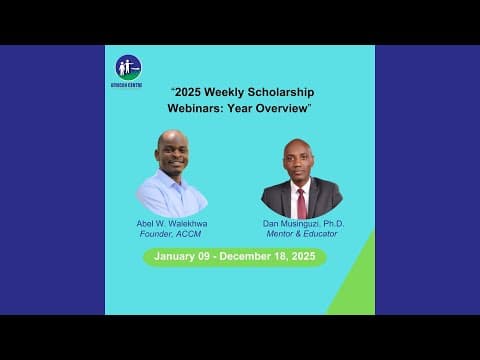
Summary of Weekly Scholarship Webinars for 2025
Dan Musinguzi
35m 36s5,777 words~29 min read
YouTube auto captions
Transcript source
YouTube auto captions
This transcript was extracted from YouTube's auto-generated caption track. The transcript below is server-rendered so it can be read, searched, cited, and shared without opening the original YouTube player.
Pull quotes
[0:00]We're not just summarizing a few sources, we are compressing an entire year, a whole strategic 12 month mentorship curriculum.
[0:00]And we're distilling it into the essential high impact takeaways you need right now to fundamentally change your competitive profile.
[0:00]Our source material is this comprehensive chronological schedule of 58 strategic conversations.
[0:00]They span from January to December 2025, and they were developed by the Musinguzi's ScholarshipT program and the African Center for Career Mentorship.
Use this transcript
Related transcript hubs
Watch on YouTube
Share
MORE TRANSCRIPTS


