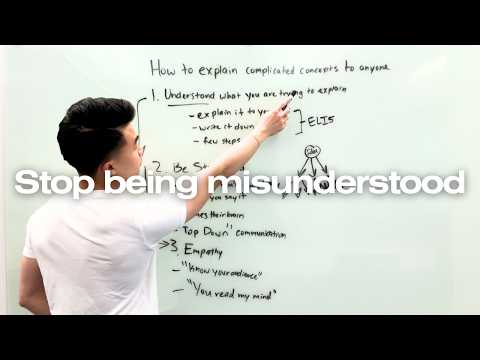
[0:00]Alrighty, why should you listen to a random guy in a white t-shirt standing in front of a whiteboard? Hi, my name is Matt. I'm a current strategy associate at Google. Prior to that, I was a management consultant at BCG. And today I'm going to explain to you how to explain complicated concepts to anyone. Now, this is a skill that literally anyone can benefit from, regardless of whether you're a student right now or a working professional or even if you're in academia. Because not only is this going to save you so much time because you won't have to re-explain things to people over and over again. This will also just give you a very useful skill that can be applied in many, many different situations, both in and out of work. And so, without further ado, let's get right into it. So, the first thing that we need to understand before we even think about how do we explain a complicated concept to a friend or a colleague or a co-worker, is do we even understand what we're trying to explain in the first place? And so, I know some of you are probably thinking, what are you talking about? Of course, I understand the thing that I'm trying to explain. But, hear me out. A lot of people don't really understand things nearly as well as they think they do. Part of it has to do with the fact that our egos don't allow us to admit that we don't know something as well as we think we do. And a lot of us tend to overstate our own abilities. I'm guilty of it and I'm sure some of you are as well. Now, the reason why it's so important to understand what we're trying to explain is because, again, if you don't understand it and you can't explain it in simple terms to someone, like a 12-year-old, then you don't understand it well enough. And if you have to resort to explaining things using complicated concepts or jargon, if you're in a technical field, like medicine or engineering, then that means that you simply don't understand it well enough, because you're not able to break it down into first principles and to really understand the key components of a core concept or idea. Now, the best method in my experience to understand something is to just try and explain it to yourself before you explain it to anyone else. And it really helps if you write it down and you use as few steps as possible. Because basically what this is going to do is it's going to force you to take away all of the fluff and to be very concise and to truly understand what you are actually trying to explain. Because say, for example, you're in the medical field and you're trying to explain a concept that people in the industry would know very well, but somebody outside of the industry will have no idea what it is. Or, for example, maybe you work in finance and you want to explain a complicated financial concept to someone who has very little context or knowledge of finance. Well, the thing that you should try to do is you need to explain it like you're five, right? There's a popular subreddit called explain like I'm five, where people basically ask questions about complicated things, whether it's quantum physics or medicine or technology, and they ask people to explain it like they're five years old. And the reason why people want you to explain it like this is because if you can explain something to a five-year-old, then theoretically, anyone older than five years old should be able to understand it. And so, this is what we're trying to get at. If you're not able to explain a concept to a five-year-old without them being confused and not understanding and needing multiple clarifications, then you probably don't understand it nearly as well as you think you do. But let's say that you do understand the concept very well, which brings us to number two, which is be structured. Now, what does being structured mean and why is it important? Being structured means that when you explain something to someone or when you say anything in a meeting, for example, or talking to your boss at work, or to your professor in office hours, you say what you're going to say before you actually say it. Now, I know that might sound really silly to some of you, but what I mean by that is, if you're going to explain three different problems to your professor, then what you want to do before you even dive into each of them is you want to say, okay, so what I'd like to do today is I actually want to run through these three problems with you. Or, for example, if you're a working professional and you're trying to explain some work that you've done to your client or to your boss, say there's three different workstreams, what you're going to say before you dive into any of them is you're going to say, okay, so what we've done is we've pushed forward on three different workstreams. And what we'd like to do today is to run through each of those with you, one, two, three.
[4:08]And the reason why being structured is so effective and just literally listing what you're going to say before you dive into the detail is because this basically primes the other person's brain to listen and to understand. Because whenever you say something like, okay, so I'm going to explain three things to you right now. And I'm going to explain number one first and then number two, and then I'm going to end by talking about point number three. What's actually happening in the listener's mind is their brain is actually subconsciously thinking to itself, oh, okay. So, something important is about to be explained to me, and I need to pay attention and I need to retain that information and connect the dots between the disparate bits of information that I'm about to receive. And so, it's a small thing, but what it actually does is it really, really helps with preparing people to actually listen to what you have to say and to actually understand the thing that you're trying to explain. And so, it's not just for you to be organized. It's also for them to subconsciously prepare for learning something new. But the other thing that you really want to focus on when you're being structured is you want to do what's known as top-down communication. Now, top-down communication is very popular among management consultants, but it's a concept that is applicable to literally anyone. And all it means is that whenever you're explaining something, you're going to start with the main idea or the main key takeaway first, and then you're going to progress into sub-points and from there explain further in detail the supporting evidence or the supporting data points that support the previous points. Now, I know that sounds like a mouthful, but essentially, and this is a really bad drawing, but the idea and the main point is what you want to open with first. And so, for example, if you're recommending something to someone, say, for example, your friend asks you, what kind of shoes he should buy for his new running hobby. Say your friend is hitting his quarter-life crisis and he's suddenly really, really into marathons and running 5Ks. You're a seasoned runner and you've been running 5Ks and 10Ks and marathons for a number of years now. Now, what you say to him is you say, hey, awesome. So, I actually think you should buy the Nike Pegasus running shoes because they're super comfortable, the shock absorption is really good, and they're also really, really stylish. And so, you might not realize it, but what you did right there was you actually did top-down communication because you gave him the recommendation first, and you said exactly what shoe you think he should buy, and then you followed it up by saying three reasons why you thought the shoe was worth the purchase. Now, conversely, if you were to take a bottom-up approach, you would have started with these details and you would have said something like, well, you know, what's really important when I think about buying shoes is I want a shoe that is very comfortable. I want a shoe with very good shock absorption. And I also want shoes that are very stylish. And so, you know, within each of these buckets, there's a lot of different shoes that could work like the Adidas shoes are very comfortable. The Hoka shoes have very good cushioning and the On shoes are actually very stylish nowadays. But out of those three, I would ultimately recommend you go for the Nike Pegasus. And so, you see, there's a subtle difference right there where with top-down communication, you get the main point across and the main recommendation across ASAP. And then everything that follows is simply supporting evidence or supporting detail. Versus providing a bunch of pieces of detail first and then eventually tying it up to the recommendation or the main idea. Now, what I will say is that there isn't necessarily a right or a wrong way to approach it. Both top-down and bottom-up communication work perfectly well, but if you're talking about a corporate setting or if you're at work and you're talking to someone more senior than you, then you almost always want to go with top-down communication because senior leaders at your company very likely don't care about the details nearly as much as you do. And their time is very valuable and precious and so they're not going to want to waste time hearing about all the fluff before you get to the main point. Just get to the point and tell them what's up. And so, top-down communication is a really good habit to get into whenever you're talking to anyone and you're trying to explain a problem, say, to your boss. Don't go to your boss and spend five minutes explaining the context before you give him the issue. You should start by giving him the issue and then explaining everything behind why that issue has arisen. But once we understand the idea of top-down communication and to stay structured, this will be very valuable with delivering the message to whomever is on the receiving end. But there's a third thing that I also want to talk about here today, which is you need empathy. Now, I would argue that the best communicators in the world are people who are honestly just very empathetic and able to truly understand how their audience is going to react, how their audience is going to feel, and what their audience is going to think when they say certain things. Now, a lot of people might think that they know what other people will say or think or do when they say something to them. But the reality is, all of us have our own perspective and our own view of the world, which often taints our ability to be empathetic to the perspectives of other people. And it's very easy sometimes when you're at work or you're at school, to forget and to automatically assume that everyone has the same perspective as you. And so, what might be logical to you or what might make sense to you, might not actually make sense to other people nearly as much. Or they might not react to that statement in the same way that you do. And so, this is where you run into issues like, oh, I said this thing and I didn't mean to do something, but then I hurt this person's feelings because the way that they perceived it was different from how I perceived it. Which was just a harmless joke, but to them it was, for example, a very offensive thing to say. And the same thing applies when you're trying to explain a complicated concept to someone because if you don't anticipate what they're going to be thinking and what they're what's going to be going through their head while you're explaining it, then you're going to continue explaining it in a way that makes sense to you, but may not necessarily address all of their concerns. Now, a classic example of this is if you're a student in college, college professors are notoriously terrible at teaching. There are many, many professors at top universities all across the world who do incredible, incredible research, but when it comes to teaching even a 101 class to a group of freshmen, they are absolutely terrible. And it's not a knock on those professors, but the fact of the matter is, often times the reason is that they don't understand, or they forgot because it's been so long, what the perspective of an incoming freshman college student is like, where you literally know nothing. And if you compare that to the work that they're doing outside of the classroom, which is often cutting-edge research, if you're in a stem field, being very, very deep in one specific topic, then it begins to make sense why suddenly when they go and try to teach a 101 class, they seem to gloss over concepts that to freshmen are very difficult to grasp or are very foreign. But to the professor, it's just like, oh, yeah, just another walk in the park. No big deal. Just like as easy as 1+1. And so, if our goal is to explain things to people in a way that makes sense and regardless of how complicated the concept is, and regardless of who the audience is, then we need to be very, very attuned to how they're going to think and how they're going to feel. It's been said before, but knowing your audience is truly the number one most important thing to keep in mind when you're delivering any kind of message to a group of people, or even an individual person. Because think about the times when you walked out of a class, lecture, or you walked out of a meeting and you thought to yourself, wow, this person, they are so good at explaining stuff. They really understood how I was thinking about it and they understood how I felt and they literally read my mind, right? When people say things like, oh, you read my mind, it means that you were able to successfully understand your audience. And so, you were able to say things like, now, I just said this, but I know what you're thinking, but let me address that like this. Or, now I just said a bunch of stuff, but hear me out, this is why it's important. Small things like that are actually indications that you understand your audience and you're acknowledging what's going through their mind as they listen to you. Because the worst thing is for the person in the audience or the person you're speaking to to be thinking in the back of their mind, I have no clue what this guy is talking about. This makes zero sense to me, but I'm just going to continue nodding and saying, mhm and yes, to pretend that I understand what he's saying and to save face. What we want instead is for the person to feel heard and to feel understood, and ultimately, to understand what we're trying to say. And so, we need to address their questions and their potential issues and concerns as well. And so, again, just to nail the point home, if you can get them to say, you read my mind, or to think that, then you're already 90% there. And so, to summarize, again, we need to understand what we're trying to explain in the first place, because how can we be good teachers if we don't understand what we're trying to explain extremely well down to first principles thinking, which is understanding the most basic and core components of any concept or idea. We also need to be structured with how we deliver our message to not only prime the recipient's brain to receive this message and to learn something new, but also because it helps us to stay structured and to stay concise and get the main points across and then the supporting details. And finally, we need to have empathy and we need to know our audience, and we need to understand what's going through their mind and how their perspective might differ from ours. And so, if you make sure that you're doing all three of these things, then you'll be able to explain complicated concepts to literally anyone. Thanks for watching and I'll see you in the next one.


