[0:00]The mid-to-late 80s kicked off a trend of punk metal fusion that remains a prominent element of both scenes to this day. Although many of this concept's most significant pioneers, such as Suicidal Tendencies and D.R.I. came out of the United States, it wouldn't be long until the trend would catch on in punk scenes elsewhere in the world, especially in the raging UK scene. How's it going, folks? My name is Jack Miller. I am the incredibly underqualified punk historian, and today I am very excited to bring the Crust Course series back with a subgenre all too appropriate for its title, Crust Punk and D-beat. As usual, I'll be taking you guys through the timeline of D-beat and crust from its formative stages in the early to mid-80s to the scene's status in the current day, as well as offering some of my thoughts about the genre. Before we dive in, I want to mention that I did my best to make an overview playlist for Crust and D-beat. Keep in mind, a number of these bands aren't on Spotify though, so there's a lot of great music I had to leave out here. And finally, if you are interested in seeing YouTube videos about punk rock, may I humbly ask that you please subscribe to my channel here. I'm having a lot of fun making these, and I want to make sure that all of you can keep having fun watching them. Also, if you're wondering where the hell I've been for the past month or so, stay tuned for the end of the video, and I'll clear that up. Anyways, as I'm sure many of you probably know, if we're going to talk about the origins of Crust Punk and D-beat, we first have to talk about the UK Anarcho-punk scene of the late 70s and early 80s. Classic names such as Crass, Conflict, and the Subhumans are, of course, the most obvious examples here, but they were by no means the only bands in this cohort. And others include the Poison Girls, Flux of Pink Indians, Icon A.D., and my personal favorite, Oi Polloi. Also, just as a fun fact, I'm sure a lot of you guys know the band Chumbawamba that had that stupid Tubthumping hit song during the 90s, but something you might not know is that they actually started out as an Anarcho-punk band in the 80s. As far as the music of Anarcho-punk goes, the sound is defined a little more loosely in comparison to a genre like Crust or Street Punk. But aside from its anarchistic lyrics and scene participants, something that characterizes this style is its incredibly raw production and stripped-down instrumentals. In other words, you could certainly argue that the stereotype of punk bands writing music to sound terrible on purpose was kind of the sound of Anarcho-punk. If you ask me, though, I think abrasive musical genres like this are very much something you could call an acquired taste, and I for one have grown to enjoy it. Alongside the Anarcho-punk scene in the early 80s, the Oi! sound was also making its debut in the UK, which presented a much more structured, musically proficient take on punk rock. Despite the genre's superior musicality, though, the first wave of Oi! was significantly less politically driven, and songs tended to be focused on day-to-day subjects like going to punk shows and bars, working, or going to soccer games with your friends. I've done an entire video on Street Punk and Oi!, so if you want more information on either of those genres, you should definitely check that one out. The reason I felt it necessary to bring up Oi! in this video is because it would birth what I guess we could consider to be Crust Punk's sister genre, Street Punk. Although the Anarcho-punk stuff is just as important to the Crust Punk foundation in terms of message and overall scene atmosphere, we definitely wouldn't have the Crust Punk sound the way we do now without bands like The Varukers, The Exploited, and G.B.H. that really established and defined the characteristics of British Hardcore in the early 80s. I also, of course, have to mention Discharge, who would inevitably be grandfathered into the Crust scene as the Godfathers of D-beat, but Street Punk is very much the scene that birthed them as a band. I'm sure if you're watching this video, you've probably heard Discharge's first album, Hear Nothing, See Nothing, Say Nothing, but just in case you haven't, definitely check that record out as soon as you get the chance. Alongside Discharge, though, I also want to talk about the band Antisect. They may not have had quite as big of an impact, but they certainly were a crucial band to Crust Punk and D-beat, and in many ways, they're another forefather band that would later be grandfathered into the subgenre. And last but not least, the third Crust Punk Godfather band is Amebix, who would make their mark on the scene a few years after Discharge and Antisect. Although they put out a couple of EPs in the early 80s, they wouldn't really have their break until they dropped their debut full-length Arise! in 1985. Unlike the other two pioneer bands, though, Amebix had deep roots in both metal and post-punk, and because of this, their songs were often written at noticeably slower tempos compared with a dark, sludgy riffing style. They also weren't afraid to dial back the volume for a post-punk-inspired track here and there, and in a lot of ways, I'd say Amebix were really ahead of their time. Although the slower Crust sound was something only Amebix was doing in the early to mid-80s, it would certainly catch on later, especially in the 90s, when all the Sludge Crust crossover bands like Dystopia and Grief came out. So now that the foundation had been thoroughly laid out, what was next on the agenda for Crust Punk? So at this point, we've entered the mid-80s, and the sound of Crust Punk is relatively established. This harsher, more structured style has pretty much taken the place of the noisier Anarcho-punk sound of the late 70s, and bands that sounded more like Discharge or Antisect were starting to pop up more rapidly. To get the ball rolling into the first real wave of Crust Punk, I want to mention the band Hellbastard, who actually coined the term Crust Punk with their 1986 demo, Ripper Crust, but they were by no means the only band. And a few other notable names include Doom, Extreme Noise Terror, the Electro Hippies, and Deviated Instinct. I also, of course, have to talk about the band Broken Bones that was started by two of Discharge's founding members in 1983, who would further solidify the D-beat sub-subgenre. And then last but not least, I also want to mention the budding Grindcore genre that was coming up around this time, and particularly the band Napalm Death. As some of you probably know, Napalm Death actually started out as a Crust Punk band, and they would later grow into the more extreme sound that we know them for today. Regardless of what genre you would consider them, though, I don't think we would have Crust Punk or really any other form of extreme punk music the way we do now without them. Plus, being the most influential band in Grindcore as a whole, I think it's pretty safe to say that entire genre was born out of the UK scene with Napalm Death. I know some of you guys seem to want me to talk about Grindcore in more detail, but to be honest, I'm not really sure if I want to. Personally, I think of it as more of a metal subgenre, and I'm also not nearly as invested in it as I am in Crust Punk, D-beat, or Power Violence, but I guess I could be talked into covering it somewhere down the line. Anyways, I think it's also important to note that this was around the time the Crust Punk aesthetic and really stereotype were starting to take shape as well. The genre was commonly referred to as Stenchcore back then, and like I was saying earlier, the whole anarchist squat scene that birthed Anarcho-punk a few years prior had more or less been taken over by Crust by the mid-80s. Shortly after its conception in the UK, Crust Punk would also make its debut in several other countries, most notably the U.S., Sweden, and Japan. In the U.S. camp, we have the likes of Nausea, Disrupt, Final Conflict, Antischism, and Destroy. There were also a number of bands from the Berkeley, California scene that I would certainly consider Crust Punk, like Filth and Neurosis in their early days. Then across the pond in Sweden, we had the likes of Anti Cimex, Crude S.S., Totalitar, and Mob 47. Interestingly enough, the Swedish Crust scene actually predates the American one by a year or two, but I think that kind of makes sense, as it was probably a little easier for the British bands to get over to Sweden and play shows in the early 80s. And like I said, Crust Punk also struck a chord pretty early on in the Japanese punk scene, and I think in a lot of ways, Japan actually still has one of the strongest Crust scenes in the entire world. The most notable band here is definitely GISM, which I'm sure a lot of Western punks mistakenly refer to as GISM or simply G.I.S.M. But there were also a few more bands like G.A.U.Z.E. and The Comes that pioneered Crust Punk in Japan. That being said, all three of these scenes, along with the many others around the world, would come to prominence much, much more towards the mid-90s. And on that note, I think it's time we moved on to the next decade of Crust Punk and take a look at what I like to think of as the prime years of Crust, from let's say, around 1994 to 2002. Like I was saying earlier, a lot of the more significant bands from the latter end of the 80s continued on into the scene of the 90s. Just to name a few, Disrupt, Nausea, Antischism, and Destroy were all still going strong on the U.S. front, and a lot of the U.K. bands like Doom and Extreme Noise Terror were doing the same. Even though the veteran bands were still going stronger than ever, this was by no means the extent of 90s Crust Punk, and as I'm sure many of you know, around 1994 was when the many different branches of punk rock that had been taking shape in the late 80s and early 90s kind of took over the alternative music scene. Although Crust Punk was still very much an underground scene, this was definitely the era when it solidified itself as one of the most significant branches in punk music. A few key players in the 90s American circuit include Los Crudos, Naked Aggression, Drop Dead, His Hero is Gone, and one of my all-time favorite bands, Aus-Rotten. I also want to mention the Japanese D-beat band Disclose, who had a lot of really strong releases during this era, and remains one of the biggest Japanese hardcore bands to this day. Alongside some of the bigger names doing the standard Crust Punk sound, I think it's also important to discuss the Sludge Metal Crust Punk crossover stuff that was gaining a lot of traction in the 90s through bands like Dystopia, Grief, and Noothgrush. I'm not going to go into too much detail about these bands as most of them lean a lot heavier on the Sludge Metal than they do the Crust Punk, but it was definitely an important piece of the 90s Crust scene, or at the very least, Dystopia was a very important band to that scene. Aus-Rotten is probably my number one in this genre, but Dystopia is a close second for sure, and I would definitely recommend their 1999 album, The Aftermath, to anyone who's trying to get into Crust Punk. And finally, I do, of course, also have to mention Power Violence here, which was more or less part of the same, if not an adjacent scene to Crust in the 90s. This stuff really deserves an entire video of its own, since it's become such a big part of hardcore, but if you're looking to dip into it and don't quite know where to start, I'd recommend checking out Despise You, Infest, No Comment, Spazz, and the pioneers of Power Violence, Siege. So like it was for most punk subgenres, the 90s were definitely the time when the Crust Punk scene was at its most active. That being said, since then, it's become one of the largest pillars of punk, and the past 20 or so years have given us some really, really great Crust bands. If you ask me, I'd say the biggest Crust Punk band to come out of the past 15 or 20 years is probably Tragedy, but they are definitely not the only band worth mentioning here. And just to name a few more recently established bands, we have Resistant Culture, Nuclear Death Terror, Appalachian Terror Unit, Caustic Christ, as well as Dave Trenga from Aus-Rotten's band, Behind Enemy Lines. I also want to give a shout-out to the Seattle-based band Skarp, who I'd imagine is probably the biggest Crust Punk band in the local scene here. I saw them open for Leftover Crack a number of years ago, but I haven't heard anything about them recently. If any of this channel's specific Northwest viewers have, please leave a comment below. I'd love to get a chance to see them again. I'd also like to mention the Swedish bands Wolf Brigade and Skitsystem, which came out in this era. If any of you guys watching are Death Metal fans, you're probably familiar with the band At the Gates, which actually shares a number of members and former members with Skitsystem. And lastly, on the topic of Crust Punk in the 2000s, I want to talk about the Canadian band Inepsy. They're really not your typical Crust Punk band in terms of musicality, and to be honest, they sound a lot more like Motorhead, but they definitely do have strong ties to this scene and are really just a phenomenal band overall. These are just some of the most notable bands from this era, and there's hundreds of other bands from all around the world, so it would be impossible to name every single one. That being said, though, Crust Punk remains a pretty consistent sound worldwide, and I think that's also something that's pretty important to address. Crust Punk is a lot like Street Punk and Oi! in that its sound remains pretty consistent no matter where you are in the world. But personally, I think the reason for this consistency is a little different than it is for Street Punk and Oi!. Well, much like what I guess you could call its sister genre, Crust Punk is very strongly rooted in its origins in early U.K. punk. The genre is also one of the most extreme sounds in the overall blanket genre. I think in a lot of ways, you could argue that Crust is punk's equivalent to a genre like Death Metal or Black Metal in the metal world. And when music becomes that extreme, it's naturally just going to sound pretty universal between different countries and cultures. Although a lot of individual bands have certainly made their own marks on the sound when it comes to extreme music in general, I feel like this has a lot more to do with groups of people and their personal influences as opposed to which country they happen to live in. Another similarity Crust has with its Street Punk and Oi! counterparts is that it's very much an underground scene, despite its popularity worldwide. So, naturally, I'm going to be most familiar with the Crust scene in the country I live in. And finally, as always, to close on my personal thoughts regarding Crust Punk, it's a genre I definitely visit from time to time. I used to listen to it a lot more when I was around 18, 19, 20, and during that period of my life, I was very much what you could call a stereotypical Crusty. I don't really want to talk about this kind of thing too much in the video because I think it's sort of a negative stereotype of the genre, but it is definitely a phase a lot of people that are into punk in general tend to go through. In my case, I was kind of just floating around, getting high all the time, and hopping from one dead-end job to the next while I abused my mental health. Fortunately for me, I was never homeless, but it's not uncommon for people to end up there if they do what I was doing for too long. I've long since recovered from all that, though, and I certainly hope the same for anyone who finds themselves in that situation, but I do still love the Crust Punk genre. And I'd say it's probably my second favorite sect of hardcore punk next to Crossover Thrash. Now, if any of you guys have made it this far in the video, I think I owe you all an explanation as to why I I've been absent for like a month and a half. As I mentioned before, I'm running this whole thing by myself, and the weekly uploads just completely burned me out. I would be spending hours on my computer every day after getting done with all my schoolwork or getting off work at my job where I move these big-ass bales of hay and bags of grain around, and it got to the point with the weekly uploads where it really just became a miserable process, and if I'm being honest, it was really taking a toll on my mental health. I actually started writing this video like a week after I did the Propagandhi one, but I just ended up taking a longer break because I was so dry. Nonetheless, though, like I always say, I do really appreciate y'all coming back and watching this shit, and I do still want to keep making videos going forward. I thought about the channel pretty much every day since I fell off the face of the earth, and I don't want you guys to think I'm completely abandoning it. Speaking of which, we're actually almost at 2,000 subs now, which is seriously f*cking amazing given how painfully unprofessional of a YouTuber I am. And on that note, I will do my best to get another video out sometime in December, and thank you all so, so much for watching, comment, and subscribing. But anyways, that's enough for me. I want to hear what you guys have to say. What are some of your favorite Crust Punk bands? Do you have a favorite era or subsect of the genre? If so, which one? Thanks again for watching.
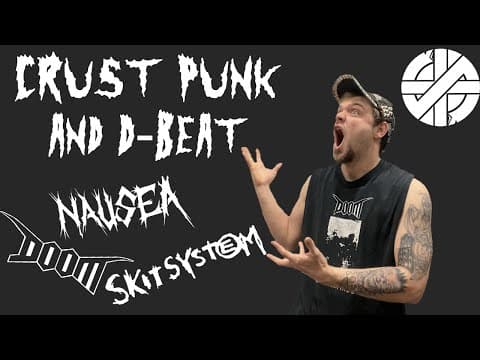
Crass Course: Crust Punk & D Beat
The Punk Historian
13m 45s3,231 words~17 min read
YouTube auto captions
Transcript source
YouTube auto captions
This transcript was extracted from YouTube's auto-generated caption track. The transcript below is server-rendered so it can be read, searched, cited, and shared without opening the original YouTube player.
Pull quotes
[0:00]The mid-to-late 80s kicked off a trend of punk metal fusion that remains a prominent element of both scenes to this day.
[0:00]Although many of this concept's most significant pioneers, such as Suicidal Tendencies and D.R.I.
[0:00]came out of the United States, it wouldn't be long until the trend would catch on in punk scenes elsewhere in the world, especially in the raging UK scene.
[0:00]I am the incredibly underqualified punk historian, and today I am very excited to bring the Crust Course series back with a subgenre all too appropriate for its title, Crust Punk and D-beat.
Use this transcript
Related transcript hubs
Watch on YouTube
Share
MORE TRANSCRIPTS


