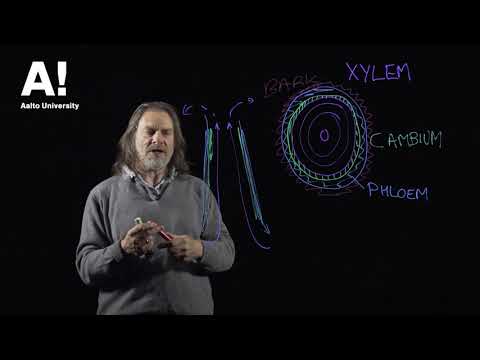
[0:10]So I'm going to say something about how the tree produces wood and how it lays down these different types of wood as it grows. If we look through a transverse section of a tree and we look at the the trunk, we've got the growth rings here. So this forms the the wood part of the tree, which is also referred to as the xylem tissue. And then surrounding that, we have a region where cell growth occurs, and this is the part of the tree that is living. And that's referred to as the cambium. So this is where the cells are created that make the wood tissue. And then outside that we have a different type of tissue, which is the floem. And then getting one more color because I've got four things to talk about today. Outside that is a protective region, which is the bark. So that's completely dead material. So if we look at the tree and a cross section vertically, we have the floem tissue here. Uh we have the cambium, which color is the cambium green. Too many colors here. the cambium. So this is producing cells on the inside of the tree and it's producing cells on the outside of the tree as well. And then inside that of course we have this xylem tissue. The xylem conducts water from the roots up to the crown where it evaporates into the atmosphere. And the floem, we have a conduction in the opposite direction and this is the products of photosynthesis that come down in that direction. So that supplies all the nutrients that are needed, well the nutrients that sort of the molecules that are made during photosynthesis that are needs to produce cells to make the tree. Whereas a lot of the nutrients of course come up from the roots, so we have these this double transport pathway. And then in between these different types here between the cambium and the and the xylem tissue, we have these conducting pathways of parenchyma cells. Apologies for using the same color twice, but I'm running out of pens here. Parenchyma cells, the ray cells which have a conductive role, but they are also also living tissues, so they have a metabolic function as well. So they help with the synthesis of molecules to make cells. They act as a storage, uh they have a storage function. And as the water demand of the tree changes, there comes a point where it's not pulling hard enough on all the water running through the cross section of the trunk. And then that material begins to die off and produces this heartwood that I was talking about. And this appears to be a function of water demand where these ray cells are meeting the heartwood. The ray cells are alive. The vertical cells are dead. So although technically speaking, wood is a dead tissue, the parenchyma cells are still alive, sorry, the heartwood is completely dead tissue, it has no conductive role and there's no living cells in there.
Wood anatomy (6) cambium
Aalto University - Wood Science
4m 25s514 words~3 min read
YouTube auto captions
Transcript source
YouTube auto captions
This transcript was extracted from YouTube's auto-generated caption track. The transcript below is server-rendered so it can be read, searched, cited, and shared without opening the original YouTube player.
Pull quotes
[0:10]So I'm going to say something about how the tree produces wood and how it lays down these different types of wood as it grows.
[0:10]If we look through a transverse section of a tree and we look at the the trunk, we've got the growth rings here.
[0:10]So this forms the the wood part of the tree, which is also referred to as the xylem tissue.
[0:10]And then surrounding that, we have a region where cell growth occurs, and this is the part of the tree that is living.
Use this transcript
Related transcript hubs
Watch on YouTube
Share
MORE TRANSCRIPTS


