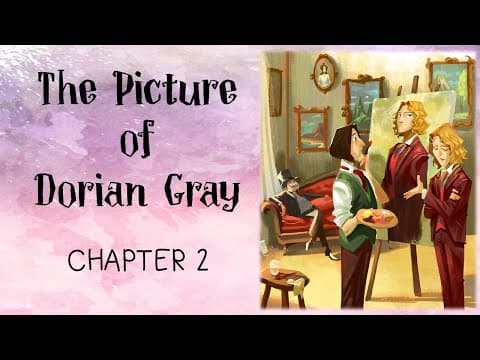
[0:01]Hello everyone. The following presentation is a brief summary and analysis of chapter two of Oscar Wilde's novel The Picture of Dorian Gray.
[0:16]Lord Henry and Basil find Dorian playing a song at Basil's piano. Lord Henry is introduced to Dorian and mentions he has heard wonderful things about Dorian from his aunt. Lord Henry notices Dorian's remarkable beauty. Basil gets nervous at Lord Henry's presence and the effect he is having on the afternoon that Basil had planned. He tells Lord Henry to leave so he can continue painting Dorian's portrait. Dorian reprimands Basil for being unsociable while he takes his place on the platform to be painted. Dorian inquires about Lord Henry's reputation for being a bad influence.
[1:05]Lord Henry explains that all influence, whether good or bad, is immoral because it takes over the soul of the other person. He describes poetically how the ideal way to live is to strive to be the purest, most natural version of oneself. He believes that although society has moved away from this idea to religion and other beliefs, one day a hedonistic revolution will take place. The only thing stopping this revolution is that man is afraid of his own desires. The concept of hedonism is something you need to understand for your studying of this novel. Hedonism: A philosophy that pleasure and enjoyment should be the highest goals in a person's life and ethical responsibilities (morality and justice) should be less important considerations. Hedonism is all about the pursuit of pleasure and sensual self-indulgence.
[2:19]Dorian is amazed and filled with admiration for Lord Henry's views. Lord Henry senses that his words have stirred something in Dorian's mind. He marvels over the potential transformations that might be taking place in the young man's mind. With eyes bright and his lips parted in curiosity, Dorian is in perfect form for Basil's painting. Basil lets Lord Henry and Dorian go into the garden for some fresh air. He excitedly finishes off the painting, convinced that it will be a masterpiece.
[3:01]In the garden, Lord Henry sees Dorian smelling one of the lilac flowers. He praises him for it and tells Dorian that a great secret of life is to learn to cure the soul with the senses. In other words, to cure the soul, one must live life fully by having experiences that heighten the five senses of sight, smell, touch, sound, and taste. He praises Dorian again for knowing these philosophies instinctively. Dorian is again filled with awe and wonder. Dorian is shocked, even somewhat afraid, at how quickly Lord Henry has entered and influenced his life.
[3:50]Lord Henry takes Dorian back inside. He warns Dorian that getting sunburnt would ruin his perfectly beautiful skin. Lord Henry says Dorian must conserve his youth and beautiful looks because youth is the most important and powerful thing Dorian owns, but it is destined to fade away. Lord Henry tells Dorian that he will suffer all the more because time will jealously steal his good looks away. Lord Henry then returns to his idea about the new era of hedonism and he makes the suggestion that Dorian could be at the forefront of the movement.
[4:36]Lord Henry asks Dorian if he is happy that they met. Dorian is indeed happy, but he has a feeling the friendship won't last. Lord Henry responds that he is not interested in faithfulness and lasting relationships, so they agree to have a friendship that is unpredictable. Basil is painting with a great passion, and he finally finishes the painting. Lord Henry congratulates him on his masterpiece.
[5:08]Dorian comes over to look at the painting. It is as if he sees his beauty for the first time. He takes in the painting with complete awe and admiration. Suddenly, he understands Lord Henry's compliments, but he also realizes the meaning of his warning, that all his beauty will eventually fade away.
[5:36]Dorian cannot bear the thought of losing his youth and beauty. He exclaims a desperate wish that he should trade places with the painting. He wishes for the painting to become old and for he to remain young and beautiful forever. He says he will give his soul for this exchange. He accuses Basil of admiring him as if he were only a statue. In his outburst, Dorian further pledges to kill himself before he grows old.
[6:12]Basil tries to comfort Dorian, but Dorian is beside himself. Basil blames Lord Henry and they argue about his influential ways. Basil becomes increasingly upset and grabs a knife with the intention of destroying the painting, to which Dorian cries out for Basil to stop. He now feels so a part of the painting that he thinks to destroy it would be murder of the most perfect version of himself. Basil says he will give the painting to Dorian, but Lord Henry wants it for himself, but Basil has always felt the painting belongs to Dorian.
[7:00]As they have tea, Basil criticizes Lord Henry for saying outrageous things to Dorian. However, Dorian is not at all unsettled. When Lord Henry suggests a trip to the theatre, Dorian leaps at the chance. Basil decides that he would rather stay with the painting, which he calls 'the real Dorian.' Basil tries to get Dorian to stay longer, but Dorian is more excited about spending time with Lord Henry. Dorian promises Basil that he will visit tomorrow as planned, but Basil is disappointed. Basil reminds Lord Henry of the warning he gave him earlier about manipulating Dorian's innocent nature.
[7:50]This chapter contains many luxurious images which reflect the aesthetic lifestyle of Basil, Lord Henry, and Dorian. Basil's garden can be likened to the Garden of Eden, where Adam and Eve are tempted by a snake (Satan) to commit sin. How can we relate this image to the novel? We could say like the snake, Lord Henry tempts Dorian. Lord Henry tempts Dorian with his ideas of beauty and pleasure. It is these ideas that will ultimately lead to Dorian's corruption and downfall.
[8:34]In this chapter, Dorian is described as a 'lad.' What does this imply about his character? We can conclude from the use of the word 'lad' that he has an innocent, almost childlike personality. We have learned that Dorian is initially smitten by Basil, but later abandons him for a newfound friendship of Lord Henry. What can we say this suggests about Dorian's character? We can deduce that he has an unpredictable nature and that he is quite selfish and self-absorbed.
[9:15]Lord Henry says that a person who is influenced by someone else is no longer his own person, but rather 'an echo of someone else's music.' Note the irony in this above statement. Lord Henry maintains that a person who is influenced by someone else is no longer his or her own person.
[9:42]And he also encourages Dorian to be the most natural version of himself. However, Lord Henry influences and manipulates Dorian to the extent that Dorian is no longer his own person and indeed becomes an echo of Lord Henry's music. Lord Henry says, "People are afraid of themselves nowadays. They have forgotten the highest of all duties, the duty that one owes to one's self." Lord Henry's selfishness is evident in these lines. He says that a man should not be confined by society's expectations and that he should not deny himself his desires and the things that bring him ultimate pleasure.
[10:25]I would like you to consider whether or not you agree with Lord Henry's point of view. This idea of living selfishly and pursuing one's personal pleasures with no regard for society in general, challenges the strict conventions of morality of Victorian society.
[10:47]In Victorian society, people were required and expected to deny and suppress their natural desires to be deemed socially acceptable. Lord Henry's hedonistic views encourage immoral behavior.
[11:07]Dorian feels that his life would have no purpose if his youth and beauty are no longer there. We can ask ourselves what his willingness to sacrifice his soul in exchange for eternal beauty says about his character. To answer that question, we could infer that his willingness to sacrifice his soul in exchange for eternal beauty reflects his narcissism and obsession with his physical appearance.
[11:41]Basil says, "Dorian Gray is my dearest friend. He is a beautiful person. Don't spoil him. Don't try and influence him. Your influence would be bad. Don't take away from the one person who makes me a true artist." Basil is worried about the bad influence Lord Henry might have on Dorian, but Lord Henry says it is merely the real Dorian revealing himself. This introduces an important question: Who influences whom and who is responsible for Dorian's downfall? Does Basil play a part in making Dorian aware of his beauty, should Lord Henry take any blame for introducing Dorian to his theories about life, or is Dorian solely responsible for his own downfall? These are questions you can reflect on throughout your studying of this novel. Thank you for watching this presentation on chapter two of the novel The Picture of Dorian Gray by Oscar Wilde. Please keep an eye out for further presentations on each of the chapters in the novel.


