[0:00]I discovered the secret to writing a perfect scoring essay every single time. Now you'll never have to stare a to blank page like an idiot again. Nobody tells you this, but writing a great essay isn't about being smart. It's about knowing how to connect the pieces of a puzzle. In this video, I'll show you exactly how to do it with four simple steps that will guarantee you a high score. I'm going to write a full essay from scratch with you right now, starting with the preparation phase. This is where most people immediately fail because they think they're too smart for it. You are not. The single biggest idiot move you can make is glancing at the essay prompt and just starting to write. That's like trying to build IKEA furniture without looking at the instructions. You seriously got to break down the question first. What is it actually asking you to do? Agree, disagree, compare two things. If you don't answer the exact question posed, everything that follows is garbage. For example, if the prompt is some people believe that the increasing use of technology in education is improving learning, while others think it is a distraction. Discuss both views and give your own opinion. First, stop everything and think. Your dumb first instinct will probably be to see the word technology and go off on some one-sided rant. Like an idiot, if you just start typing about how much you love Tik Tok or how video games taught you more than school, you've already failed. Why? Because you've ignored half the damn prompt, you animal. That means you got to lay out both sides of the argument first before you even start running your mouth about what you think. If you don't, you are literally by definition not answering the question and you will be punished with a low score. Got it? Good. Now let's craft your thesis, and here's the only framework you'll ever need. But we can't build a thesis out of thin air, so first you need to make a goddamn plan. Here's what you do. Look at the prompt about technology and education and ask yourself what's one good thing about it. Maybe personalized learning. And what's one bad thing? Maybe it distracts everyone. Write those two things down. Congratulations, you now have a plan with two sides, personalization versus distraction. Now, pay attention, Princess. In this case, your thesis is nothing more than those two ideas connected. Start with the good side. While technology can provide personalized learning, add the bad side. It often serves as a major distraction, and then finish with your own judgment. Making its true educational value dependent entirely on how it's implemented. That's it. Simple. The plan gives you the pieces, and the thesis just puts them together in a sentence. Now let's go to step two, writing the introduction. Pay attention, you animal, because your introduction follows a specific order. And if you change this order, it will become a complete mess. It's like making a burger, bun, patty, cheese, lettuce. You can't mess it up. First, you start with the hook. This is your opening sentence, and it can't be some weak garbage like since the dawn of time, or in today's society. Because you're putting the teacher to sleep before you've even started. You need to grab the reader by the throat immediately, but here's the crucial part. The hook is neutral. It introduces the topics importance or sets the scene, but it does not give your opinion or argument yet, you idiot. That comes later with your thesis. For our topic, a good hook would be, the modern classroom has undergone a radical transformation, becoming a landscape dominated by screens and digital interfaces. See what that does, it states a big relevant trend without taking a side. But you're probably thinking, how am I supposed to come up with that? Don't use that as an excuse, you idiot. Here's your cheat code. You need to actively build a vocabulary arsenal. Stop recycling the same basic words from the prompt. When you see technology, your brain should immediately have options like digital tools, algorithms or ed-tech. When you see education, you should think modern classroom, learning environments or pedagogy. It's called having a vocabulary. To do this, get a notebook and start creating your own personal dictionary of useful synonyms for common essay topics. Write down words like crucial, paramount, and foundational to replace that pathetic word important. Review this list daily until it's burned into your memory. Now, if you're tired of doing this the hard way, I've done all the work for you. My idiot's guide to essay writing includes the exact synonym Bible I use, plus all my essay templates and direct access to me for questions. But that's not all, you'll also get full access to the exact same system that got me into the top university in Latin America. Studying completely alone from home. This is everything you need to stop studying like an idiot and start scoring higher with less effort. Click the link in the description or comments below before it's too late. Now, right after that hook, you need to paraphrase the prompt. And no, you idiot, you can't just copy it. Why? Because copying the prompt is the academic equivalent of walking into a job interview and just reading your resume back to the interviewer. It screams, I have no original thoughts and my brain is empty. You need to restate the essay question in your own words while keeping the original meaning. This is not the place for your opinion either. It's where you prove you actually understand the damn question. And guess what? That vocabulary arsenal you just built is your secret weapon here. Now let's use it with two simple tricks, word-swapping and sentence-flipping. First, use your synonyms. Swap increasing use for growing integration, change improving learning to enhancing academic outcomes, turn distraction into source of diversion. See, you're already halfway there, but don't stop there. You also need to change the sentence structure, you idiot. Don't start with some people believe. Try starting with the situation itself. For example, a central debate in modern education concerns the growing integration of digital tools, with opinions divided on whether they enhance learning outcomes or merely serve as a source of diversion. Boom! You just took the boring original prompt and made it your own. You showed you actually get the topic, you used some fancy vocabulary and you set the stage perfectly for your thesis. Now, right after your paraphrased prompt, you drop the thesis statement you already prepared during the preparation phase. So the introduction goes like this. Hook, set the scene, paraphrase the essay prompt, show you understand your thesis, your opinion. Now let's go to step three, building the body paragraphs. This is where you stop talking about what you're going to do and actually do it. Remember those two main ideas from your quick plan, each one gets its own paragraph, and to make a decent body paragraph, you need at least four sentences. Don't even think about writing less, you lazy idiot. Every paragraph needs to start with a topic sentence that tells the reader exactly what you're going to prove in that paragraph. For example, if your first point is about personalized learning, you don't beat around the bush. You just write, the primary advantage of educational technology is its capacity to tailor content to individual student needs. Now that you've made your claim, you need evidence and examples to back it up. Don't just say it's good, you idiot. Prove it with something like, for instance, adaptive learning software can analyze a student's mistakes in real-time and provide customized exercises to address specific knowledge gaps. But here's where most of you idiots fail. You can't just drop a fact and run away. You need explanation, that crucial sentence where you explain how your evidence proves your point. This means that technology can effectively mimic a personal tutor, allowing students to learn at their own pace without holding back the entire class. Finally, end with your concluding sentence. That summarizes everything and links back to your main argument. Therefore, when properly implemented, technology serves as a powerful tool for democratizing personalized education. See, four sentences minimum claim, proof, explanation, conclusion. Now, do the exact same structure for your second main idea about distractions. Same formula, different content. Now that you've built two solid body paragraphs, it's time for the final step. Writing a conclusion. Listen up. Your conclusion is not the place for new ideas or a sudden apology for your shitty arguments. It's only job is to hammer home what you've already proven. Start by restating your thesis in different words. Don't just copy paste it from the introduction, you idiot. Rephrase it to show you've proven your point. Something like, this analysis has demonstrated that technology's role in education is ultimately determined by its implementation. Next, briefly summarize your two main points. This reminds the reader of the journey you just took them on. It has been shown that digital tools can offer unparalleled personalization for students, yet this potential is frequently sabotaged by the same devices capacity for distraction. Finally, end with a strong final thought or a look to the future. This is your so what moment. Why does your argument matter? Ultimately, the goal must be to empower educators to wield technology not as a replacement for teaching, but as a disciplined tool in service of it. All right, now you finally know how to write a proper essay. Go send this to your other idiot friends who still start paragraphs with, I think, and I hope to see you in the next video. If you don't show up, well, you're even dumber than I thought.
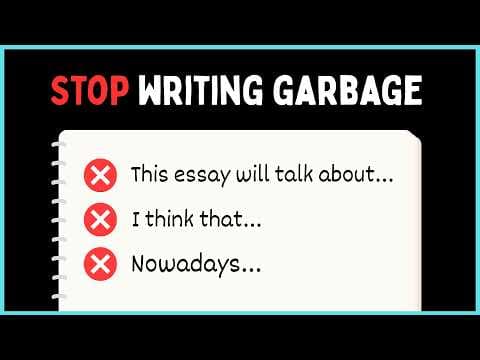
How to Actually Write an A+ Essay (The Easy Way)
The Angry Explainer
11m 4s1,657 words~9 min read
YouTube auto captions
Transcript source
YouTube auto captions
This transcript was extracted from YouTube's auto-generated caption track. The transcript below is server-rendered so it can be read, searched, cited, and shared without opening the original YouTube player.
Pull quotes
[0:00]In this video, I'll show you exactly how to do it with four simple steps that will guarantee you a high score.
[0:00]I'm going to write a full essay from scratch with you right now, starting with the preparation phase.
[0:00]This is where most people immediately fail because they think they're too smart for it.
[0:00]The single biggest idiot move you can make is glancing at the essay prompt and just starting to write.
Use this transcript
Related transcript hubs
Watch on YouTube
Share
MORE TRANSCRIPTS


