[0:02]Tak.
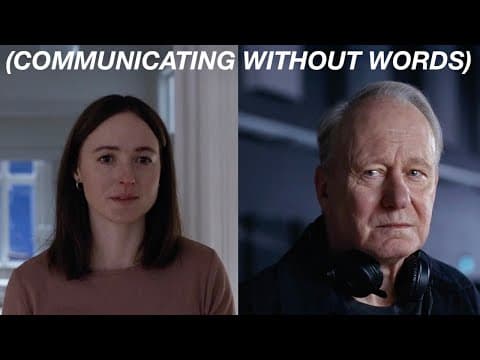
[0:06]Perfekt. Ja, tak, vi går videre. In the final scene of Joachim Trier's 2025 film Sentimental Value, two of the main characters have what is probably my favorite scene of dialogue on film in 2025.
[0:25]Which is interesting because neither character has any lines. Sorry, I'm getting ahead of myself. Let me restart.
[0:37]The fact that Sentimental Value is a beautiful, amazing movie is no secret. It won the Grand Prix at Cannes in 2025, took home a number of Golden Globes about a month ago, and is now nominated for nine Oscars. At its core, Sentimental Value is a film about the ways in which trauma lingers in a family over time and travels through the generations, from mother to son, father to daughter. The film grapples with the question, what can be done to put an end to these cycles? The plot centers on the tense relationship between Norborg, an actor, and her father, Gustav Borg, a filmmaker. Gustav re-enters Nora's life after her mother, and his ex-wife, passes away. Gustav wants Nora to play the lead role in his upcoming and likely last film, but when he gives her the script, she turns it down and storms off on him. Nora hates her father. When Nora was a child, her parents fought frequently. After they divorced, Gustav left and remained somewhat estranged for the rest of Nora's childhood. As an adult, Nora struggles with depression. She views herself as a deeply broken individual, which has made it hard for her to sustain relationships and lead a happy life. She blames her father for not being there and for robbing her of a stable childhood. Throughout the film, a voiceover narration guides the audience on a journey up the Borg family tree. His great-grandfather died in the bedroom on the second floor. The same room where her grandmother was born. We learn about Karen, Gustav's mother, who spent two years in a Nazi torture camp for protesting the war. We learn that Gustav was born in the 1950s. We learn about how Karen never fully recovered from the trauma of the Nazi camp and quietly took her own life when Gustav was still very young. Although he doesn't show it publicly, Gustav's childhood has left him extremely traumatized. Similar to Nora, it has ruined his ability to form stable relationships, his ability to communicate, to fill the role of parent. Neither Nora nor Gustav know how to verbally articulate the wells of suppressed emotion, of unsaid things that exist inside of them. Hi, Dad.
[2:32]Hi. Both have turned to the arts as a means for self-exploration and expression. At the end of the film, Nora finally agrees to read Gustav's screenplay. She's immediately shocked by how similar certain scenes are to her own life. One scene, which is clearly inspired by Gustav's mother's suicide attempt, very closely mirrors an attempt that Nora made on her own life, one that she never told her father about. Did you ever tell Dad about my...
[2:59]my attempt? No, of course not. The script reveals to Nora just how similar she is to her father, that they've been struggling side by side with the same issues their entire life. Gustav didn't create Nora's trauma, as much as he did pass his own onto her. One theme that Sentimental Value explores is the cathartic and healing effects of communication when it comes to familial trauma. The stakes of the film essentially boil down to, will Nora and Gustav be able to communicate with each other, or will Gustav die and Nora pass her trauma down, continuing the family curse? Gustav is coming to terms with the fact that he will soon be dead. He recognizes that he has caused great damage as a father and wants to do what he can to heal Nora's wounds. There are many scenes in the film where Gustav tries to sit down with Nora, but even he knows that talking to her is futile, that the things he wants to say can never be conveyed in a simple conversation. You two are the best thing that has ever happened to me. Best that's ever happened to you? Hmm. Then why weren't you there? This is why he's written his script, and why he's asked Nora to play the protagonist. He's a filmmaker. He knows no better way to communicate than through the language of cinema. It's not until Nora reads the script that she fully grasps what her father has been trying to say to her for so long. This brings us back to the film's final scene. Tak.
[4:16]Perfekt. Nora has agreed to star in her father's film.
[4:38]In between takes, the two lock eyes. Now, I know what people are going to say. They don't speak, it's not dialogue if there are no lines. Well, what is dialogue? There are many different definitions online, but listen to this one. "An interactive communication between two or more people." I think it'd be pretty hard to refute the fact that Nora and Gustav are communicating. With his eyes, Gustav says to his daughter what he wishes his mother had told him when he was young. You're not broken, you are not alone, none of this is your fault. Wordlessly, Nora responds, thank you, I forgive you. In these brief seconds, the entire emotional core of the film is resolved. The Borg family curse is lifted. I'm sure everyone has experienced the feeling of wanting to tell someone something, but not being able to, because words wouldn't be able to convey the complexity or emotional intensity of the message. The beautiful thing about the moment in Sentimental Value is that no words are needed. Nora, Gustav, and the audience all understand exactly what is being communicated, and nobody utters a single word. Thanks for watching. If you enjoyed the video, possibly think about, I don't know, maybe giving it a thumbs up and subscribing, if you feel so inclined. Um, if you didn't like the video, that's cool. Go to the comments and tell me why, I will respond. If you want to watch another video of mine on cycles of trauma in film, I've linked one of my earlier videos on Magnolia, Paul Thomas Anderson movie, right here. See you next time.


